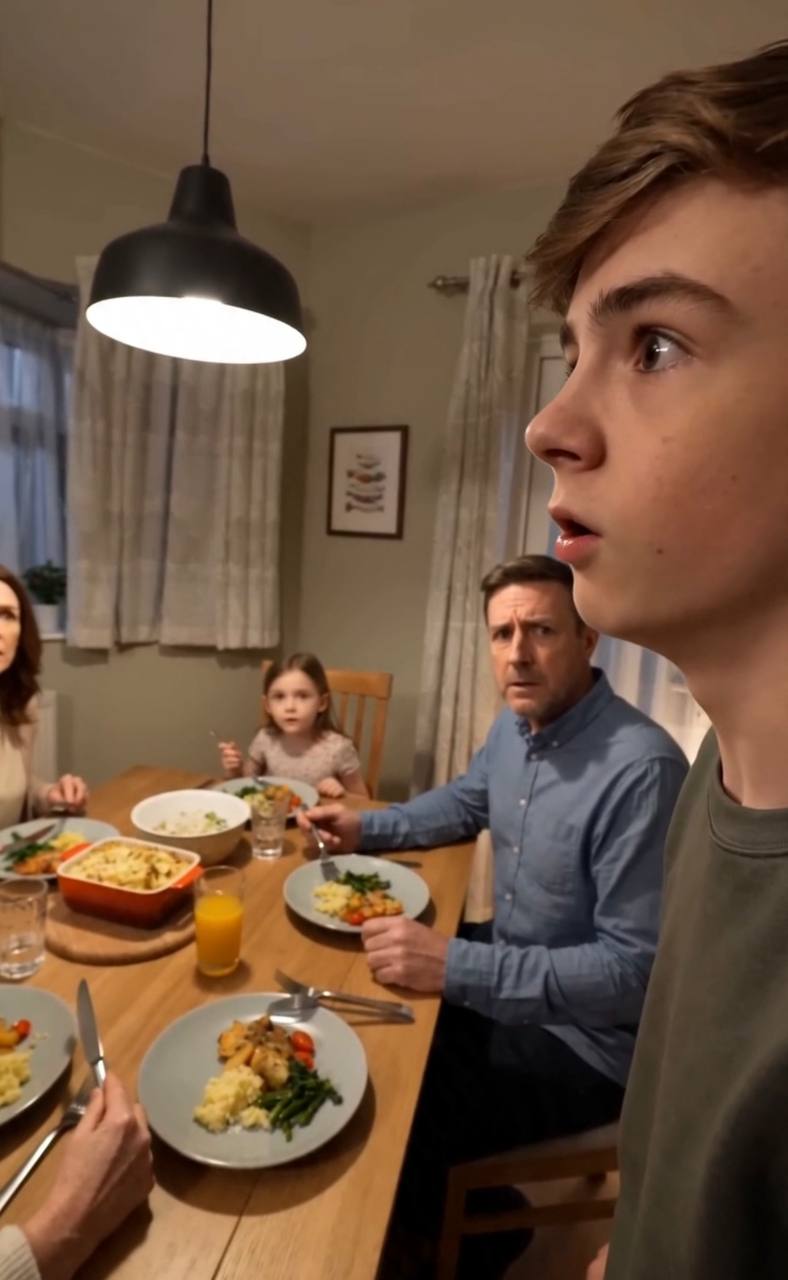
Every Sunday, Noah’s family ate dinner under the same black kitchen lamp. His mother served potatoes, his father poured juice, his little sister talked too loudly, and his grandmother laughed at every small joke.
But that evening, Noah could not smile.
The chair beside the window was empty again.
It had belonged to his older brother, Daniel, who had left home two years earlier after one terrible argument with their father. Since then, no one said his name at the table. His mother still cooked Daniel’s favorite meal, pretending it was only a habit. His father looked at the empty chair, then quickly looked away.
Noah was sixteen now, old enough to understand pride, but young enough to hate it.
While everyone tried to act normal, a soft knock came from the hallway.
No one moved.
Then it came again.
Noah stood up so quickly his chair scraped the floor. His father whispered, “Sit down.” But Noah had already left the table.
His heart pounded as he walked through the narrow hall. The house felt strangely quiet behind him. At the door, he paused, took a breath, and opened it.
Daniel stood there.
Thinner. Tired. Holding a small bag in one hand and a folded letter in the other.
“I didn’t know where else to go,” Daniel said.
Noah didn’t answer. He just hugged him.
When they returned to the kitchen, nobody spoke. Daniel stood in the doorway like a stranger in his own home. Their mother covered her mouth and began to cry. The little girl ran to him first.
Their father slowly rose from his chair. For a moment, pride almost won again.
Then he looked at the empty chair.
And he pulled it out.
“Your dinner is getting cold,” he said, his voice breaking.
Daniel sat down. His mother placed a plate in front of him with shaking hands. No one asked questions that night. No one mentioned the years lost.
They simply ate together.
And under the warm kitchen lamp, the empty chair was empty no more.