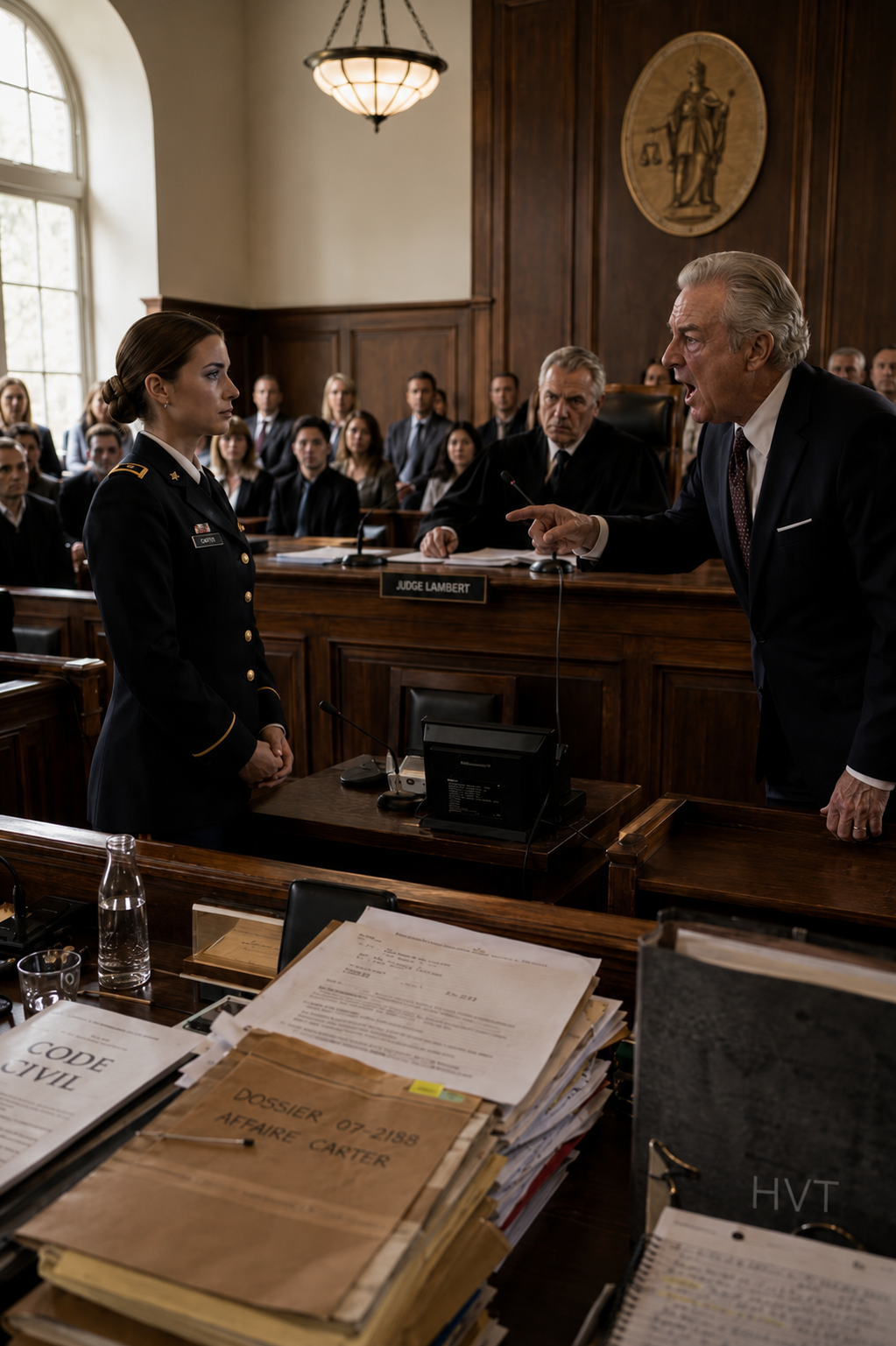
“You can’t even afford a lawyer,” my father said loudly across the courtroom.
A few people laughed.
I stood alone in my Royal Canadian Air Force uniform, without anyone beside me. My father had come with a famous lawyer and relatives who were sure they were about to watch me lose everything.
For fifteen years, he had told people I abandoned the family. He said I ran away, failed in life, and had no right to my grandmother’s inheritance.
The truth was different.
I left home at nineteen because he told me a woman had no place in uniform. Only my grandmother kept writing to me. Every letter ended with the same warning: “Never sign anything. One day, you will understand.”
After she died, my father went to court, claiming I had given up my place in the family. I arrived with only one thing: a sealed envelope my grandmother had left for me.
When the judge opened it, his expression changed.
“For the record,” he said calmly, “Mrs. Carter will not need representation.”
The room went silent.
The document inside was not just a family letter. It was an official deed signed years earlier by my grandfather. It proved that money had disappeared from the Carter business long before I left home.
And the person responsible was not me.
It was my father.
His lawyer immediately asked for a recess, but the judge refused. Then he read the final page aloud. My grandfather had left his shares, the house, and control of the estate to me because I was the only Carter who had refused to lie.
My father stood up, red with anger, but the judge ordered him to sit down.
For the first time in my life, he had no power over the room.
I walked out of the courthouse still wearing my uniform, with my grandmother’s last letter in my pocket.
She had not abandoned me.
She had protected me all along.