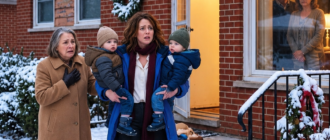
For nearly three hours, the stranger sitting behind me on the bus kept brushing against my leg. I was traveling with my nine-year-old son, Leo, to visit my critically ill father-in-law, Arthur Sterling, and I was seconds away from confronting the man.
Then, just before our stop, he pressed a gray handkerchief into my palm.
“Pretend you feel dizzy,” he whispered. “And whatever happens, don’t sign anything.”
Inside the handkerchief was a note:
Don’t trust anyone inside Arthur Sterling’s house.
I thought it was some bizarre prank—until we arrived.
Arthur wasn’t dying. He was sitting upright in his living room, surrounded by relatives who stared at Leo as if they had been waiting for him.
“There’s the Sterling heir,” one uncle said.
That evening, everyone talked about my late husband’s investments and how a widow like me needed “help” managing money.
Late at night, I overheard my brother-in-law speaking behind the prayer-room door.
“She signs tomorrow, and the shares become ours.”
Arthur answered sharply.
“Leave Leo out of this.”
The next morning, my mother-in-law placed several documents in front of me. She claimed they were routine papers giving the family permission to manage Leo’s inheritance.
I remembered the warning.
“I feel dizzy,” I said suddenly.
Everyone panicked just long enough for me to slip away.
In Arthur’s study, behind a loose panel inside an old cabinet, I found an envelope marked with my husband’s name.
Inside was Arthur’s real will.
My husband had secretly owned a large share of the family company, and after his death, those shares legally belonged to Leo—with me controlling them until he became an adult.
The papers downstairs weren’t routine documents.
They would have transferred control of everything to my brother-in-law.
Then the stranger from the bus walked through the front door.
Arthur smiled when he saw him.
His name was Samuel Reed, Arthur’s longtime attorney. Arthur had discovered that several relatives were intercepting his calls and monitoring visitors, so Samuel had followed us on the bus to warn me without alerting them.
Arthur had never asked the family to bring us there.
They had done it themselves.
I returned to the dining room holding the real will.
“I think we should read this before I sign anything.”
The color disappeared from my brother-in-law’s face.
Within weeks, the attempted transfer was stopped, Arthur appointed an independent trustee to protect Leo’s inheritance, and several relatives were removed from the company.
As Leo and I left Pine Ridge, I found the gray handkerchief in my bag.
I had spent three hours believing a stranger was bothering me.
In reality, he was the only person on that bus trying to protect my son.