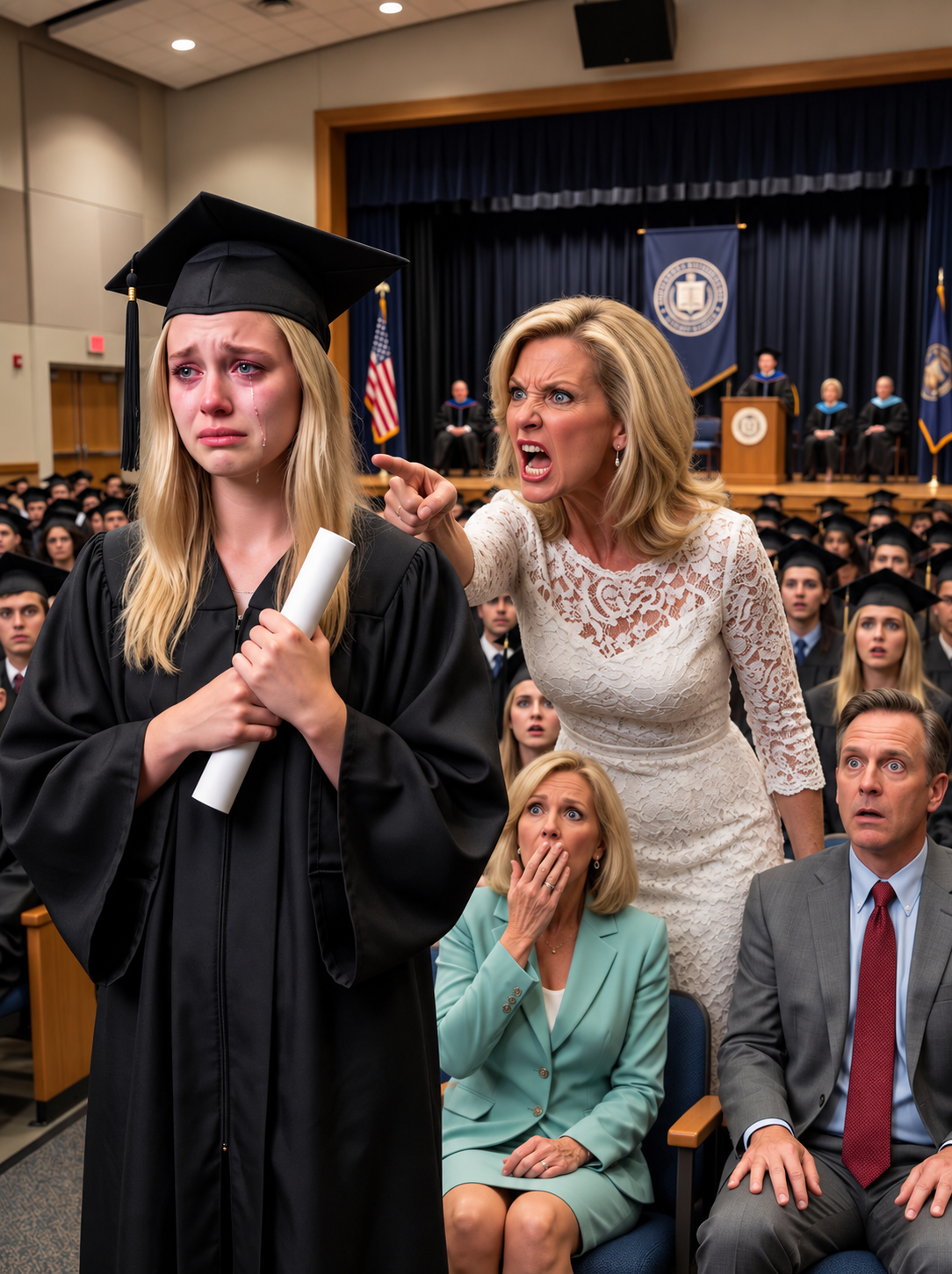
My name had barely been called at graduation when my sister rose in front of nearly two thousand people and shouted:
“She cheated her way through college!”
The entire auditorium seemed to go silent.
I stopped halfway down the aisle.
Hundreds of graduates turned in their seats. Parents craned their necks. Faculty members looked toward the third row, where my sister Vanessa stood with one hand pressed dramatically against her chest.
My mother covered her mouth.
But her eyes gave her away.
She wasn’t surprised.
She had known this was coming.
I didn’t argue.
I didn’t defend myself.
I simply kept walking toward the stage with a sealed white envelope hidden beneath my graduation gown.
And Vanessa had no idea what was inside.
My name is Emily Carter, and for most of my life, my older sister had been the person everyone noticed first.
Vanessa was beautiful, outgoing, charming, and exceptionally good at turning every disaster she created into somebody else’s responsibility.
I was the opposite.
I worked.
I saved.
I kept my head down.
And somehow, that made my family resent me.
When I earned a full scholarship to college, Vanessa laughed.
“Guess they needed to fill a quota.”
My mother told me not to be sensitive.
When I received a research fellowship during my junior year, Vanessa suggested I had become “very close” to one of my professors.
My father changed the subject.
Then, during my final year, a technology company offered me a position in its cybersecurity division before I had even graduated.
Vanessa smiled across the Thanksgiving table.
“Must be nice getting hired for diversity points.”
Again, nobody defended me.
I had spent four years working night shifts at a hotel while studying digital forensics during the day. I survived on coffee, cheap noodles, and four hours of sleep.
Yet every accomplishment somehow became evidence, in Vanessa’s mind, that I had cheated.
Then February came.
I received an email from the university’s Academic Integrity Office asking me to attend an urgent meeting.
When I entered the room, three administrators were waiting.
Someone had anonymously submitted screenshots, emails, and transaction records supposedly proving that I had purchased exam answers and paid another student to complete part of my research.
The evidence looked devastating.
My scholarship was immediately frozen.
My graduation status was placed under review.
The company that had hired me postponed my start date.
If the allegations were proven, I could be expelled months before graduation.
I walked out of that meeting feeling as if four years of my life had disappeared.
Two days later, Vanessa appeared at our parents’ house carrying wine.
She hugged me.
“I heard what happened.”
I stared at my mother.
She looked away.
Apparently, everyone already knew.
Vanessa poured herself a glass.
“Maybe this is a blessing, Emily. You’ve always pushed yourself too hard. Maybe college just wasn’t meant to work out.”
Then I noticed something.
A pale crescent-shaped scar near the base of her right thumb.
Normally, it would have meant nothing.
Except that earlier that morning, an attorney helping me challenge the accusations had shown me a still image from security footage.
Someone had used a public computer at a private shipping-and-printing store to create one of the accounts used to fabricate the evidence.
The camera had captured only part of the person’s hand.
There was a crescent-shaped scar on the thumb.
I looked at Vanessa.
And for the first time, I wondered how far my own sister was willing to go to destroy me.
I said nothing.
That was Vanessa’s biggest mistake.
She thought silence meant surrender.
What she had forgotten was that I specialized in digital forensics.
With my attorney and the university’s investigators, we began examining the anonymous evidence.
The screenshots had been manipulated.
Metadata showed several files had been created weeks after the dates they supposedly represented.
One email contained a timestamp from a software version that hadn’t even existed when the message was allegedly sent.
Then investigators traced an anonymous account to the print shop.
Security footage showed Vanessa entering the store.
That still wasn’t enough.
But Vanessa had made another mistake.
She had paid for printing services with her personal credit card.
Investigators also discovered that one of the fake transaction receipts contained a partial device identifier connected to a tablet registered to her.
By April, the university knew the truth.
I had been framed.
My scholarship was restored.
My academic record was cleared completely.
The company reinstated my job offer.
But the university asked me to remain silent while its legal department finished preserving evidence.
So I did.
Vanessa interpreted my silence exactly as expected.
She became bolder.
She told relatives I was “probably getting expelled.”
She told family friends that my valedictorian nomination had been fraudulent.
And apparently, sometime before graduation, she decided exposing me publicly would be her grand finale.
What Vanessa didn’t know was that the university knew about that plan too.
Three days before commencement, Dean Whitaker asked me into his office.
He handed me a sealed white envelope.
“Keep this with you on graduation day,” he said.
Inside were two documents.
The first was an official letter stating that the investigation had conclusively cleared me of every allegation.
The second concerned Vanessa.
I carried that envelope beneath my gown as I walked toward the stage.
“Why won’t you deny it, Emily?” Vanessa shouted from the audience.
This time, I stopped.
I turned around.
“Because I don’t need to.”
The room became quiet again.
Dean Whitaker stepped toward the microphone.
“Ladies and gentlemen, I apologize for the interruption. However, because a serious allegation has just been made publicly against one of our graduates, I believe clarification is appropriate.”
Vanessa’s expression changed.
Dean Whitaker looked directly toward her.
“Ms. Emily Carter was the subject of an academic integrity investigation earlier this year.”
A murmur swept through the auditorium.
Vanessa smiled.
Then the dean continued.
“That investigation concluded that the evidence against Ms. Carter had been deliberately fabricated.”
Vanessa’s smile vanished.
“Ms. Carter was completely exonerated. Her academic achievements, including her selection as valedictorian, were independently reviewed and confirmed.”
Applause began somewhere behind me.
Then spread.
Within seconds, hundreds of people were clapping.
Vanessa sat down.
But Dean Whitaker wasn’t finished.
“The university also identified substantial evidence regarding the source of the fabricated materials. That evidence has been referred to the appropriate authorities.”
My mother grabbed Vanessa’s arm.
Vanessa whispered something to her.
Then she stood.
“We should go.”
Two university security officers were already approaching their row.
That was when I removed the envelope from beneath my gown.
Vanessa stared at it.
“What is that?”
I opened it.
The second document was a formal notice informing Vanessa that the university had preserved evidence relating to suspected identity theft, falsification of electronic records, unauthorized access to an academic system, and harassment.
The university wasn’t prosecuting her.
Universities don’t prosecute people.
But the evidence had been turned over to law enforcement.
Vanessa looked at me as if I had betrayed her.
“You did this to me?”
For years, that question would have made me feel guilty.
Not anymore.
“No, Vanessa. You did this to yourself.”
My mother stood.
“Emily, please. She’s your sister.”
I looked at her.
“And I was your daughter.”
Mom went silent.
“You knew she was going to accuse me today.”
Her face answered before her mouth could.
“I thought maybe she needed to get it out of her system.”
“In front of two thousand people?”
“She’s been struggling.”
I almost laughed.
There it was.
The sentence that had protected Vanessa her entire life.
She was struggling.
She was jealous.
She was emotional.
She didn’t mean it.
Meanwhile, I was expected to survive whatever she did without making anyone uncomfortable.
“No,” I said quietly. “You don’t get to explain this away anymore.”
Then I turned back toward the stage.
Dean Whitaker called my name again.
“Emily Carter.”
I walked forward.
He handed me my diploma.
The auditorium erupted.
But the most important moment came a few minutes later when I stood behind the podium to deliver the valedictorian address.
My prepared speech was sitting in front of me.
I didn’t read it.
Instead, I looked across the audience.
“For a long time,” I began, “I believed success meant proving people wrong.”
The hall grew quiet.
“I thought if I worked hard enough, achieved enough, and became good enough, eventually everyone would recognize my worth.”
I paused.
“But there are people who will never celebrate your growth because your growth forces them to confront their own choices.”
I looked toward the third row.
Vanessa’s seat was empty.
“So perhaps success isn’t convincing everyone that you deserve your place. Perhaps it’s learning that you don’t need their permission to stand there.”
That time, the applause lasted nearly a minute.
The consequences did not end that afternoon.
The criminal investigation continued for months.
Vanessa eventually accepted a plea agreement related to falsified electronic records and unauthorized account access. She received probation, community service, restitution for legal and investigative costs, and mandatory counseling.
My parents paid for her attorney.
They asked me to write a letter requesting leniency.
I refused.
Then my mother told me I was destroying the family.
I reminded her that I hadn’t fabricated evidence against anyone.
After that, we stopped speaking for almost a year.
It hurt.
I won’t pretend otherwise.
Losing the family you hoped you had can hurt almost as much as losing one you actually had.
But something unexpected happened when I stopped trying to earn their approval.
My life became peaceful.
I started my new job that summer.
Two years later, I became the youngest senior forensic analyst on my team.
The university invited me back to speak to graduating students about digital ethics.
And slowly, I built relationships with people who celebrated good things happening to me instead of treating them as personal insults.
My father eventually contacted me.
His message was simple.
“I should have protected you. I’m sorry.”
We began rebuilding our relationship carefully.
My mother took longer.
Vanessa never apologized.
The last time I heard from her, she told a cousin that I had “ruined her life over one mistake.”
One mistake.
Sometimes I think about those words.
Creating fake accounts wasn’t one mistake.
Fabricating evidence wasn’t one mistake.
Trying to get me expelled wasn’t one mistake.
Standing in front of two thousand people and publicly accusing me after knowing the evidence was false wasn’t one mistake.
It was a series of choices.
And for the first time in her life, Vanessa had to live with the consequences of her own choices.
I still have that white envelope.
It sits in a drawer beneath my graduation photograph.
Not because I enjoy remembering what my sister did.
But because it reminds me of something I wish I had learned much earlier.
When Vanessa stood up in that auditorium, she expected me to panic.
She expected me to beg people to believe me.
She expected to control the story simply because she was willing to shout louder.
Instead, I kept walking.
Sometimes the strongest response to someone determined to destroy your reputation isn’t screaming back.
It’s knowing the truth is already walking beside you—and letting the evidence speak when the time comes.