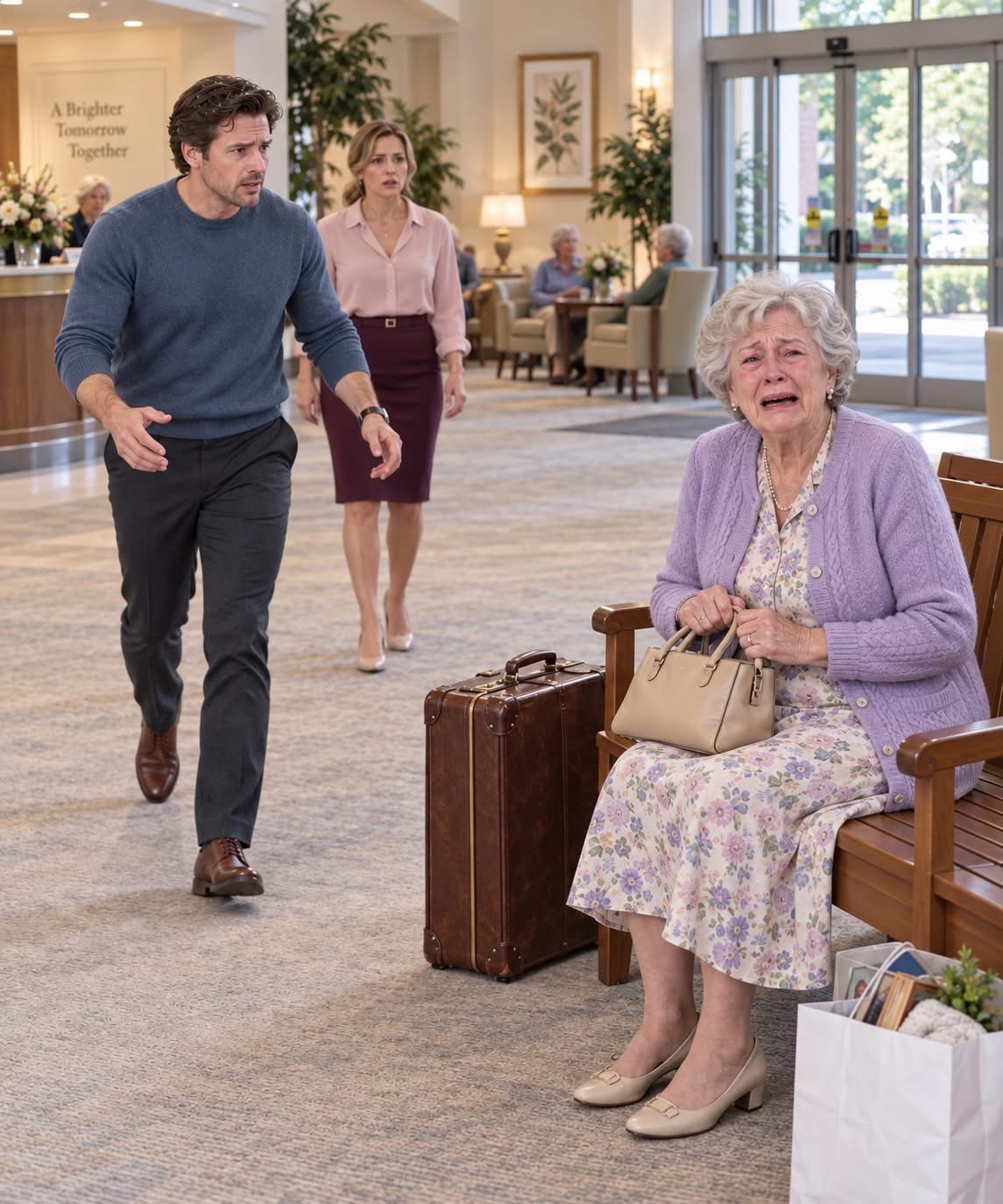
My parents told Grandma Eleanor they were taking her out to lunch.
Three hours later, a nursing facility in Ohio called me.
“Is this Ivan Sterling?” the woman asked. “Your grandmother listed you as her emergency contact. Her suitcase is still here in our lobby, but the family members who brought her left before the admission paperwork was finished.”
I was standing in the kitchen of my apartment, holding a cup of coffee I suddenly had no desire to drink.
“What do you mean, they left?”
The administrator hesitated.
“They said they needed paperwork from their car. They never came back.”
I called my father, Arthur.
Straight to voicemail.
Then my mother, Wendy.
Same thing.
I drove 190 miles with both hands locked around the steering wheel.
When I arrived, Grandma Eleanor was sitting beside one brown suitcase and a grocery bag filled with medications.
She still wore her church coat despite the warm lobby.
Her silver-gray hair was carefully pinned, and her face had the calm, stone-hard expression she always wore when she was furious.
I crouched beside her.
“Grandma.”
She stared at me for several seconds.
Then she stood.
No tears.
No questions.
She walked to my car, climbed into the passenger seat and fastened her seatbelt.
“Don’t call them,” she said.
I looked at her.
“I’ll tell you where we’re going.”
“Where?”
“First, the county courthouse.”
That got my attention.
Once we reached the highway, she opened her purse and handed me a folded bank statement.
Three withdrawals had been circled in red.
$12,000.
$18,000.
$25,000.
All within six weeks.
“Your father has power of attorney,” she said. “Temporary. I signed it after my knee surgery because I trusted him.”
My stomach tightened.
“He told me I was becoming forgetful. Said I needed help with the bills.”
She stared through the windshield.
“Yesterday, I found those withdrawals.”
“Did you confront him?”
“Yes.”
“What did he say?”
“That the money was paying for my care.”
I glanced at the single suitcase behind us.
Grandma gave a humorless laugh.
“This afternoon, your mother told me we were stopping somewhere with a lovely garden. They walked me into that nursing facility and disappeared.”
My phone buzzed.
Dad.
Grandma reached across the console and turned it facedown.
“Courthouse first,” she repeated. “Then the bank. Then one more place.”
“What place?”
“My house.”
“Why?”
She reached inside her coat and pulled out a small envelope.
Across the front, in my late grandfather’s handwriting, were two words:
HOUSE DEED.
“I hid this before they picked me up,” Grandma said. “I wanted to know whether they would look for it.”
Her voice lowered.
“They wanted me out of the way.”
At the courthouse, Grandma moved faster than I expected for a seventy-nine-year-old woman recovering from knee surgery.
She had already called her attorney that morning.
That was the first surprise.
The second was finding him waiting for us.
Martin Hale had handled my grandparents’ legal affairs for nearly thirty years.
The moment he saw Grandma, his expression changed.
“Eleanor, are you all right?”
“I will be when Arthur can no longer sign my name.”
Within forty minutes, documents were filed formally revoking my father’s power of attorney.
Martin also prepared notices for every financial institution where Grandma held accounts.
Then he looked at me.
“You should understand something. Eleanor called me yesterday because she suspected financial exploitation. Today confirmed it.”
Grandma didn’t flinch.
I did.
“Can we prove it?”
“We’re going to find out.”
The bank was next.
The branch manager took us into a private office.
When Grandma requested a complete transaction history, the woman’s expression grew increasingly uncomfortable.
The $55,000 in withdrawals wasn’t everything.
There had also been an attempted transfer of $140,000 from one of Grandma’s investment accounts.
It had been rejected because the account required additional authorization.
Then the manager turned her monitor slightly.
“There was also an inquiry regarding a home-equity line of credit against your residence.”
Grandma became completely still.
“Who made the inquiry?”
The manager hesitated.
“Your son.”
I felt sick.
Grandma simply nodded.
“I’d like every account frozen against third-party access immediately.”
“Of course.”
“And I’d like copies of everything.”
When we finally returned to the car, I expected Grandma to break down.
Instead, she opened her purse and took out a peppermint.
“Now the house.”
Her home sat on four acres outside Dayton.
Grandpa had built it in 1978.
I’d spent nearly every summer there as a child.
The tire swing was gone, but the maple tree remained.
So did the blue shutters Grandma refused to replace because Grandpa had painted them himself.
We pulled into the driveway at 6:14 p.m.
There was already a car there.
My father’s.
Grandma looked at it.
“Well.”
I turned to her.
“Stay here.”
“No.”
“Grandma—”
“That is my house.”
She got out.
The front door was unlocked.
Inside, we heard drawers opening.
Then my mother’s voice.
“It has to be somewhere.”
We entered the study.
Dad was standing beside Grandpa’s old desk.
Every drawer had been pulled open.
Papers covered the floor.
Mom was kneeling in front of a cabinet.
They both froze.
Dad recovered first.
“Ivan, what the hell are you doing here?”
Grandma stepped around me.
“This is an interesting way to look for nursing-home paperwork.”
Mom’s face went white.
“Eleanor—”
Grandma reached into her coat.
Then she placed the deed envelope on the desk.
Dad stared at it.
I saw the answer on his face before he spoke.
Grandma saw it too.
“You were looking for this.”
“No.”
“You emptied my desk.”
“We were trying to organize things.”
“You left me in a nursing home three hours ago.”
Mom stood.
“We were coming back.”
Grandma looked at her.
“With what paperwork?”
Silence.
Dad’s voice hardened.
“Mom, you need care.”
“Then why didn’t you finish the admission?”
“Because you would have fought us.”
“And apparently abandoning me was easier.”
Dad looked at me.
“Stay out of this.”
I actually laughed.
“You stole fifty-five thousand dollars from her.”
His face changed.
“Those were expenses.”
“For what?”
“Her care. Repairs. Bills.”
Grandma reached into her purse and removed copies from the bank.
“Then show me the receipts.”
Dad stared at the papers.
Mom started crying.
Not loudly.
Just enough to make me realize she knew exactly what was happening.
Finally, she whispered, “Arthur, tell her.”
Grandma’s eyes shifted toward my father.
“Tell me what?”
Dad sat down.
For the first time in my life, he looked small.
His construction business had been struggling for almost a year.
A development project had collapsed.
He owed suppliers.
Then came personal loans.
Credit cards.
Taxes.
The first $12,000 had gone toward payroll.
The next $18,000 had covered a business loan.
The $25,000 had gone toward overdue taxes.
“And the hundred and forty thousand?” I asked.
Dad said nothing.
Grandma answered for him.
“He was trying to save his company.”
Dad slammed his palm against the desk.
“I was going to put it back.”
Grandma didn’t even blink.
“With what?”
He had no answer.
Then Grandma asked the question that changed everything.
“Why the nursing home?”
Mom covered her face.
Dad looked toward the window.
“We needed time.”
“For what?”
“To sell the house.”
I stared at him.
“You cannot be serious.”
Dad turned toward Grandma.
“You don’t need this place anymore. It’s too large. The facility was good. You would have been comfortable.”
“And selling my house would have solved your problems.”
“It would have solved everyone’s problems.”
Grandma’s voice became very soft.
“No, Arthur. It would have solved yours.”
He stood.
“You have almost two million dollars in property and investments sitting around while your own son is drowning.”
“And therefore you decided it belonged to you?”
“I’m your son!”
Grandma looked at him for a long time.
“Yes.”
The word hurt more than shouting could have.
“You’re my son. That is why I trusted you.”
No one spoke.
Then she looked at Mom.
“And you?”
Mom’s lips trembled.
“I thought once you settled into the facility…”
Grandma closed her eyes briefly.
When she opened them, something had changed.
“I understand.”
Dad stepped toward her.
“Mom—”
“No.”
She raised one hand.
“You have mistaken my age for helplessness and my love for permission.”
Then she looked at me.
“Ivan, call Martin.”
Dad’s face hardened.
“You’re going to destroy your own son over money?”
Grandma looked almost surprised.
“No, Arthur. You did this over money.”
The police became involved two days later.
Grandma didn’t have Dad arrested dramatically at the house.
She didn’t scream.
She simply gave her attorney and the bank everything.
Investigators followed the transactions.
Dad eventually admitted using the power of attorney for expenses that had nothing to do with Grandma.
Because he repaid part of the money and cooperated, the eventual legal outcome was less dramatic than some people expected—but it was still serious.
His access to Grandma’s finances disappeared permanently.
He sold his vacation property and a collection of classic cars to repay what he had taken.
His business eventually closed.
Mom moved out of their large house six months later.
But something else happened before any of that.
The morning after we found them searching Grandma’s study, I woke in her guest room to the smell of coffee.
Grandma was sitting at the kitchen table.
The little brown suitcase was still by the door.
“You’re coming home with me,” I told her.
She smiled.
“I am home.”
“You know what I mean.”
I lived three hours away.
I had already decided I would convert my office into a bedroom.
Grandma studied me.
“Ivan, do you think I’m incapable of living here?”
“No.”
“Then don’t make your father’s mistake.”
That stopped me.
She reached across the table.
“I don’t need somebody to decide my life for me. I need people who will be there when I ask.”
So we made a different plan.
I stayed for two weeks.
We installed cameras and a new security system.
She hired someone to help with the garden and heavy housework twice a week.
Her neighbor drove her to physical therapy when I couldn’t.
I began visiting every other weekend.
And every Sunday at seven, Grandma called me whether she had anything to say or not.
Usually she did.
Three months later, she asked me to drive her to Martin Hale’s office.
I assumed we were reviewing the fraud case.
Instead, Martin placed a new estate plan on the conference table.
Dad was no longer executor.
Neither was Mom.
I looked at Grandma.
“Please don’t tell me you’re leaving everything to me because I picked you up.”
She laughed.
“Good Lord, Ivan. Don’t flatter yourself.”
Martin tried not to smile.
Grandma tapped the documents.
“The house will eventually go into a family trust.”
“For who?”
“My grandchildren and great-grandchildren.”
She paused.
“Provided nobody tries to put me in a nursing home to get it early.”
Even Martin laughed at that.
But then Grandma became serious.
“I changed one other thing.”
She had created a fund for Sophie, my cousin’s daughter, and the other young children in our family.
Education.
Medical needs.
Housing assistance.
Things that might actually help the next generation build their lives.
“Your grandfather and I worked too hard for this money to become a prize people fight over,” she said.
I looked at her.
“What about Dad?”
Her expression softened.
“He’s still my son.”
That surprised me.
“But being my son doesn’t entitle him to my bank account.”
She never cut him completely out of her life.
That was her decision too.
For almost a year, she refused to see him.
Then one Sunday afternoon, Dad appeared at her door alone.
No Mom.
No lawyer.
No excuses.
I happened to be there.
Grandma opened the door but didn’t invite him inside.
Dad stood on the porch for almost a full minute before speaking.
“I’m sorry.”
Grandma said nothing.
“I kept telling myself I was borrowing it.”
Silence.
“Then I told myself you’d be happier somewhere smaller.”
Still nothing.
Dad looked down.
“But the truth is I needed your money, and I convinced myself that gave me the right to make decisions for you.”
Grandma finally spoke.
“That is the first honest thing you’ve said to me in a year.”
Dad wiped his eyes.
“I know.”
She didn’t hug him.
She didn’t forgive him instantly.
She simply opened the door wider.
“You can have coffee.”
That was all.
But it was a beginning.
Two years have passed since the nursing facility called me.
Grandma Eleanor is eighty-one now.
She still lives in the house Grandpa built.
She still complains that everyone overwaters the hydrangeas.
She still drives during daylight, although I wish she wouldn’t.
And the brown suitcase my parents packed for her?
She keeps it in the hall closet.
A few months ago, I asked why she hadn’t thrown it away.
She looked at me as if the answer were obvious.
“Because sometimes you need to remember the day people showed you who they were.”
Then she smiled.
“And the day you remembered who you were.”
I thought about that 190-mile drive.
About the courthouse.
The bank.
The deed hidden inside her coat.
And the moment she sat in my passenger seat and told me not to call my parents.
At the time, I thought I was rescuing my grandmother.
It took me much longer to understand the truth.
Grandma Eleanor had already decided she wasn’t going to be abandoned.
She simply needed someone willing to drive.