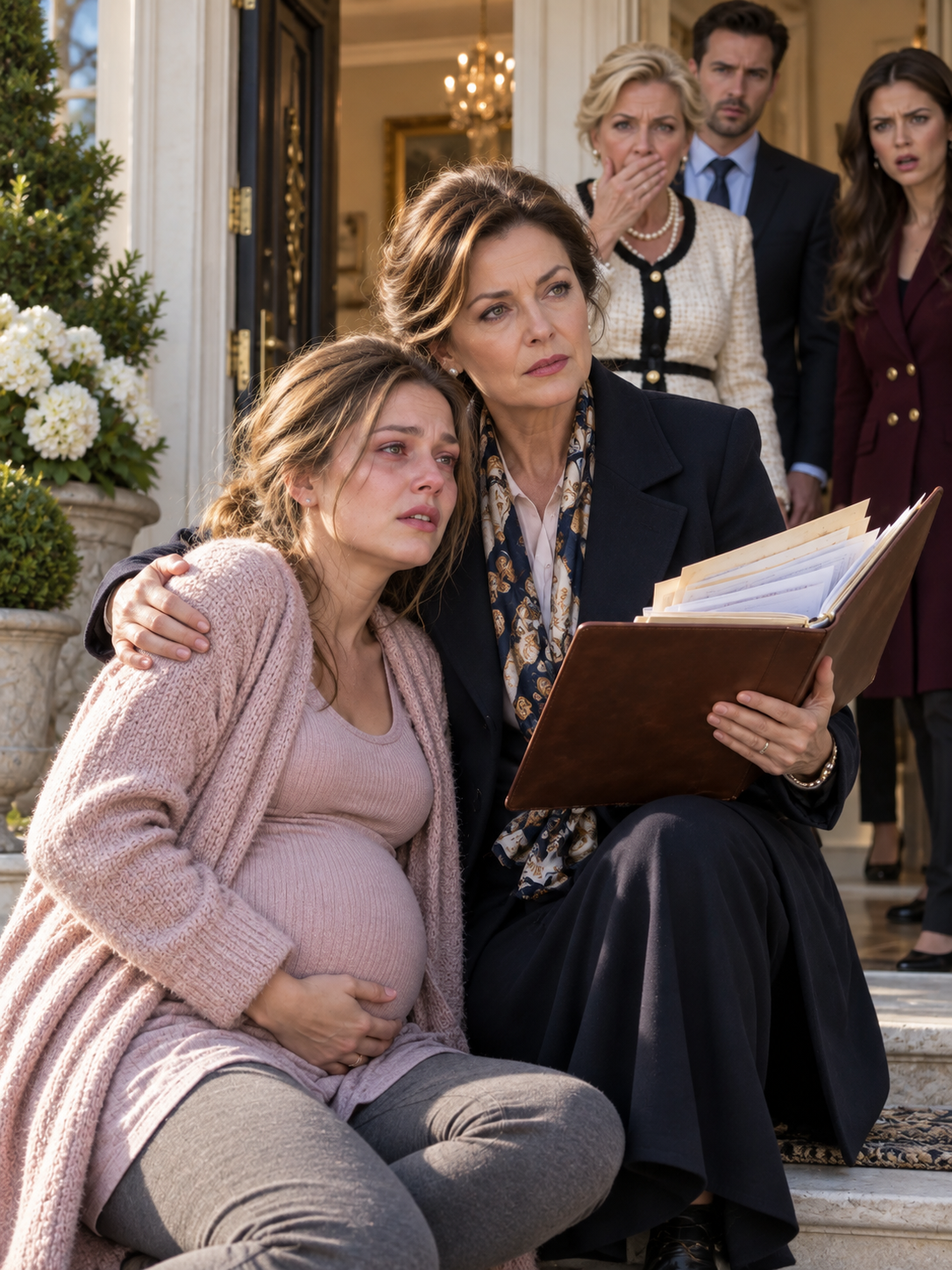
At 6:03 in the morning, my seven-months-pregnant daughter collapsed on my front porch.
She was so thin that when I caught her before she hit the ground, I could feel every bone in her back beneath her oversized gray sweater.
Her lips were cracked. Her cheeks were hollow.
She opened her eyes just long enough to whisper:
“Mom… please don’t tell them where I am.”
Then she passed out.
I hadn’t seen Renata in almost two months.
Hours later, a doctor told me she was severely dehydrated, anemic and significantly malnourished.
Her baby was alive, but measuring smaller than expected.
“This didn’t happen in a few days,” the doctor said. “We’re looking at weeks. Possibly longer.”
It made no sense.
Renata lived with her husband, Mateo, on his parents’ beautiful property. They had money, a huge kitchen and refrigerators full of food.
So how had my pregnant daughter been starving ten miles from my house?
Renata gave me the answer when she woke.
“It started when Teresa found out I was pregnant.”
Teresa was Mateo’s mother.
At first, she only criticized Renata’s food.
Too much bread.
Too much pasta.
Too much milk.
She claimed a smaller baby would make childbirth easier.
Then the comments became rules.
Teresa began serving Renata herself.
One egg instead of two.
Half a sandwich.
A small serving of rice.
Some days, only one real meal.
If Renata complained that she was hungry, Teresa told her to drink water.
“And Mateo?” I asked.
My daughter looked down.
“He knew.”
Those two words destroyed whatever respect I had left for my son-in-law.
Renata’s obstetrician had specifically told her to increase her iron, protein and calorie intake.
Mateo chose his mother’s advice instead.
“She had three healthy pregnancies,” he would say. “She knows what she’s doing.”
Soon Teresa began controlling more than food.
Car keys.
Trips outside.
Phone calls.
Visits with me.
Each restriction seemed small when considered alone.
“Mom worries.”
“She’s traditional.”
“She’s trying to help.”
Together, they created a prison.
The night before Renata escaped, she woke around two in the morning with hunger pains.
She went downstairs and found leftover chicken in the refrigerator.
She had eaten only a few bites when Teresa switched on the kitchen light.
“If you can’t control yourself for three more months,” Teresa told her, “you have no business being a mother.”
Then she took the plate away.
Renata resisted.
Mateo came downstairs.
My daughter thought her husband would finally defend her.
Instead, he sighed.
“If you can’t respect my mother’s rules, maybe you should go stay with yours.”
So Renata did.
She waited until everyone returned to bed.
She had twenty-three dollars, eleven percent battery on her phone and one change of clothes.
She took a rideshare, then two buses.
When her phone died, she walked the remaining distance.
Seven months pregnant.
Weak.
Starving.
In the dark.
All the way home to me.
“Why didn’t you ask someone for help?” I asked.
Her answer frightened me more than anything else.
“I didn’t think it was an emergency.”
That was when I understood what they had really done to her.
They hadn’t only deprived her of food.
They had taught her not to trust her own suffering.
I took her hand.
“Listen to me. Leaving that house doesn’t mean you failed.”
Her eyes filled with tears.
“But my marriage—”
“Staying might have killed you and your baby.”
That evening, we listened to my granddaughter’s heartbeat.
Fast.
Steady.
Alive.
Then Renata’s phone began ringing.
Mateo.
Teresa.
Mateo again.
Messages followed.
WHERE ARE YOU?
MOM IS WORRIED.
Then:
COME HOME BEFORE YOU TURN THIS INTO SOMETHING BIGGER THAN IT NEEDS TO BE.
I saved every message.
I asked the doctors to document every medical finding.
Dehydration.
Anemia.
Malnutrition.
Fetal growth concerns.
Then I requested the hospital social worker.
Renata watched me carefully.
“Why are you doing all this?”
“Because from now on, nobody gets to rewrite what happened to you.”
But that night, something else bothered me.
Teresa had been trying to distance Renata from me since the wedding.
Why?
Around one in the morning, I returned home and opened an old cedar box hidden in the back of my closet.
I hadn’t touched it in fifteen years.
Inside were newspaper clippings, an old courthouse credential and a thick blue folder bearing the seal of the U.S. Attorney’s Office.
Before I became quiet, widowed Lucía Alvarez—the woman Teresa assumed had never had a “real career”—I had been an Assistant United States Attorney.
After my husband died, I left that life to raise Renata away from publicity and threats.
I opened the folder.
Then I found the photograph.
My breath stopped.
Teresa.
Fifteen years younger.
Standing beside Victor Salazar, her older brother.
A man my team had helped send to federal prison for fraud, money laundering and embezzlement.
Teresa had also been questioned during the investigation.
She was never charged.
But she had seen me in court.
She knew exactly who I was.
The next morning, Teresa walked into Renata’s hospital room with Mateo behind her.
“Get dressed,” she ordered my daughter. “You’re coming home.”
I stood.
“No.”
Teresa glared at me.
“Lucía, stay out of our family business.”
I took the photograph from the blue folder and placed it on the table.
“Too late.”
Teresa looked down.
Every trace of color vanished from her face.
Mateo stepped closer.
“Mom… who is that man?”
Teresa said nothing.
So I answered.
“Victor Salazar. Your uncle.”
Mateo stared at her.
“What uncle?”
I explained that fifteen years earlier, Victor had been sentenced to eleven years in federal prison.
“I was part of the team that built the case against him.”
Mateo turned toward his mother.
“You knew who she was?”
“Of course not!”
I hadn’t mentioned the details of Victor’s fraud.
But Teresa suddenly snapped:
“Victor never stole from those accounts!”
Silence filled the room.
I looked directly at her.
“I never mentioned the accounts.”
Teresa realized her mistake.
At that moment, the hospital social worker appeared in the doorway with an investigator.
Everything changed.
Renata told them about the food restrictions.
The confiscated keys.
The threats.
The isolation.
Her medical records showed the physical consequences.
Then investigators reviewed messages between Mateo and his mother.
Don’t give her anything after seven.
Hide the keys.
She called Lucía again. Make her understand she belongs to our family now.
Mateo’s replies were painfully simple.
Okay, Mom.
Again.
And again.
He could no longer claim ignorance.
Renata obtained a protective order and filed for divorce.
Mateo tried apologizing.
Once, he came to the hospital carrying flowers.
Renata refused to see him.
Teresa became the subject of a separate investigation after questions emerged about financial information connected to her brother’s old case. Whatever came of that investigation, one thing was already gone forever: her ability to present herself as the unquestioned authority everyone had to obey.
Two months later, Renata went into labor.
I held her hand when her daughter gave her first cry.
She was small.
But strong.
Renata named her Elena.
When we finally brought Elena home, Renata stopped at my front gate.
The exact place where she had collapsed weeks earlier.
The hydrangeas were blooming.
For a moment, my daughter said nothing.
Then she whispered:
“I’m ashamed I waited so long.”
I shook my head.
“Never let the people who hurt you decide what you should be ashamed of.”
She looked down at Elena sleeping against her chest.
“I thought being a good wife meant staying.”
“No.”
“Then what does family mean?”
I smiled.
“It’s a place where you never have to ask permission to eat.”
Renata burst into tears.
Then she laughed through them.
A year later, she had her own apartment, a part-time job and a little girl who had begun running through my garden.
As for the blue folder, I kept it.
Not because I wanted revenge.
Not because I wanted to live in the past.
I kept it because it reminded me of the morning my daughter came home believing she had failed.
She hadn’t failed.
She had survived.
And sometimes the bravest thing a person can do isn’t stay and fight.
Sometimes it is opening the door, walking away, and finding the road home.