“Sir, can we eat the leftovers?”
The question was so quiet that William Parker almost thought he had imagined it.
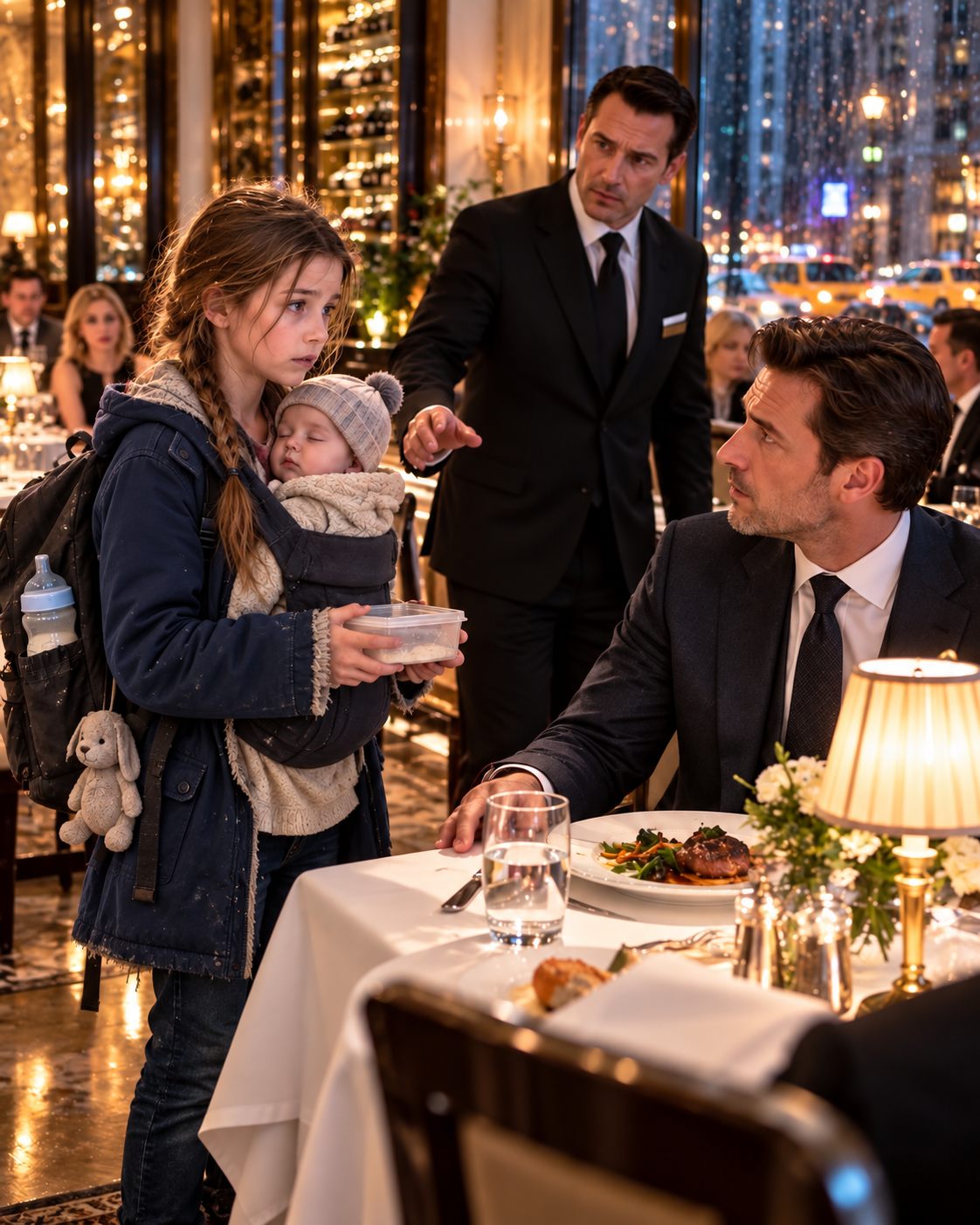
He looked up from his phone and saw a girl standing beside his table.
She could not have been older than eleven.
Her coat was wet from the October rain, her shoes were worn at the toes, and a sleeping baby was tied against her chest with a faded bedsheet.
She was not asking for money.
She was looking at the untouched steak on William’s plate.
“When you’re finished,” she whispered, “could we have what’s left?”
Before William could answer, the restaurant manager hurried toward them.
“I’m terribly sorry, Mr. Parker. Security will remove them immediately.”
He reached for the girl’s arm.
William raised one hand.
“Don’t touch her.”
The manager stopped.
The girl instinctively pulled the baby closer.
William pushed his phone aside.
“What’s your name?”
“Emma.”
“And the baby?”
“Noah.”
“Your brother?”
Emma hesitated.
“He’s family.”
That answer told William there was more to the story.
He turned toward the manager.
“Emma and Noah are my guests.”
The manager stared at him.
“Mr. Parker—”
“Bring another chair.”
Within minutes, Emma was sitting across from William.
She looked uncomfortable beneath the crystal chandeliers and white tablecloths.
When the waiter brought soup, bread, chicken, vegetables, and warm milk, Emma shook her head.
“I only wanted the leftovers.”
“I know,” William said. “But tonight you’re having dinner.”
At first, Emma ate carefully.
Then hunger won.
William pretended not to notice how quickly the bread disappeared.
Halfway through the meal, Noah woke and began crying.
Emma immediately stopped eating and rocked him gently.
William watched her.
“Where are your parents?”
Her face changed.
“Our mother died.”
“I’m sorry.”
Emma nodded.
“She got sick very fast.”
“And your father?”
“I don’t know where he is.”
William frowned.
“Who is taking care of you?”
Emma looked down at the baby.
“I am.”
The words landed heavily.
William Parker had spent the last twenty-five years building one of New York’s largest real-estate companies.
He negotiated multimillion-dollar deals without blinking.
But the sight of an eleven-year-old girl calmly explaining that she was raising a baby by herself left him speechless.
“Where are you staying?”
Emma did not answer.
“Emma?”
“Sometimes at the bus station.”
William stared at her.
“Sometimes the basement of a church. If the side door is open.”
“With a six-month-old baby?”
“I keep him warm.”
She said it defensively.
As if she expected him to accuse her of failing.
William leaned back.
“Why didn’t you go to the police?”
Emma’s eyes filled with fear.
“They’ll take Noah away.”
There it was.
The reason she had chosen hunger over help.
William picked up his phone.
Emma stood immediately.
“Please don’t call them.”
“I’m not calling the police.”
“You promise?”
“I promise.”
William called Margaret Collins, director of the Parker Family Foundation.
Twenty minutes later, Margaret arrived with a coat, diapers, formula, and the calm voice of someone who had helped frightened children before.
Emma watched her suspiciously.
“Are you going to separate us?”
Margaret shook her head.
“Not tonight.”
Emma’s shoulders collapsed.
She began to cry.
William looked away.
Not because he was uncomfortable.
Because he understood that she had fought too hard to deserve an audience for the moment she finally stopped being brave.
That night, Emma and Noah were placed in temporary family housing through the foundation.
But their story was far from over.
The next morning, William received a call from Margaret.
“You need to hear something.”
“What happened?”
“We identified their mother.”
Her name was Sarah Reynolds.
William froze.
“Sarah Reynolds?”
“Yes.”
He knew that name.
Eleven years earlier, Sarah had worked as an accounting assistant at Parker Development.
At the time, William’s company was still young and dangerously close to bankruptcy.
Sarah had discovered irregular payments hidden inside construction invoices.
Those payments led to one of William’s own business partners, who had been quietly stealing from the company.
Sarah’s discovery saved Parker Development millions.
William had offered her a promotion.
She had refused.
She was pregnant and planned to leave New York.
Her unborn daughter had been Emma.
William sat alone in his office staring at Sarah’s old employee file.
The woman who had once helped save his company had died.
And her daughter had ended up asking him for scraps from his plate.
The coincidence felt impossible.
More than that, it felt like a debt returning after eleven years.
William immediately hired an attorney to help Emma and Noah.
The investigation confirmed that after Sarah’s death, there had been no stable relative willing to take both children.
Emma had overheard adults discussing foster placement.
Terrified that Noah would be placed with another family, she had run away with him.
William made one condition clear.
“They stay together.”
The legal process was not simple.
There were interviews.
Background checks.
Court hearings.
Social-worker visits.
But while lawyers handled paperwork, William slowly became part of the children’s lives.
He visited them after school.
He attended meetings with Emma’s teachers.
He bought Noah a proper crib.
When Emma received her first good report card, William took them out for ice cream.
When Noah developed an ear infection, William sat beside Emma for three hours in a pediatric waiting room.
Little by little, Emma changed.
She stopped hiding bread in her backpack.
She stopped asking whether meals cost too much.
She stopped sleeping in her shoes.
One evening, almost a year after they had first met, Emma stood in William’s apartment staring at the city lights.
“Are we going to have to leave soon?”
William looked at her.
“Why would you think that?”
“Because nothing good lasts forever.”
He walked toward her.
“Emma, I need to show you something.”
He placed a folder on the table.
Inside were the final guardianship documents.
Emma read the first page.
Then the second.
Her eyes widened.
“You’re our guardian?”
“If you want me to be.”
She stared at him.
“We can stay?”
“For as long as you want.”
Emma covered her mouth.
Then she threw her arms around him.
Noah, now walking, came running from the hallway and wrapped himself around William’s leg.
For the first time in years, William’s enormous apartment did not feel empty.
It felt like home.
Three years later, the three of them returned to Laurent’s.
Emma was fourteen now.
She wore a blue dress and carried herself with quiet confidence.
Noah sat beside her, completely focused on an oversized chocolate dessert.
The restaurant manager who had tried to remove Emma that first night still worked there.
When he recognized her, he approached slowly.
“Miss Reynolds?”
Emma looked up.
He cleared his throat.
“I owe you an apology.”
“For what?”
“For the way I treated you that night.”
Emma studied him.
“I was afraid,” he admitted. “I saw a problem instead of a child.”
Emma nodded.
Then she said quietly:
“You should be careful about deciding who someone is before you know what happened to them.”
The man lowered his eyes.
“You’re right.”
After dinner, Emma noticed a nearly untouched meal being carried toward the kitchen.
She watched it disappear.
Then she turned to William.
“I want to do something.”
“What?”
“No kid should ever have to ask strangers for leftovers.”
William smiled.
“What do you have in mind?”
Six months later, the first Parker-Reynolds Family Kitchen opened in Manhattan.
It provided free meals to children, parents, and anyone else who walked through the door hungry.
There were no humiliating forms.
No questions about income.
No separate entrance.
No one had to prove they deserved to eat.
At the opening ceremony, reporters crowded around William.
“Mr. Parker, why invest millions into community kitchens?”
William looked toward Emma.
“Ask her.”
Emma stepped toward the microphones.
For a moment, she remembered the rain.
The wet shoes.
The baby against her chest.
The untouched steak on William Parker’s plate.
Then she said:
“Because being hungry is already hard enough. Nobody should be made to feel ashamed for it.”
Years later, Parker-Reynolds Family Kitchens operated in more than a dozen cities.
Emma eventually became one of the youngest board members of the foundation.
She often visited the kitchens herself.
One evening, she noticed a small boy standing outside the glass entrance.
He was holding his younger sister’s hand.
They stared at the food but did not enter.
Emma opened the door.
“Are you hungry?”
The boy nodded.
“Do we have to pay?”
“No.”
“What if we don’t have anything?”
Emma smiled.
“That’s exactly why you should come inside.”
The children followed her.
Across the room, William watched.
Many years earlier, Emma Reynolds had walked into a restaurant believing she was asking a rich stranger for his leftovers.
But that night, something far greater had happened.
She had reminded William what wealth was supposed to mean.
She had given him a family.
A purpose.
And a chance to repay the kindness her mother had once shown him.
Sometimes a person enters your life asking for almost nothing.
A little food.
A little warmth.
A little mercy.
And somehow, without knowing it, they end up giving you everything.