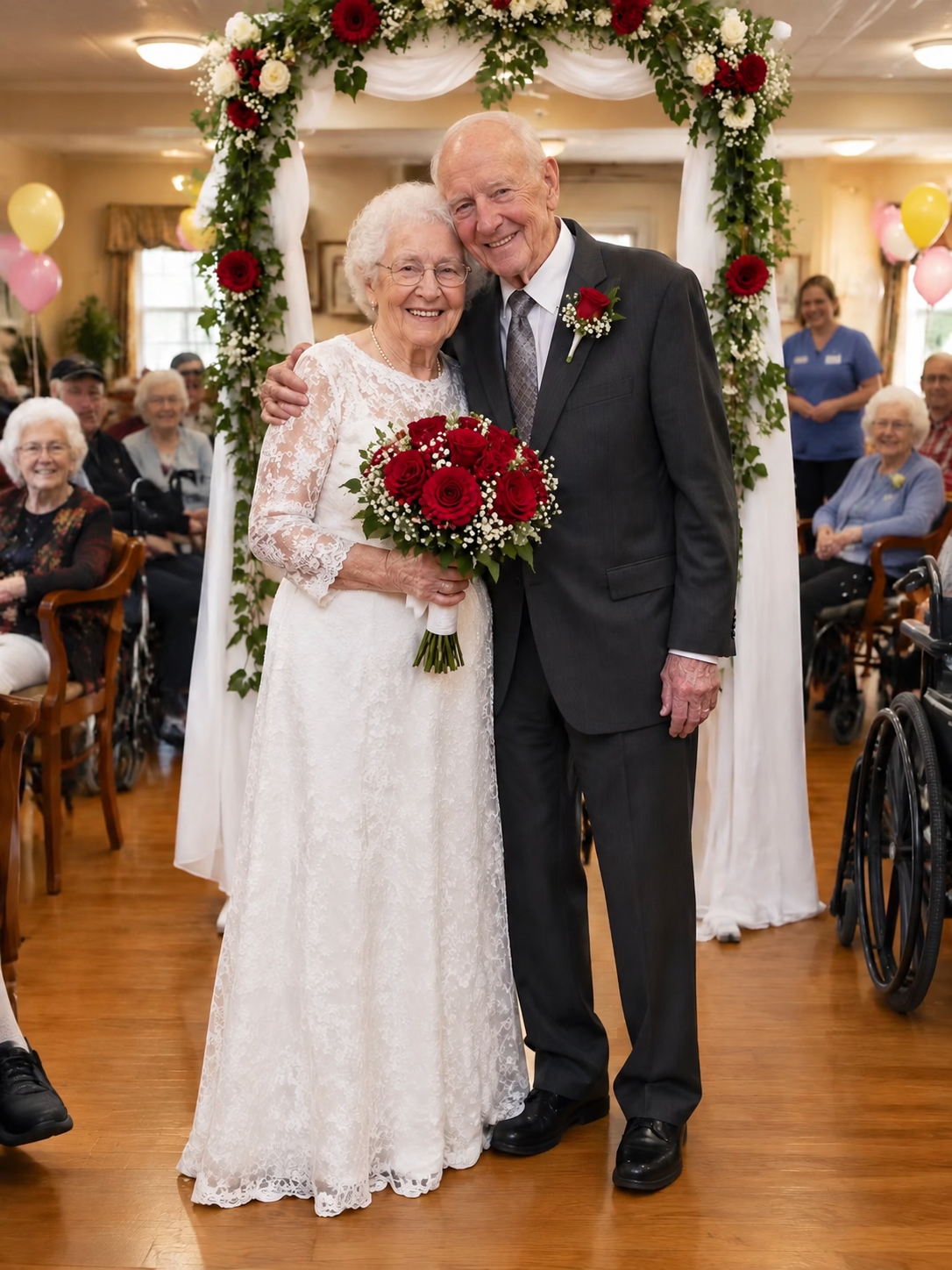
At seventy-eight, I married the wealthy widower who lived upstairs in our retirement home. His children were convinced I had done it for his money.
They were wrong.
I agreed to become Walter Bennett’s wife because he was terrified that if his health deteriorated, his children would gain control over the final days of his life.
Before Walter, my world had been very different. I lived in the state-funded wing of the retirement home, shared a cramped room, and stretched my small pension as far as it would go.
Walter was eighty-two and occupied the penthouse upstairs. He had a private chef, round-the-clock nursing care, and a balcony overlooking the city.
Yet for all his wealth, Walter was terribly lonely.
We met over a chessboard.
One afternoon, I was sitting beneath the old oak tree in the courtyard when a well-dressed stranger stopped beside my table.
“Do you play?” he asked.
“Better than I look,” I replied.
Walter laughed and sat down.
That was how it began.
Soon, chess became our daily ritual. Walter brought expensive tea, while I contributed cookies from the dining hall. We listened to old jazz records and talked about youth, regret, love, and all the things people our age rarely admitted aloud.
One afternoon, Walter sighed.
“Money can buy you a comfortable bed, Margaret. It can’t make someone sit beside it.”
Since his first wife’s death, Walter’s three children had rarely visited.
Then his health began to fail.
Suddenly, they returned—with lawyers.
They started discussing powers of attorney, medical treatment, finances, and property. Walter felt as though control over his own life was slowly being taken away.
“They talk about me as though I’m already gone,” he told me.
Then he asked me to marry him.
At first, I thought he was joking.
But Walter explained that as his wife, I would have a stronger position to protect his wishes and remain beside him if his children attempted to take complete control.
“I don’t want your money,” I said.
“That’s exactly why I’m asking you.”
We married two weeks later.
There was no extravagant ceremony. Just Walter, me, his attorney, two nurses, several friends, and a small bouquet of white roses.
Our marriage was supposed to be practical.
Instead, something happened that neither of us had expected.
We fell in love.
I moved into the penthouse, but the luxury meant little to me. My favorite memories were the ordinary ones.
We read books aloud.
We listened to records.
We argued over chess.
We sat on the balcony holding hands as the sun disappeared behind the buildings.
We had two wonderful years.
During Walter’s final months, he became too weak to leave his bed very often.
One evening, he looked at me and whispered:
“You gave me more time than you realize.”
Three days later, Walter died.
His hand was in mine.
At the funeral, his children treated me like a criminal.
His oldest daughter, Carol, approached me after the service.
“I hope it was worth it,” she whispered.
“What?”
“All of this. Two years of pretending for an inheritance.”
I didn’t argue.
One week later, Walter’s attorney, Mr. Grant, arrived at the penthouse.
A cream-colored envelope sealed with red wax lay on the table between us.
“All three children are challenging your marriage,” he said. “They claim Walter was incompetent and that you manipulated him.”
“He beat me at chess three nights before he died.”
“I have medical evaluations proving that he understood exactly what he was doing.”
Then Mr. Grant pushed the envelope toward me.
“But Walter instructed me to give you this personally.”
I broke the seal.
Inside was an old black-and-white photograph.
I looked at it—and forgot how to breathe.
A young Walter stood in the picture.
Beside him was my mother.
Eleanor.
On the back, someone had written:
“Summer 1944. The only woman I thought I had lost forever.”
Underneath the photograph was a letter.
“Dear Margaret,
There is a truth I should have told you long ago.”
Walter explained that he had met my mother when they were barely in their twenties.
They had fallen deeply in love.
But Walter came from a wealthy, influential family, while Eleanor did not. His parents strongly opposed the relationship.
Then Eleanor disappeared.
Walter later learned that she had been pregnant.
The next sentence turned my blood cold.
“For most of my life, I suspected that I might be your biological father.”
The letter fell from my hands.
“No…”
Mr. Grant remained silent.
There was another document inside the envelope.
A DNA report.
Months earlier, Walter had secretly arranged for our possible biological relationship to be tested.
I could barely read the conclusion.
Paternity excluded.
Walter was not my father.
Relief washed over me, followed immediately by confusion.
Then why had he searched for me?
The answer was on the second page.
After years of searching through old records, Walter had discovered that my mother had indeed been pregnant with his child—but she had lost the baby.
Years later, Eleanor met the man I had always known as my father, married him, and eventually gave birth to me.
Walter and I were not related.
But decades later, his attempts to discover what had happened to Eleanor had led him to my name.
When Walter first approached my chess table, he already knew whose daughter I was.
At first, he had only wanted to speak with me.
He wanted to know what had become of the life of the woman he had once loved.
Then something happened that he had never planned.
“I came to you because of Eleanor,” Walter wrote. “But I returned every day because of you.”
I covered my mouth with my hand.
“I didn’t marry you because of guilt or because of the past. I married you because I fell in love with the woman who argued with me, laughed at my terrible chess moves, and made me look forward to waking up in the morning again.”
Tears fell onto the page.
But Walter had one more surprise waiting for me.
He had not left me his entire fortune.
Most of his wealth was divided among his three children. A substantial amount went to a charitable foundation.
Walter left me the penthouse and a lifetime trust large enough to ensure that I would never have to worry about money again.
His will contained one sentence about me:
“Margaret never asked me for a single dollar. So I leave her not wealth, but security.”
Once the medical evaluations and other documents were produced, Walter’s children realized they had little basis for claiming that their father had been mentally incompetent.
Their legal challenge eventually collapsed.
But that wasn’t the end of the story.
Several weeks later, someone rang my doorbell.
Carol was standing outside.
She looked completely different from the woman I had seen at the funeral.
Tired.
Lost.
“May I come in?”
We sat beside the window.
For a long time, Carol stared at the chessboard.
“Why did he leave you the apartment?”
“Probably because he wanted me to continue calling it home.”
Then she finally asked the question she had probably wanted to ask from the beginning.
“Did you really love him?”
I looked into her eyes.
“Very much.”
Carol lowered her head.
“I thought you took our father away from us.”
“I didn’t take him from anyone.”
“But he stopped needing us.”
“No,” I said softly. “He never stopped needing his children. He simply stopped waiting for you to come.”
Carol began to cry.
And suddenly, I no longer saw an enemy sitting across from me.
I saw a daughter who had realized too late how much time she had lost.
I reached across the table and took her hand.
“Tell me about the Walter you knew when he was younger,” I said. “And I’ll tell you about the man he became during his final two years.”
Carol smiled through her tears.
After that day, she began visiting me.
Eventually, her brothers came too.
We did not become a family overnight. Some wounds are too deep for a perfect reconciliation after a single conversation.
But we stopped being enemies.
I’m eighty-one now.
I still live in Walter’s apartment.
Every evening around seven, I make two cups of tea.
Then I remember that the second person isn’t coming, and I pour one cup back into the pot.
The old photograph hangs on the wall beside our chessboard.
Young Walter and my mother are smiling at the camera, neither of them knowing where life will eventually take them.
When I first saw that photograph, I thought it would destroy everything I believed about my husband.
Instead, it helped me understand why our paths had crossed.
The past brought Walter to my chess table.
But the past didn’t make him return every afternoon.
It didn’t make him hold my hand.
It didn’t make us laugh together late at night.
And it certainly didn’t make him look at me during his final days as though our two years together had been worth an entire lifetime.
Walter left me an apartment, financial security, and enough money to live without fear.
But his real inheritance was inside that sealed envelope.
Because it finally taught me the most important truth of all.
Our meeting may have begun because of a woman Walter had loved sixty years earlier.
But the love we found afterward belonged entirely to us.