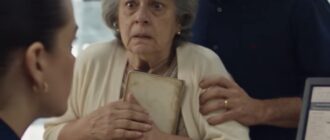
A SINGLE DAD DROVE HIS CEO HOME ON CHRISTMAS EVE — THEN HER MOTHER SPOKE A NAME BURIED FOR 15 YEARS
The first time my boss looked at me that Christmas evening, she saw nothing more than a facilities employee useful enough to drive her home.
An hour later, her mother was standing barefoot in the snow, staring at the battered old watch on my wrist as if she were looking at a ghost.
“Daniel?” she whispered.
Claire Whitmore froze.
The champagne glass slipped from her mother’s hand and shattered against the stone steps.
And in that moment, I knew the secret I had spent fifteen years trying to bury had just returned.
My name was Daniel Mercer. I was forty-one years old, a widower, and the single father of a fourteen-year-old daughter named Sophie.
Officially, I worked as a senior facilities technician at Whitmore Aerospace headquarters in Pittsburgh.
I liked being invisible.
A pipe froze, I fixed it.
The ventilation failed in the middle of the night, I climbed onto the roof.
If an executive complained about the temperature in a conference room, I usually solved the problem before he could send a second email.
Nobody asked about my past.
That was exactly why I worked there.
That evening, the company had taken over the entire thirty-sixth floor for its Christmas party.
Nearly three hundred employees drank champagne beneath white lights. A massive Christmas tree stood beside the panoramic windows while a jazz quartet played near the elevators.
At 7:40 p.m., CEO Claire Whitmore stepped onto the stage.
She was thirty-six. After her father’s death, she had spent eleven years working her way through operations, finance, and international sales before becoming CEO.
“Whitmore wasn’t built by people who asked whether work was convenient,” she said. “It was built by people who stayed when the job demanded more.”
The room applauded.
I didn’t.
My phone had buzzed three minutes earlier.
Sophie had sent me a message.
“You’ll be home before nine, right?”
Underneath was a picture of two mugs of hot chocolate beside the unfinished gingerbread house we had promised to complete together.
“I promised,” I replied.
Seconds later, another message appeared.
“Mom used to say your promises are legally binding.”
I smiled despite the ache in my chest.
Rachel, my wife, had died from cancer four years earlier.
During the final weeks of her life, I learned something I should have understood years before.
A company will always find someone else to do the work.
Your child cannot find another father.
After Rachel died, I promised Sophie that she would never have to compete with my job for my attention.
At 8:15 p.m., that promise unexpectedly became a problem.
Marissa Hale, the company’s general counsel, stopped me near the bar.
“Mercer. You declined weekend duty last Saturday.”
“Yes.”
“Why?”
“My daughter had a swim meet.”
Marissa raised an eyebrow.
“And that was more important than company business?”
That was when Claire joined us.
After hearing the explanation, she looked directly at me.
“Whitmore wasn’t built by people who constantly watched the clock.”
I held her gaze.
“Mechanical room twelve is running six degrees above normal. Excuse me.”
Then I walked away.
Twenty minutes later, the ballroom cooling system failed.
The temperature climbed quickly.
Outside contractors studied the computer diagnostics and insisted the system was already providing maximum chilled-water flow.
I looked at the panel.
“No. The controller is demanding maximum flow. That doesn’t mean the valve actually opened.”
I touched the pipe.
Cold on one side.
Warm on the other.
“The actuator linkage came loose.”
A young manager stared at me.
“You haven’t even opened the housing.”
“I don’t need to.”
“You’ve worked with this system before?”
I paused.
“You could say that.”
He had no idea that fifteen years earlier, I had helped develop the technology on which the system was based.
Within thirty minutes, the temperature returned to normal.
Then another problem arrived.
A major snowstorm buried Pittsburgh.
Claire’s driver became stranded downtown, and she needed to reach the Whitmore family estate for Christmas dinner.
Someone remembered that my aging SUV handled snow better than most new vehicles.
Claire found me in the garage.
“Mercer, can you drive me?”
I checked my watch.
Sophie was waiting.
“I need to call my daughter first.”
Claire looked surprised.
“Of course.”
Sophie agreed on one condition.
“Now you owe me two mugs of hot chocolate.”
“Deal.”
The drive took nearly an hour.
For most of it, Claire worked from her phone.
Then she noticed my watch.
It was an old mechanical watch with a scratched case and a worn leather strap.
“That looks old.”
“It is.”
“Your father’s?”
“No. It belonged to someone else.”
I covered it with my sleeve.
When we finally reached the estate, Claire invited me inside to warm up.
I declined.
Then the front door opened.
Evelyn Whitmore, Claire’s mother, appeared.
She smiled at her daughter.
Then she saw me.
The smile disappeared.
Her eyes dropped to my wrist.
She stepped down onto the snow without even realizing she was barefoot.
“Where did you get that watch?”
I said nothing.
Evelyn slowly looked up at my face.
All the color drained from hers.
“Daniel?”
Her champagne glass fell.
Claire turned sharply toward me.
“Mom… you know him?”
“Come inside, Daniel,” Evelyn said.
“I need to get back to my daughter.”
“To Sophie?”
I froze.
I had never told Evelyn my daughter’s name.
Claire noticed immediately.
“How do you know about Sophie?”
Evelyn closed her eyes.
“Because I knew she existed before she was born.”
Minutes later, we were sitting inside the study that had once belonged to Thomas Whitmore, the company’s late founder.
Evelyn opened an old safe and removed a yellowed envelope.
Fifteen years earlier, I had worked for Whitmore Aerospace.
But I hadn’t been a technician.
I had been an aerospace systems engineer.
At twenty-six, I led a small team developing an experimental thermal-management system.
Before a critical test, I discovered a serious defect.
I submitted a written report and demanded that testing stop.
The project executives refused.
A massive contract was at stake.
The test went ahead.
There was an accident.
One engineer died.
And I was blamed.
My warnings disappeared from the official record.
The company claimed a design error had caused the accident.
My error.
My career disappeared in days.
Then Thomas Whitmore secretly contacted me.
He had discovered my original reports.
Thomas knew I was innocent.
But Rachel was pregnant, the company was facing a devastating legal scandal, and he asked me to disappear temporarily while he gathered enough evidence to expose the executives responsible.
Before we separated, Thomas removed his watch and handed it to me.
The same watch I still wore.
“When this is over,” he told me, “I’ll give you your name back myself.”
A few months later, Thomas died of a heart attack.
The investigation stopped.
I assumed the evidence had disappeared forever.
But Evelyn placed the envelope on the desk.
Inside were my original reports.
Internal correspondence.
Documents showing that senior management knew about the defect.
And a handwritten letter from Thomas.
Claire read everything in silence.
Then she looked up.
“The company knew Daniel was innocent?”
“Several executives did,” Evelyn answered. “Your father was preparing to expose everything to the board. He died before he could finish.”
Claire turned toward me.
“Why did you come back here?”
“Rachel got sick. I needed a job with good medical insurance. Facilities was hiring. Fifteen years had passed, most of the leadership had changed, and nobody recognized my name.”
“And after your wife died?”
“Sophie needed stability.”
Claire was silent for a long moment.
Finally, she said:
“Daniel, I’m sorry for what I said tonight.”
I shook my head.
“Don’t apologize because you know my past now. Decide whether you really believe a father should miss his child’s life just to prove loyalty to a company.”
Claire looked at her father’s documents.
“No,” she said quietly. “He shouldn’t.”
I checked the time.
It was nearly eleven.
“Then I need to go home.”
When I opened my front door, Sophie was sitting beside our unfinished gingerbread house.
“You’re late,” she said.
“I know.”
“That’s a breach of contract.”
“What are the damages?”
“Two mugs of hot chocolate.”
“Three.”
She smiled.
“Accepted.”
We finished the gingerbread house after midnight.
Two days later, Claire called an emergency meeting of the Whitmore Aerospace board.
An independent investigation began.
The old archives were reopened.
Within weeks, everything was confirmed.
My reports had been received before the accident.
Senior managers had known about the risk.
The test had gone forward despite my warning.
Whitmore Aerospace formally corrected the fifteen-year-old accident record and cleared my name.
The family of the engineer who died received the complete findings and additional compensation.
But the biggest surprise came when Claire called me into her office.
A folder was waiting on her desk.
“Vice President of Engineering.”
I looked at the salary.
Then I closed the folder.
“No.”
Claire blinked.
“Why?”
“Sophie leaves for college in four years. I’m not spending those four years on airplanes.”
“You understand what I’m offering?”
“Yes.”
“And you’re refusing?”
“Money can be earned later. She’ll only be fourteen once.”
Claire smiled.
“I thought you might say that.”
She pulled out a second folder.
Director of Technical Operations and Systems Safety.
Flexible hours.
No mandatory travel.
Direct authority to halt testing whenever a safety risk was identified.
And a salary that made me read the number twice.
I looked at her.
“Now that we can discuss.”
Six months later, Sophie reached the regional swimming finals.
I sat in the front row.
My work phone was switched off.
Claire sat beside me.
My position wasn’t the only thing that had changed.
Whitmore Aerospace had changed too.
Executives were no longer praised simply for spending pointless nights at the office. Employees received more protection for important family time. And every engineer gained the authority to stop dangerous testing without fearing for their career.
Claire had finally understood what I learned beside Rachel’s hospital bed:
A company could demand excellent work without demanding a person’s entire life in return.
After her race, Sophie ran toward us with a medal around her neck.
She looked at Claire.
“So you’re the boss who made Dad late for our gingerbread house?”
Claire raised both hands.
“Guilty.”
Sophie considered her carefully.
“I might forgive you.”
“Under what condition?”
“Dad always gets home on time for Christmas.”
Claire smiled.
“Consider that official company policy.”
I laughed and looked down at Thomas Whitmore’s old watch.
For fifteen years, it had reminded me of the worst day of my life.
The colleague we lost.
The career that was taken from me.
The injustice I had been unable to correct.
Now it meant something different.
Thomas had once promised that he would give me my name back.
He hadn’t lived long enough to do it himself.
But the evidence he preserved had fulfilled his promise.
I had spent too many years thinking about the time that had been stolen from me.
Now I finally understood.
The past cannot be returned.
I could never live those lost fifteen years again.
But I could decide who would receive the next fifteen.
I looked at Sophie, proudly holding her medal.
And for the first time in a very long while, I didn’t care what time it was.
Because I was exactly where I was supposed to be.