My father laughed when I invited him to the biggest night of my career.
“What are they honoring you for?” he asked. “How fast you mop toilets?”
My mother had already told me to call my custodial job “administration” so nobody at church would know what I really did.
They skipped the gala.
Then Dad called me eleven times after seeing who presented my award.
And that was before my sister showed up at my apartment with a sixteen-year-old envelope from our family mailbox.
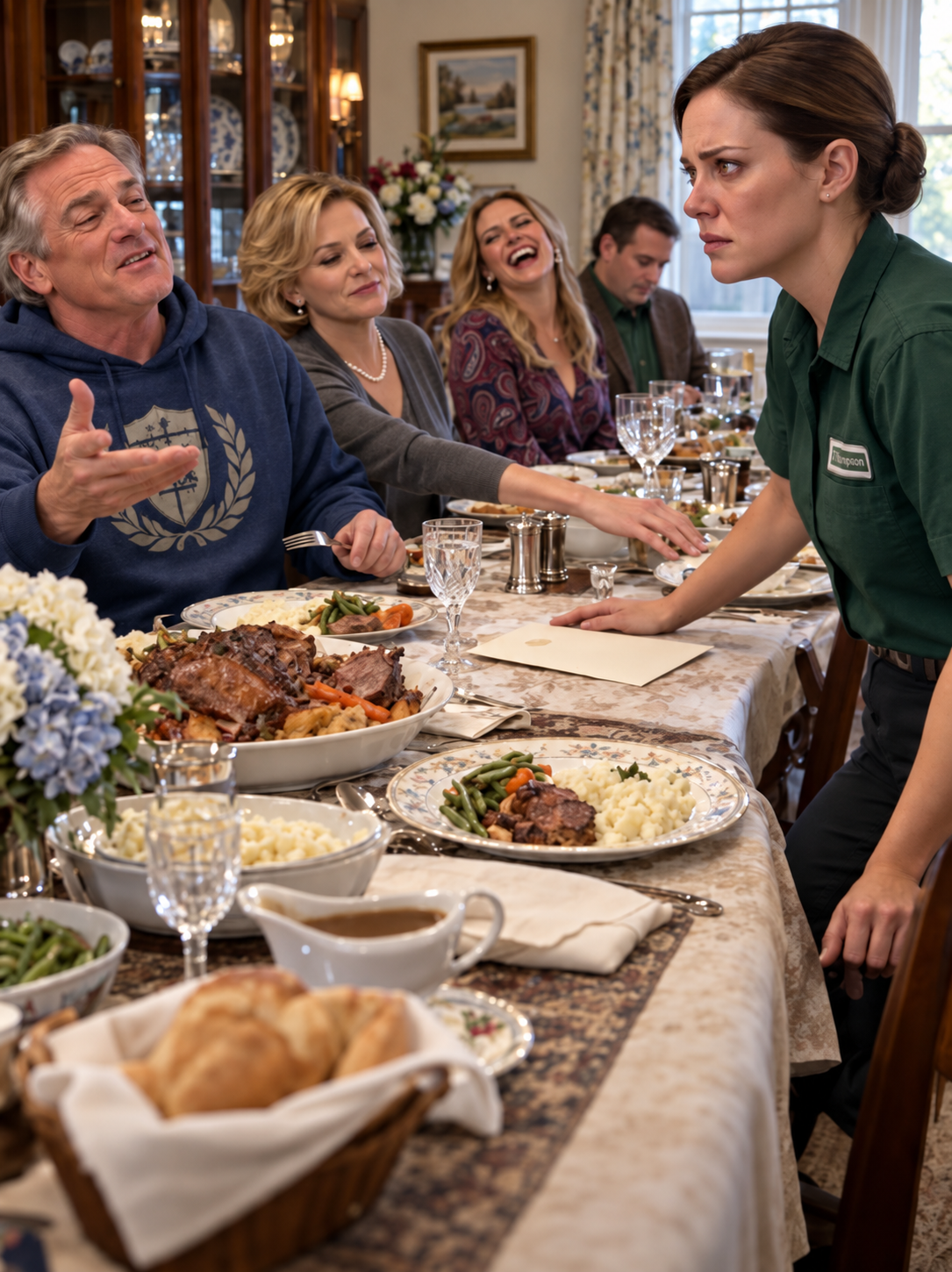
Three weeks before Hartwell State’s spring gala, I set a cream-colored invitation beside my father’s dinner plate.
“The university is honoring me on May first,” I said. “I have two guest seats. They’re for you and Mom.”
Dad looked at the envelope.
Then he looked at the facilities-services patch on the work shirt I hadn’t changed out of.
“You’re a janitor, Chloe.”
I waited.
He smiled.
“What are they honoring you for? How fast you mop toilets?”
My older sister Megan laughed.
Her husband Todd stared at his plate.
My mother rested a hand on my wrist.
“Sweetheart, if anyone asks what you do, just tell them you work in administration. The Hendersons go to our church. People don’t need all the details.”
I looked around the table.
Then I put the invitation back into my purse.
“Then don’t come.”
Dad rolled his eyes.
“Don’t be dramatic. It’s a janitor banquet.”
That should have hurt.
Instead, it freed something in me.
Because for sixteen years, my family had made it clear that some lives deserved to be celebrated.
Mine simply wasn’t one of them.
When I was eighteen, I had been wait-listed at Hartwell State.
Every day, I waited for a letter.
In our house, Dad collected the mail.
Every afternoon he came back from the mailbox and said the same thing.
“Nothing for you, kiddo.”
Summer passed.
No letter came.
Meanwhile, Megan, who was already attending Hartwell, had lost her scholarship during her senior year.
My parents used all $38,000 of what they had always called “the kids’ college fund” to pay for her final year.
The fund had supposedly belonged to both daughters.
Nobody asked me.
Dad simply sat me down and said:
“College isn’t for everybody. There’s no shame in that. Besides, Hartwell never accepted you.”
I believed him.
For three years, I worked at a diner.
Then I joined a commercial cleaning company.
I learned chemical safety, bloodborne-pathogen protocols, floor maintenance, sanitation systems, and all the things my family compressed into the word “mopping.”
Several years later, a custodial position opened at Hartwell State.
I applied.
When I told my family, Dad looked horrified.
“Of every place in Ohio, you’re going to clean my university?”
“It has state benefits and a pension.”
Megan smiled into her wine.
“At least she’ll finally get onto a college campus.”
Everyone laughed.
I let them.
During employee orientation, HR explained that after twelve months, workers in good standing could take up to six university credits per semester tuition-free.
I knew immediately that my life had changed.
One year later, I enrolled in Introduction to Economics.
At night, I was a student.
In the morning, I cleaned the same classrooms.
That was how I met Professor Everett Hail.
The same Everett Hail whose book, Invisible Hands, my father owned two copies of.
Dad loved quoting one line:
“An economy runs on hands it refuses to look at.”
On my first night in Professor Hail’s classroom, he recognized me as the woman who cleaned the building every morning.
I expected embarrassment.
Instead, he said:
“In the mornings, you take care of the room. In the evenings, it’s yours.”
I never forgot those words.
For nine years, I cleaned Hartwell before sunrise and studied there after dark.
Six credits at a time.
Economics.
Statistics.
Accounting.
Public policy.
Research methods.
Sometimes I slept in my car between work and class.
During the pandemic, while students attended lectures remotely, custodians like me remained on campus disinfecting buildings.
After receiving the worst grade on my transcript, I nearly quit.
Donna, one of my coworkers, stopped me.
“One bad grade after years of work?” she said. “That’s a speed bump, sweetheart. Not a stop sign.”
So I kept going.
In January 2026, the registrar finally confirmed something my family never would have imagined.
Bachelor of Science in Economics.
123 credits.
3.88 GPA.
Then I learned Hartwell had selected me to receive its Distinguished Staff Service Award.
Only one employee received it each year.
The nomination packet included a three-page letter from Professor Hail.
One sentence stopped me.
“In thirty years of teaching, I have met one person who cleaned a lecture hall at dawn and mastered it by dark.”
That was when, against all available evidence, I decided to invite my parents.
One final chance.
They didn’t come.
The night of the gala, two seats beside me remained empty.
Paul Watson.
Susan Watson.
At 9:30, the university president approached the microphone.
Then he introduced the person presenting my award.
“Professor Everett Hail.”
I would have paid to see my father’s face.
Professor Hail walked onto the stage.
He repeated Dad’s favorite quote.
“An economy runs on hands it refuses to look at.”
Then he spoke about me.
He told them about Whitmore Hall at five in the morning.
The classrooms prepared before students arrived.
The burst pipe I had helped manage thirty hours before final exams.
The pandemic.
Nine years of studying while working full time.
Then he said:
“Tonight, Hartwell gives its Distinguished Staff Service Award to an employee who, in eight days, will also graduate from this university. Chloe Watson, Bachelor of Science in Economics, class of 2026.”
Four hundred people stood.
I walked toward the stage between my parents’ two empty chairs.
Professor Hail handed me the award.
Then he made another announcement.
“At commencement, Chloe will become the first Hartwell staff representative to address the graduating class.”
At 10:06, my phone started vibrating.
Dad.
Again.
Again.
Eleven calls altogether.
Then came a text.
WE JUST SAW WHO HANDED YOU THAT AWARD. CALL ME NOW.
I turned my phone face down.
For sixteen years, my family had ignored my life.
They could wait until I finished dessert.
Two days later, Megan knocked on my apartment door.
She was holding an old yellowed envelope.
“I need to show you something.”
She came inside and set it on my kitchen table.
The Hartwell State logo was printed in the corner.
My name was in the center.
The postmark was sixteen years old.
My stomach tightened.
“Where did you find this?”
Megan’s eyes were red.
“Behind the drawer in the cabinet where Dad used to keep the mail.”
I turned the envelope over.
It was still sealed.
My fingers shook as I opened it.
Inside was a letter dated June 18, sixteen years earlier.
I read the opening lines.
Then I read them again.
“Dear Chloe Watson,
We are pleased to inform you that a place has become available for the fall semester. We are delighted to offer you admission to Hartwell State University…”
I had to sit down.
I had been accepted.
The letter had arrived.
Dad had lied.
Megan began crying.
“I asked Mom if she knew.”
I looked at her.
“And?”
“She did.”
One word.
It was enough.
Megan continued.
“Dad found the letter. They already knew the college fund had been spent on me. They were afraid you’d insist on going, that they’d have to borrow money or admit they had used your share. So Dad hid it.”
I expected rage.
Instead, I felt hollow.
“Did you know?”
Megan shook her head immediately.
“No. I swear.”
Then she placed another document on the table.
An old bank statement.
The $38,000 transfer.
Every dollar had been withdrawn days before my acceptance letter arrived.
For sixteen years, I had believed an admissions office had decided I wasn’t good enough.
The truth was that my own family had made the decision for them.
That evening Dad called again.
This time, I answered.
“Chloe! Finally. Your mother and I are incredibly proud of you.”
I looked at the acceptance letter on my table.
“You knew I got into Hartwell.”
Silence.
Then:
“What?”
“Don’t.”
A longer silence followed.
I heard Mom saying something behind him.
Finally Dad sighed.
“We did what seemed necessary at the time.”
“You hid my acceptance letter.”
“Megan was almost finished. She needed the money. You could find another path.”
“You decided that for me.”
“We were your parents.”
“Exactly.”
Then he tried to rewrite the story.
Money.
Sacrifice.
Hard choices.
The fact that he himself had dropped out of Hartwell years earlier.
Finally he said the sentence that explained far more than he intended.
“I couldn’t watch a second daughter fail there.”
I understood.
He wasn’t talking about me.
He was talking about himself.
Hartwell had become the place where he projected every wound he had never dealt with.
Megan had to succeed where he had failed.
And I was never even supposed to get the chance to try.
“Dad,” I said quietly, “you weren’t afraid I would fail.”
I paused.
“You were afraid I might succeed without you.”
He said nothing.
I ended the call.
Eight days later, I walked across Hartwell’s commencement stage.
This time, the seats reserved for my family were not empty.
Donna was there.
Curtis was there.
Several members of the custodial crew had taken the morning off.
Megan sat with them.
My parents had not been invited.
When my name was announced, my coworkers stood and cheered so loudly that the dean laughed.
I accepted my diploma.
Then I walked to the podium to address the graduating class.
Inside my pocket was the acceptance letter I should have received sixteen years earlier.
I did not tell four thousand people what my parents had done.
That moment did not belong to them.
Instead, I spoke about the people who enter buildings before anyone else and leave after everyone has gone home.
Custodians.
Kitchen workers.
Assistants.
Parents working night shifts.
Students who take ten years to complete degrees others finish in four.
Then I ended with Professor Hail’s words.
“Our society runs on hands it too often refuses to look at. But that does not make those hands invisible.”
I looked toward my coworkers.
“Sometimes those hands are also holding diplomas.”
The entire hall stood.
A few months later, Hartwell offered me a full-time role in campus operations and planning, where my economics degree and years of frontline experience could be used together to improve budgets, staffing, and working conditions.
I didn’t leave custodial workers behind.
For the first time, I had a seat at a table where I could advocate for them.
Megan and I slowly rebuilt our relationship.
She never tried to excuse our parents.
She simply listened.
Dad sent several letters.
Mom sent some too.
I wasn’t ready to give them the forgiveness they kept asking for.
But I no longer needed their approval either.
The Hartwell acceptance letter from when I was eighteen now hangs framed in my office.
Not as a reminder of what was stolen from me.
As proof.
They managed to hide an envelope.
They delayed my path by sixteen years.
But they never had the power to decide how far I would go.