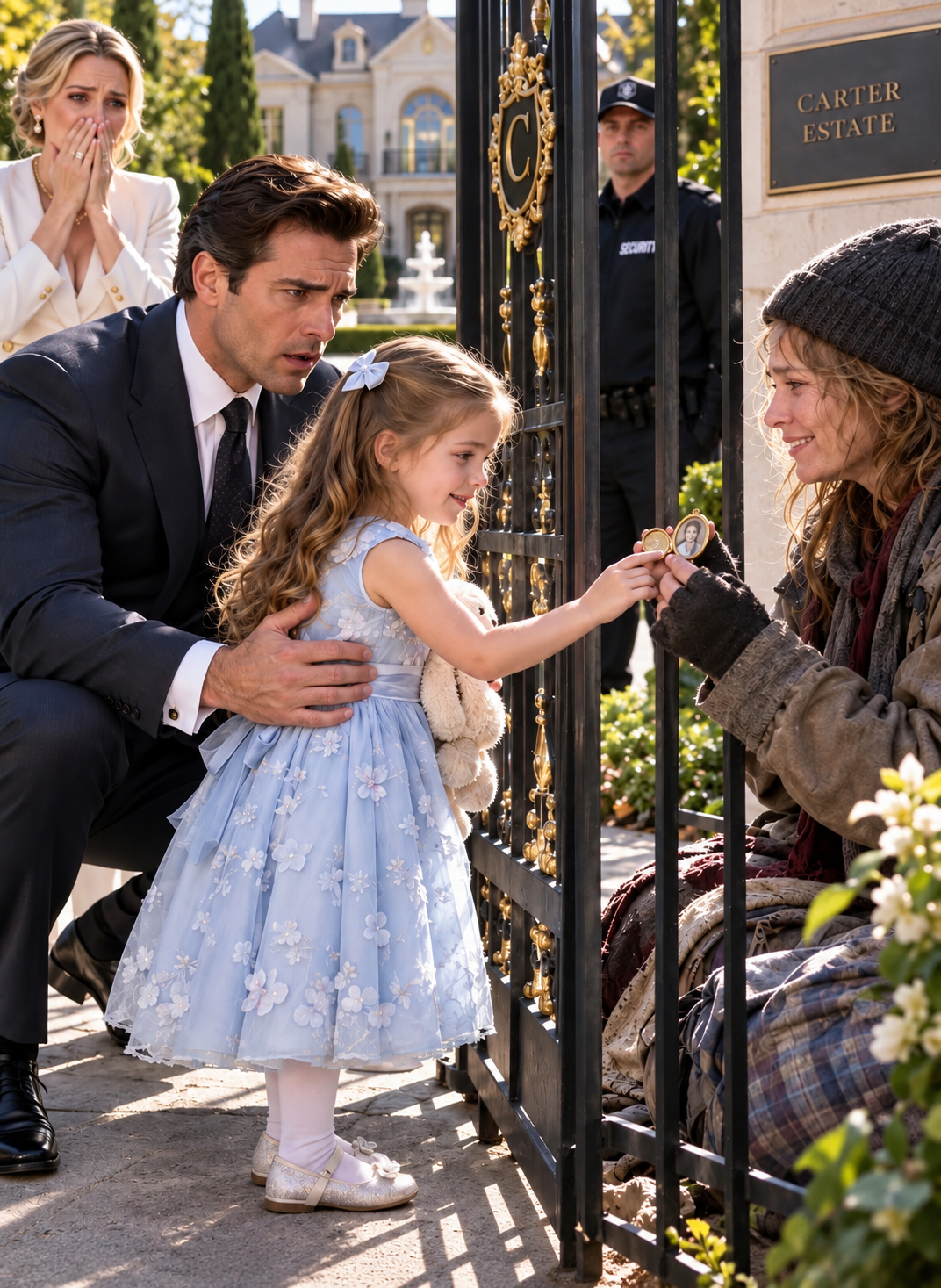
The Homeless Woman at My Gate Made My Silent Daughter Speak
A homeless woman appeared outside my mansion one afternoon, staring through the iron gates at the five-year-old daughter I had spent nearly two years and a fortune trying to help.
My security guard moved to chase her away, but before he could reach the gate, my daughter did something that made every adult around her freeze.
Emily, who had not spoken a single word in almost two years, ran straight toward the stranger.
My name is Jonathan Carter.
I built a retail empire from nothing, and by forty-two, I had more money than I could reasonably spend in several lifetimes.
But inside our estate in Greenwich, Connecticut, money had become useless.
Emily stopped speaking shortly after her third birthday.
Doctors tested everything. Her hearing was perfect. Her vocal cords were healthy. Brain scans showed nothing unusual. She understood every word we said, followed instructions, laughed at cartoons, and turned whenever I whispered her name.
She simply wouldn’t speak.
Specialists called it selective mutism.
We tried therapy, medication, behavioral programs, private specialists, and every treatment we could find.
Nothing changed.
One afternoon, I watched Emily from my upstairs office. She sat alone in the grass surrounded by toys most children could only dream of owning.
She touched none of them.
Instead, she pulled blades of grass from the ground one at a time, watching them slip between her fingers.
Behind me, my wife Victoria entered with Dr. Matthew Reynolds, another respected child psychiatrist.
After reviewing Emily’s files, he sighed.
“Physically, there’s nothing preventing her from speaking.”
Victoria’s eyes filled with tears.
“Then why won’t she call me Mom?”
He couldn’t answer.
I slammed my hand against the desk.
“I don’t care what it costs. There has to be something we haven’t tried.”
Dr. Reynolds slowly closed the folder.
“There may be something we’re overlooking.”
Before I could ask what he meant, movement near our front gate caught my attention.
A woman stood outside.
Her coat was torn. Her hair was tangled, and beside her sat an old shopping cart filled with blankets and plastic bags.
Security was already approaching her.
Then Emily suddenly stood.
“Wait,” I whispered.
My daughter stared at the stranger as though she recognized her.
Then she started walking.
Victoria grabbed my arm.
“Jonathan…”
Emily walked faster.
Within seconds, she was running toward the gate.
I raced downstairs, terrified.
By the time I reached the driveway, Emily stood inches from the iron bars. The homeless woman had lowered herself to her knees.
Neither spoke.
They simply stared at each other.
Then the woman reached slowly into her coat.
My security guard stepped forward.
“Ma’am, keep your hands where I can see them.”
She ignored him and pulled out a small, faded object.
The instant Emily saw it, her face changed.
Her lips trembled.
Then, for the first time in nearly two years, I heard my daughter’s voice.
“Daddy…”
My knees nearly gave out.
But Emily wasn’t looking at me.
She was pointing at the object in the woman’s hand.
It was a small yellow stuffed rabbit.
One ear had been stitched with red thread.
Across its faded stomach was a tiny embroidered letter:
E.
I knew that rabbit.
Emily had slept with it every night when she was two.
And then, shortly before she stopped speaking, it had disappeared.
Victoria had told me we’d lost it during a family trip.
I turned toward my wife.
She had gone completely pale.
“Where did you get that?” I asked the woman.
She looked at Victoria before answering.
“My daughter gave it to me.”
Victoria whispered, “No.”
The woman stood slowly.
“My name is Margaret Lewis.”
The name meant nothing to me.
But judging by Victoria’s expression, it meant everything to her.
Margaret looked at Emily.
“My daughter was named Anna.”
Emily suddenly pressed both hands against the iron gate.
“Anna.”
One word.
But it struck Victoria like a blow.
She staggered backward.
I stared at my wife.
“Who is Anna?”
Victoria said nothing.
Margaret answered instead.
“She was your daughter’s nanny.”
I almost laughed because the statement made no sense.
Emily had never had a nanny named Anna.
At least, that was what I believed.
“We’ve had the same childcare staff since Emily was born.”
Margaret shook her head.
“Not during the summer you spent six weeks opening stores in Europe.”
I remembered that summer.
Emily had just turned three.
I had been traveling constantly.
Victoria had stayed home.
Or so I thought.
Margaret reached into her shopping cart and pulled out a weathered envelope.
Inside were photographs.
The first showed Emily sitting on a park bench beside a young woman with dark hair.
The yellow rabbit was in Emily’s arms.
Another showed them feeding ducks.
Another showed Emily asleep against the woman’s chest.
In every picture, my daughter looked happy.
Completely, effortlessly happy.
“Anna was studying early-childhood education,” Margaret explained. “She worked for your family for four months.”
I looked at Victoria.
“You told me Emily stayed with your sister during that period.”
Victoria’s voice shook.
“It was temporary.”
“Why did you lie?”
She looked toward the security guards.
“Not here.”
Margaret laughed bitterly.
“Now you’re worried about appearances?”
Emily flinched.
Dr. Reynolds immediately stepped between everyone.
“No shouting. Not in front of her.”
He crouched beside Emily.
“Emily, did you know Anna?”
My daughter nodded.
“Where is she?” I asked.
Margaret’s eyes filled with tears.
“She died.”
Emily made a tiny sound.
Victoria covered her mouth.
Margaret continued.
“Anna was killed in a car accident eighteen months ago.”
I calculated the dates instantly.
Eighteen months.
Emily had stopped speaking almost two years earlier.
Something didn’t fit.
“Then why did Emily stop talking before Anna died?”
Margaret looked directly at Victoria.
“Because Anna was taken away from her.”
Silence.
I felt something cold move through me.
“Explain.”
Margaret handed me another photograph.
This one showed Victoria standing outside our house arguing with Anna.
A date was printed in the corner.
Three days before Emily stopped speaking.
“Anna called me that evening,” Margaret said. “She was crying. She said Mrs. Carter had fired her and threatened her.”
I turned to my wife.
“Threatened her with what?”
Victoria’s eyes were fixed on the ground.
Margaret answered.
“With the police.”
“For what?”
“For telling you the truth.”
My chest tightened.
“What truth?”
Margaret hesitated.
Then Emily suddenly spoke again.
“Mommy hurt Anna.”
Everything stopped.
Victoria’s head snapped toward our daughter.
I couldn’t breathe.
Dr. Reynolds remained perfectly still.
“Emily,” he said gently, “you are safe. Nobody is angry with you.”
Emily started crying.
Not silently.
She sobbed.
And between those sobs came words we had waited almost two years to hear.
But they were words no parent ever wants to hear.
“Mommy yelled. Mommy pushed her.”
Victoria shouted, “That’s not what happened!”
Emily screamed and hid behind Margaret.
That single movement told me more than anything else could have.
I ordered security to take Victoria inside but not to let her leave the property.
Then I called the police.
For the next several hours, pieces of a truth I had never known began coming together.
Anna had been hired privately by Victoria while I was overseas.
Emily adored her.
But Anna had discovered something.
Victoria had been seeing another man.
Anna had accidentally walked into the house one afternoon and found him there.
She told Victoria she would not lie if I ever asked.
Three days later, Victoria fired her.
There had been an argument near the back entrance.
Emily witnessed it.
Victoria pushed Anna.
Anna fell down two steps and injured her wrist.
Victoria then threatened to accuse Anna of theft if she contacted our family again.
She even claimed the yellow rabbit had been stolen.
Anna disappeared from Emily’s life overnight.
My daughter screamed for her for three days.
Victoria told everyone Emily was having tantrums.
Then Emily stopped asking.
Soon afterward, she stopped speaking entirely.
Dr. Reynolds later explained that although selective mutism can have many causes, Emily appeared to have associated speaking with danger and loss.
Every time she had asked for Anna, she had been punished, dismissed, or told never to mention her again.
So eventually, she learned the safest solution a terrified three-year-old could imagine.
Silence.
I felt sick.
“Why didn’t Anna contact me?” I asked Margaret.
“She tried.”
Margaret pulled out an old phone.
On it were copies of emails Anna had sent to my company address.
I had never seen them.
They had been intercepted and deleted by my former executive assistant.
An assistant Victoria had personally recommended.
Anna eventually stopped trying.
Months later, she moved to another state.
Then came the accident.
After Anna’s death, Margaret found the rabbit while sorting through her daughter’s belongings.
Along with it was a notebook.
Anna had written about Emily constantly.
There was one sentence repeated several times:
If I ever get the chance, I need Emily to know I didn’t abandon her.
Margaret had spent months trying to find us.
Then she lost her apartment after medical bills consumed what little savings she had.
She had been living in shelters and on the street.
Still, she kept the rabbit.
“I came here because I thought Emily deserved to have something Anna loved,” she said.
I looked down at my daughter.
Emily had wrapped both arms around Margaret.
For nearly two years, I had spent money trying to make my daughter speak.
The person who finally gave Emily her voice back had arrived at our gate with no home, no money, and one worn stuffed rabbit.
Victoria eventually admitted much of what had happened.
She insisted she never intended to traumatize Emily.
She said she had panicked because she believed Anna would destroy our marriage.
But our marriage ended anyway.
Not because of the affair.
Because she had watched our daughter suffer for nearly two years while knowing exactly what had triggered it.
I filed for divorce.
Margaret became an important part of Emily’s recovery.
I offered her money immediately.
She refused it at first.
“I didn’t come here for money.”
“I know,” I told her. “That’s exactly why I want to help.”
Instead of simply writing her a check, I arranged an apartment in her name, covered her medical care, and offered her a position through our company’s community outreach foundation.
But the greatest change happened slowly.
Emily began talking again.
At first, only around Margaret.
Then with me.
Then with Dr. Reynolds.
Weeks later, while I was making pancakes one Sunday morning, I heard footsteps behind me.
Emily climbed onto a kitchen chair.
I turned.
She looked at the disastrous pancake in my hand and giggled.
Then she said four words I will remember for the rest of my life.
“Daddy, you’re burning it.”
I laughed so hard I cried.
Six months later, Emily started kindergarten.
On her first morning, she held my hand with one hand and Margaret’s with the other.
Before walking into the classroom, she turned around.
“I’ll be okay.”
Margaret began crying.
So did I.
Today, the yellow rabbit sits on a shelf beside Emily’s bed.
We never repaired its torn ear.
Emily doesn’t want us to.
She says the red stitches are part of its story.
And maybe she’s right.
For most of my life, I believed every problem had a price.
If a door was closed, money could open it.
If something was broken, money could replace it.
My daughter taught me otherwise.
Sometimes the thing a person needs most cannot be purchased.
Sometimes healing begins with the truth.
And sometimes the person everyone else is prepared to turn away is the only one carrying the missing piece that can finally bring someone home.