Eight Months After Our Divorce, My Ex-Wife Opened the Door Holding My Newborn Son
Eight months after our divorce, I drove through the rain to my ex-wife’s Brooklyn Heights home ready to accuse her of stealing my son from me.
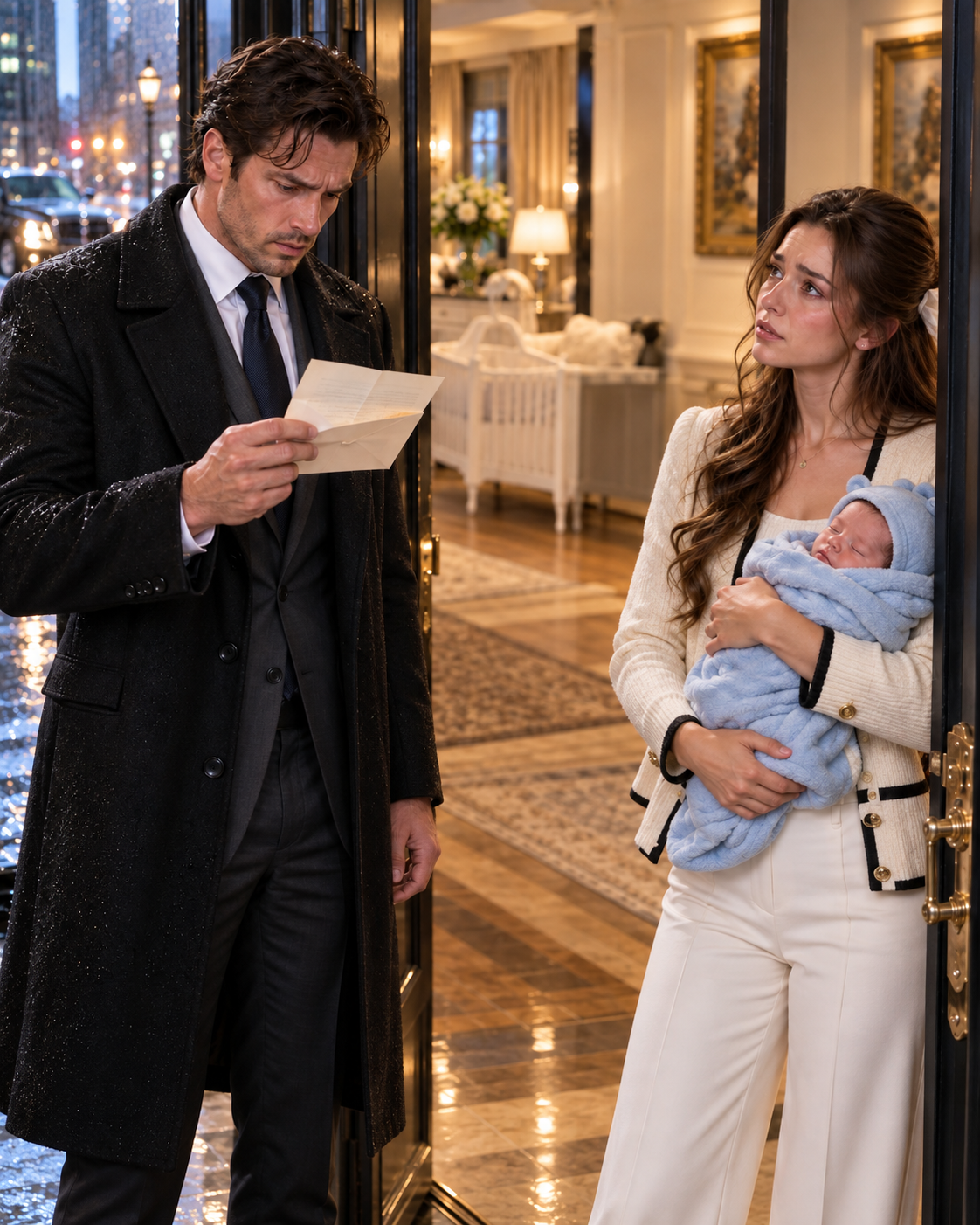
Every furious sentence I had rehearsed disappeared the moment Carolina opened the door holding a fifteen-day-old newborn with my gray eyes.
And in that instant, I realized the truth behind our divorce might be worse than anything I had imagined.
My name is Silas Lockwood.
During the drive from Manhattan, I had rehearsed everything.
Dates.
Medical records.
Names.
Who knew?
Why hadn’t anyone told me?
Two hours earlier, my attorney had called after finding something strange while reviewing paperwork connected to an old family trust.
A hospital document.
A birth record.
Mother: Carolina Hayes.
Father: not listed.
Child: Gabriel Hayes.
Date of birth: fifteen days earlier.
The timing made my blood run cold.
Carolina and I had separated eight months ago.
We had finalized the divorce five months later.
And suddenly there was a child whose conception date fit perfectly into the final weeks of our marriage.
I told myself there had to be another explanation.
Then Carolina opened the door.
She stood barefoot beneath the warm entryway light, thinner than I remembered, auburn hair twisted into a messy knot.
A pale blue blanket rested in her arms.
The baby moved.
Then he opened his eyes.
My eyes.
The same gray.
The same slight downward tilt at the corners.
Even the tiny crease between his eyebrows looked painfully familiar.
“You found out,” Carolina whispered.
“Is he mine?”
Pain crossed her face.
“You already know.”
“I need to hear you say it.”
She tightened her arms around him.
“Yes, Silas. He’s your son.”
Something inside me cracked.
“How old?”
“Fifteen days.”
Fifteen days.
My son had already spent fifteen days breathing, crying, sleeping, and existing in a world where his father didn’t even know his name.
“We need to talk.”
Carolina stepped aside.
“Keep your voice down. He finally fell asleep.”
I entered the apartment where we had once been happy.
The expensive furniture we had chosen together was gone.
Now there were bottles, burp cloths, parenting books, cold tea, unopened mail, and a white bassinet beside the sofa.
No evidence of another man.
Just Carolina.
And exhaustion.
“What’s his name?”
“Gabriel.”
“Gabriel what?”
She looked directly at me.
“Gabriel Hayes.”
Her surname.
Not mine.
I removed my coat but couldn’t sit.
“When did you know?”
“Two weeks after you asked for the divorce.”
My anger came rushing back.
“And you decided not to tell me?”
“I decided not to beg a man to want his own child.”
“That isn’t what I asked.”
“It’s the answer.”
I started pacing.
“You had eight months, Carolina. You could have called me. Emailed me. Contacted my attorney. Walked into my office.”
She gave a tired laugh.
“And said what? Surprise, Silas? Remember the children you never wanted?”
“That’s not fair.”
Her eyes flashed.
“Isn’t it?”
She reminded me of every dinner I missed.
Every anniversary interrupted by business.
Every time she mentioned children and I answered, “Later.”
Every “later” that became another year.
“I was building a company,” I said.
“And I was watching my marriage disappear.”
The words stopped me.
Gabriel stirred.
Carolina adjusted his blanket, and I noticed her hands shaking.
“When did you last sleep?”
“That’s irrelevant.”
“You look exhausted.”
“I gave birth fifteen days ago.”
I moved closer.
That was when something slipped from beneath the baby’s blanket.
A folded piece of paper.
Carolina reached for it.
Too late.
It landed near my shoe.
My name was written across the front.
Silas.
I picked it up.
Carolina went completely pale.
“Don’t.”
I looked at her.
“What is this?”
Her eyes filled with tears.
“The letter I wrote when I found out I was pregnant.”
My chest tightened.
“You wrote to me?”
“I sent it.”
Silence.
“I never received anything.”
Carolina stared at me.
Then she whispered the sentence that made eight months of hatred suddenly feel like someone else’s carefully constructed lie.
“Your mother called me the next morning and said you had read it.”
For a moment, I thought I had misheard her.
“My mother?”
Carolina nodded.
“She said you didn’t want to speak to me directly.”
“That never happened.”
“I know that now.”
I unfolded the letter.
The paper was creased and soft from being handled too many times.
The first line nearly destroyed me.
Silas, I found out today that I’m pregnant.
I kept reading.
Carolina had written that she understood our marriage was ending.
She had not asked me to come back.
She had not demanded money.
She had simply written that whatever happened between us, I deserved to know I was going to be a father.
At the bottom were two words.
Please call.
I stared at the page.
“I never saw this.”
Carolina sat carefully on the sofa, Gabriel still sleeping against her chest.
“Your mother called me less than twenty-four hours after I sent it to your office.”
“What exactly did she say?”
Carolina swallowed.
“She said you were furious.”
I felt my stomach tighten.
“She told me you thought I was using the pregnancy to stop the divorce. She said you wanted no contact, no involvement, and that if I tried to use the baby for money, your attorneys would handle it.”
I shook my head.
“No.”
“She knew exactly what to say, Silas. She knew what I was already afraid of.”
I sat down for the first time.
My mother, Evelyn Lockwood, had always been protective.
Too protective.
After my father died, she had taken over the family foundation and guarded everything connected to the Lockwood name with almost military precision.
But this?
This was something else.
“Why didn’t you contact me directly after that?”
Carolina looked at me for a long moment.
“Because by then, you had already filed for divorce.”
“That doesn’t mean I would have abandoned my child.”
“No. But I didn’t know that.”
Her voice softened.
“You had spent years showing me that work came first. Your company came first. Your family name came first. Every time I talked about having children, you asked me to wait.”
I wanted to argue.
I couldn’t.
Because she was right.
I had loved Carolina.
But for years, I had treated love as though it could survive indefinitely on promises postponed until later.
Later, when the company was stable.
Later, when the next deal was finished.
Later, when life was quieter.
Life had never become quieter.
And eventually Carolina stopped waiting.
Still, one thing made no sense.
“If you thought I wanted nothing to do with Gabriel, why keep that letter?”
Her expression changed.
“Because three days ago, your mother came here.”
My entire body went still.
“What?”
“She showed up without calling.”
“Why?”
Carolina stood, carried Gabriel to the bassinet, and gently laid him down.
Then she walked to a narrow desk near the window.
From the bottom drawer, she removed a cream-colored folder.
She handed it to me.
Inside was a legal document.
I read the first paragraph.
Then the second.
By the third, my hands were shaking.
It was an agreement.
In exchange for a substantial payment, Carolina would waive any future attempt to establish Gabriel as an heir to the Lockwood family trust.
“She asked you to sign this?”
“Yes.”
“How much?”
“Two million dollars.”
I stared at her.
“And you refused?”
Carolina gave me a look that almost offended me.
“Of course I refused.”
I looked back at the papers.
My mother’s attorney had drafted them.
The same attorney who had handled parts of our divorce.
Then I saw the attached email.
From my mother.
To the attorney.
The subject line read:
Hayes matter — resolve before Silas learns.
My vision blurred.
I read the message twice.
My mother wrote that Carolina’s child should be kept outside the family estate.
She called Gabriel a “potential future complication.”
My son.
Fifteen days old.
A complication.
Something inside me changed in that moment.
Not loudly.
Not dramatically.
It simply hardened.
“Why didn’t you call me when she came here?”
Carolina’s eyes filled.
“Because I didn’t know who to trust.”
I looked toward the bassinet.
Gabriel made a tiny sound in his sleep.
Carolina continued.
“For eight months I believed you knew. Then your mother came here trying to buy my silence before you learned he existed.”
Her voice broke.
“That was when I realized maybe she had lied to both of us.”
I stood.
“I’m calling her.”
Carolina caught my wrist.
“No.”
I stared at her.
“Carolina—”
“Not tonight.”
“She stole eight months from me.”
“She stole them from me too.”
That stopped me.
Carolina let go of my wrist.
“I went through the pregnancy alone because I thought you had chosen to abandon us. I gave birth with my sister holding my hand because I believed Gabriel’s father didn’t want him.”
Tears slid down her face.
“So no, Silas. You do not get to turn this into a battle between you and your mother tonight.”
I slowly lowered my phone.
“What do you want me to do?”
Her answer came immediately.
“Meet your son.”
I looked toward the bassinet.
For the first time since entering the apartment, I felt afraid.
Not of my mother.
Not of lawyers.
Of the tiny human being sleeping six feet away.
“I don’t know how.”
Carolina wiped her eyes.
“Nobody does at first.”
Gabriel began to fuss.
She bent toward the bassinet, but I moved first.
“Can I?”
Carolina hesitated.
Then stepped aside.
I reached down carefully.
My hands had signed contracts worth hundreds of millions of dollars without shaking.
Now they shook so badly I could barely slide one beneath Gabriel’s head.
Carolina guided me.
“Support his neck.”
“I am.”
“Not like that.”
“I’ve never done this before.”
“I noticed.”
For the first time that night, something almost like a smile crossed her face.
Then Gabriel was in my arms.
He opened his eyes.
Gray.
Mine.
His tiny fingers curled around my index finger.
I stopped breathing.
“Hello, Gabriel,” I whispered.
He stared at me for three seconds.
Then started screaming.
Carolina laughed.
Actually laughed.
I looked at her helplessly.
“What did I do?”
“Nothing. He’s hungry.”
And strangely, that ordinary answer nearly broke me more than anything else.
Nothing was wrong.
He was simply hungry.
He was a baby.
My baby.
And I had missed fifteen days of his life because someone else had decided I did not deserve to know he existed.
I stayed that night.
Not because Carolina asked me to.
Because leaving felt impossible.
At two in the morning, I learned how to prepare a bottle.
At three, I learned how to burp him.
At four, Gabriel fell asleep against my chest.
Carolina slept on the sofa beside us for nearly four uninterrupted hours.
At sunrise, I looked at the two of them and understood how badly I had failed long before my mother ever interfered.
My mother’s lie had separated us completely.
But I had created the cracks she used.
At nine that morning, I called my attorney, Nathan Cole.
I told him everything.
Then I gave him one instruction.
“Protect Carolina and Gabriel first. Deal with my mother second.”
There was a long silence.
Then Nathan said, “Understood.”
Over the next forty-eight hours, the truth became uglier.
My mother had intercepted Carolina’s letter after it arrived at my executive office.
One of my assistants had forwarded personal correspondence to Evelyn because I had been traveling overseas during the divorce.
My mother opened the letter.
She then instructed the assistant to tell me nothing.
She called Carolina herself.
Afterward, she asked our family attorney whether an unborn child could have rights connected to the Lockwood trust.
When she learned the answer might be yes, she began quietly preparing legal options.
She never planned to tell me.
The only reason I discovered Gabriel was because a junior attorney had recently flagged a hospital-related document connected to the trust review and sent it to Nathan.
One accidental piece of paperwork had exposed eight months of deception.
Three days later, I asked my mother to meet me at the Lockwood Foundation office.
She arrived in a dark green suit, calm as always.
Nathan was present.
Carolina was not.
I wanted her nowhere near this confrontation.
My mother sat across from me.
“You look terrible,” she said.
I placed Carolina’s pregnancy letter on the table.
Her expression changed.
Only slightly.
But enough.
“You remember this?”
She said nothing.
“Did you intercept it?”
“Silas—”
“Yes or no?”
She exhaled.
“Yes.”
The word felt like a physical blow even though I already knew.
“Why?”
“Because you were finally leaving that marriage.”
“She was pregnant.”
“And you never wanted children.”
“I said I wasn’t ready.”
“For six years.”
“That was my decision to make.”
My mother’s voice sharpened.
“You were building something important. You were distracted, exhausted, and she constantly wanted more from you.”
“She wanted a husband.”
“She wanted to slow you down.”
I stared at her.
“And Gabriel?”
My mother looked away.
“You have met him.”
It wasn’t a question.
“He is my son.”
She closed her eyes briefly.
“I was trying to protect you.”
“From what?”
“From being trapped.”
I pushed the legal agreement toward her.
“By a fifteen-day-old baby?”
Her mouth tightened.
“I offered Carolina enough money to ensure that child would never want for anything.”
“His name is Gabriel.”
“Silas—”
“Say his name.”
She stared at me.
I repeated it.
“His name is Gabriel.”
My mother went silent.
I stood.
“You stole my chance to be there when my son was born.”
Her face softened.
“I thought you would thank me one day.”
“That is the part I may never forgive.”
She looked genuinely stunned.
For most of my life, my mother had believed that love gave her permission to control.
She had chosen schools for me.
Business partners.
Friends she considered appropriate.
Even the guest list at my wedding.
I had tolerated it because fighting her was exhausting.
Carolina had seen it long before I did.
Now the cost of my silence was sleeping in a bassinet in Brooklyn Heights.
“You will resign from the family foundation,” I said.
My mother stared at me.
“You cannot be serious.”
“I already have the votes.”
Her face changed.
I continued.
“You will also have no contact with Carolina or Gabriel unless Carolina agrees to it.”
“You cannot keep my grandson from me.”
“I’m not doing anything to you. I’m protecting him from someone who decided his existence was a problem to manage.”
For the first time in my life, my mother looked small.
Not powerless.
But suddenly aware that power had limits.
“Silas,” she whispered, “I am your mother.”
“And he is my son.”
I left.
The weeks that followed were harder than the confrontation.
Because removing my mother from the equation did not magically repair everything.
Carolina still had eight months of fear and resentment.
I still had years of regret.
We began with practical things.
A paternity test, even though neither of us needed one emotionally.
It confirmed what we already knew.
Gabriel was my son.
I was added legally as his father.
I established child support even though Carolina initially resisted.
“That’s not what I want from you,” she said.
“I know. It’s still my responsibility.”
I rented an apartment three blocks away instead of insisting she move.
I learned Gabriel’s feeding schedule.
His pediatrician’s name.
Which diaper cream worked.
Which song made him stop crying.
At seven weeks old, he developed a fever.
Carolina called me at 1:14 in the morning.
I reached her apartment in nine minutes.
We spent the next five hours in the emergency room.
It turned out to be a minor viral infection.
But sitting beside Carolina beneath the harsh hospital lights, I realized something.
Eight months earlier, if she had called me at 1:14 in the morning, I might have been in Singapore.
Or London.
Or asleep with my phone on silent before an investor meeting.
Now nothing mattered more than being there.
I began stepping back from the company.
Not abandoning it.
Rebuilding my life around something other than work.
My board survived.
The company survived.
The world did not collapse because Silas Lockwood left the office before midnight.
That realization was embarrassing.
Carolina noticed the changes.
She did not praise me.
She did not trust them immediately.
She watched.
For months.
When Gabriel was four months old, she finally asked me to stay for dinner after he fell asleep.
We sat at the small kitchen table eating takeout noodles.
No lawyers.
No baby crying.
No accusations.
Just the two of us.
“I used to hate you,” she said.
I nodded.
“I deserved some of it.”
“Some?”
I almost smiled.
“Most.”
She looked down at her food.
“I should have confronted you directly.”
“You thought you had.”
“No. I listened to your mother because it confirmed what I was already afraid was true.”
I looked at her.
“What?”
“That you never loved me enough to choose us.”
The truth hurt because it was close to reality.
“I loved you,” I said.
“But I behaved like everything else could always come first and you would still be there when I finally had time.”
Carolina’s eyes filled.
“Yes.”
“I was wrong.”
We sat in silence.
Then she asked quietly, “Do you think we would have divorced if your mother hadn’t interfered?”
I thought carefully before answering.
“Yes.”
She looked surprised.
“Our marriage was already broken,” I continued. “But maybe we would have had a chance to repair it if we had known about Gabriel together.”
Carolina nodded slowly.
That was the beginning.
Not of reconciliation.
Of honesty.
Another three months passed.
My mother wrote letters.
At first, I returned them unopened.
Later, Carolina suggested I read one.
“She’s still your mother.”
“That doesn’t excuse what she did.”
“No. But maybe someday Gabriel deserves to know whether she became better than the woman who tried to erase him.”
So I read them.
The first was defensive.
The second was apologetic.
The third was different.
My mother admitted that after my father’s death, control had become the way she managed fear.
She wrote that protecting the family name had slowly become more important to her than protecting the people carrying it.
She did not ask for forgiveness.
She asked for the chance to earn it.
I showed the letter to Carolina.
“What do you think?” I asked.
She handed it back.
“I think forgiveness and access are two different things.”
She was right.
My mother did not meet Gabriel until he was almost a year old.
The meeting lasted twenty minutes.
Carolina was there.
So was I.
My mother cried when Gabriel grabbed her finger.
But she followed every boundary we set.
No photographs.
No gifts beyond a small book.
No speeches about family legacy.
When she left, she paused at the door.
“Thank you.”
Carolina simply nodded.
Repair did not happen overnight.
Neither did ours.
But sometimes broken things are not repaired by pretending the cracks never existed.
Sometimes you build differently around them.
On Gabriel’s first birthday, we held a small party in Brooklyn.
Carolina’s sister came.
Nathan came.
A few close friends.
My mother attended for one hour.
Near sunset, after everyone had left, Gabriel fell asleep upstairs.
I found Carolina standing on the terrace beneath strands of warm lights.
A year earlier, we had been divorced strangers.
Now I knew the exact sound of her footsteps in the hallway when Gabriel woke at night.
I stood beside her.
“He had a good day.”
“He ate cake with both hands.”
“He has your table manners.”
She laughed.
Then grew quiet.
“Silas?”
“Yeah?”
“Do you ever wish we could erase all of it?”
“The divorce?”
“The whole year.”
I thought about the letter.
The lies.
The anger.
The hospital room.
The first night I held Gabriel.
“No.”
She looked at me.
“I wish nobody had lied to us. I wish you hadn’t gone through pregnancy alone. I wish I had been there when he was born.”
I paused.
“But if I erase everything, I also erase the person I finally became because of it.”
Carolina said nothing.
So I continued.
“I don’t want our old marriage back.”
Her expression changed.
“Neither do I.”
“I want something better.”
For several seconds, neither of us moved.
Then she reached for my hand.
We did not remarry immediately.
That mattered to both of us.
We dated.
Carefully.
Slowly.
I kept my own apartment.
We went to counseling.
We learned how to disagree without disappearing.
How to ask instead of assume.
How to build boundaries around our families.
How to stop treating love as something that would simply survive whatever we neglected.
Eighteen months after the night Carolina opened the door with Gabriel in her arms, I proposed again.
Not at a restaurant.
Not on a yacht.
Not at some gala.
I asked her in our old Brooklyn apartment while Gabriel sat on the floor stacking wooden blocks.
“This time,” I told her, “I’m not promising you later.”
Carolina looked at me for a very long time.
Then she smiled.
“Yes.”
We remarried six months later.
Small ceremony.
Twenty-three guests.
No press.
No business partners.
Gabriel carried one of the rings in a tiny box and nearly threw it under a chair halfway down the aisle.
Everyone laughed.
Even my mother.
Years later, people would sometimes ask how Carolina and I found our way back to each other.
The answer was complicated.
We didn’t save our first marriage.
That marriage ended.
What we built afterward was something new.
Something based less on promises and more on presence.
Gabriel grew up knowing that his parents had once failed each other badly.
He also grew up knowing that failure did not have to be the final chapter.
As for my mother, forgiveness came slowly.
Trust came even slower.
But she changed.
Not because we demanded an apology.
Because consequences finally forced her to understand that love without respect is just another form of control.
And every year on Gabriel’s birthday, I think about that rainy night in Brooklyn Heights.
About the door opening.
About those gray eyes staring back at me.
About the folded letter falling to the floor.
For years, I thought the most important thing I could leave my son was the Lockwood name.
I was wrong.
A name is inheritance.
Money is inheritance.
Property is inheritance.
But the most important thing a father can leave his child is the certainty that when it matters, he will be there.
And after missing the first fifteen days of Gabriel’s life, I made sure I never chose “later” over him again.