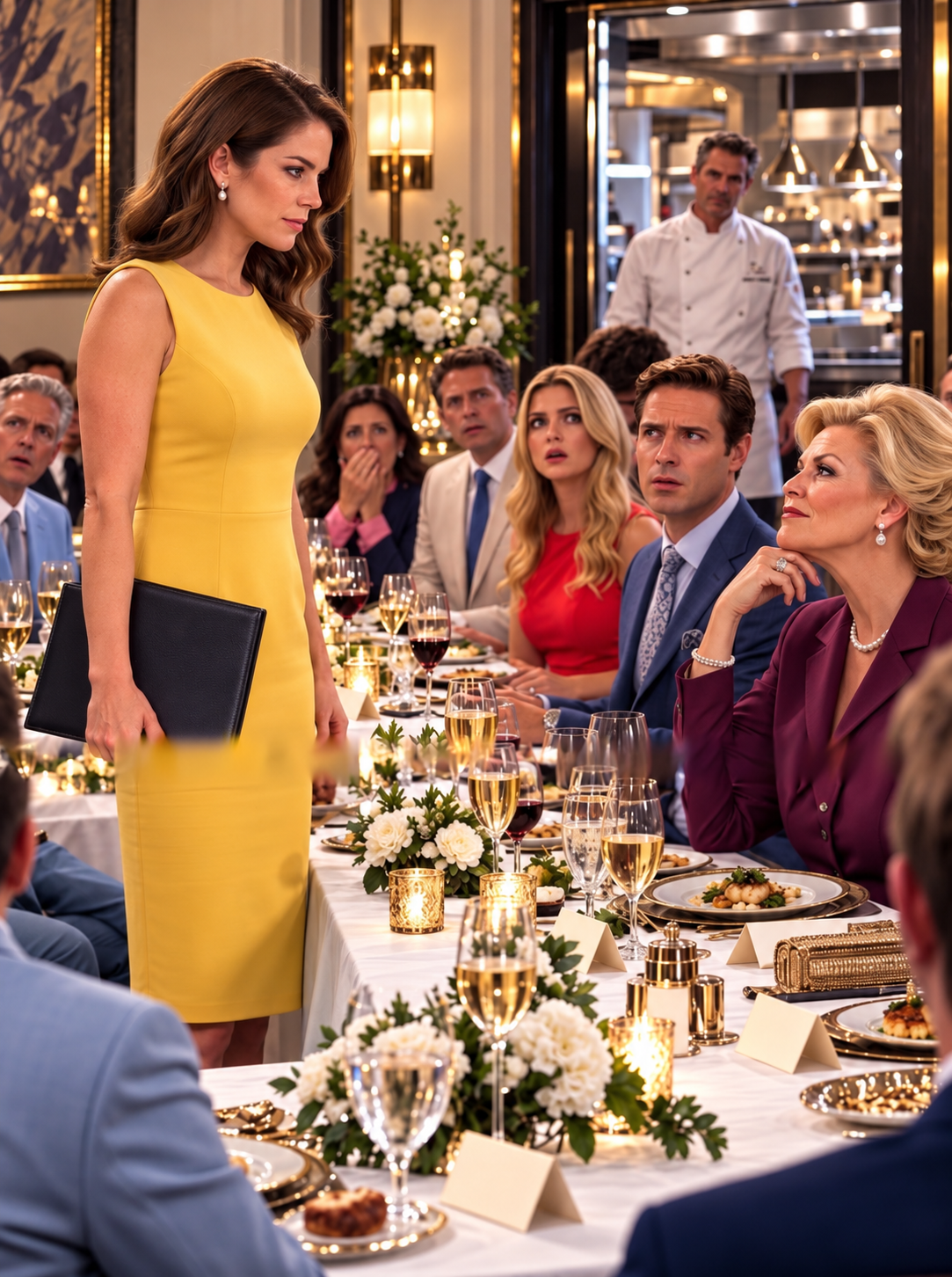
My mother-in-law arranged a dinner at one of the most exclusive restaurants in the city.
When I arrived, there were fourteen chairs.
Fourteen place cards.
And not one of them had my name on it.
Diane Marsh rested both hands beside her place setting and looked directly at me with the satisfied smile of a woman who had been waiting all evening for this moment.
My husband, Daniel, sat at her right.
His sister Whitney was across from him.
Around them were family friends, investors, business contacts, and representatives connected to the largest restaurant development project our company had ever pursued.
Daniel looked down at his wine glass.
Nobody moved.
Then Diane tilted her head.
“Oh, Athena,” she said sweetly. “Maybe a budget place suits you better.”
A few people laughed.
That was the moment she thought she had finally put me where I belonged.
Standing.
Outside the family.
Outside the business.
Outside the life she believed her son had created.
I didn’t argue.
I didn’t ask anyone to move.
I didn’t even look at Daniel for help.
Instead, I laughed.
A genuine laugh.
And for the first time that evening, Diane’s smile weakened.
Because inside my handbag was a navy leather folder.
And inside that folder were documents Diane had never seen.
Documents Daniel had signed for years without paying attention.
She also didn’t know why the owner of the restaurant would recognize my name.
For six years, I had allowed the Marsh family to mistake silence for weakness.
That was about to end.
I started working in restaurants when I was sixteen.
My first job was washing dishes in a tiny diner where the kitchen was hotter than the parking lot in July. Before I had a driver’s license, I had grease burns on my arms and knew how to close a kitchen after midnight.
Over the years, I learned everything.
Food costs.
Staffing.
Vendor contracts.
Liquor licenses.
Health inspections.
Commercial leases.
Financing.
Renovations.
Eventually, after years of saving, I founded Keystone Hospitality Group.
It wasn’t glamorous.
At first, Keystone was me working from a secondhand desk in a tiny rented office.
I handled everything.
Daniel entered the picture later.
When we met, he was charming, ambitious, and confident. He was excellent in meetings and had the kind of personality people remembered.
When we married, I brought him into Keystone.
He became president.
I remained managing member.
That arrangement worked well for a while.
Daniel represented the company publicly.
I handled strategy, financing, negotiations, and operations.
But somewhere along the way, Daniel stopped saying “our company.”
He started saying “my company.”
And Diane loved it.
To her, Daniel was the brilliant entrepreneur.
I was merely the wife who helped behind the scenes.
At Sunday dinners, Daniel always sat beside his mother.
My chair was usually closest to the kitchen.
At Diane’s birthday party two years earlier, a photographer gathered everyone for a family portrait.
I stepped forward.
Diane raised her hand.
“You’re staff, dear. Not family.”
Everyone heard it.
Nobody defended me.
Daniel later told me she had been joking.
That became his favorite sentence.
“She didn’t mean it.”
“She was joking.”
“Don’t make this bigger than it is.”
And every time, I let it go.
Not because I was afraid of Diane.
Because I had a company to run.
While the Marsh family was busy enjoying the appearance of success, I was quietly building the business that paid for it.
Three weeks before the dinner, Keystone secured the biggest opportunity in its history.
Howerin Hotel Group wanted us to develop the restaurant concept for a new luxury flagship property.
The contract was worth millions.
I created the proposal.
I designed the financial model.
I hired the architect.
I negotiated with suppliers.
I flew to Atlanta twice to meet Howerin executives.
The letter of intent came addressed directly to me.
ATHENA EXLEY
MANAGING MEMBER
KEYSTONE HOSPITALITY GROUP
Then Diane decided to throw a celebration dinner.
The invitation called it:
“An Evening Celebrating Daniel Marsh’s Landmark Partnership.”
My invitation didn’t even contain my name.
It said:
Daniel Marsh and Guest.
I showed it to Daniel.
“Your mother didn’t give me a seat.”
He adjusted the navy tie she had bought him and sighed.
“Athena, please don’t make this weird.”
“She invited people to celebrate a contract I negotiated.”
“It’s one dinner.”
“She listed me as your guest.”
He shrugged.
“I don’t want to rock the boat.”
I stared at him.
Because I had built the boat.
And he was asking me not to disturb the people standing on its deck.
The night before the dinner, I discovered something worse.
Daniel had left his phone on the kitchen counter.
A notification appeared from a Marsh family group chat.
I wasn’t trying to read his messages.
But the preview contained my name.
Diane had written:
Athena needs to understand that she’s staff.
I opened the conversation.
I wish I could say I regretted it.
I didn’t.
They had been discussing replacing me operationally with Whitney’s husband, Brad.
Daniel would remain the public face of Keystone.
Brad would manage daily operations.
And I could “consult quietly.”
Whitney had asked one intelligent question.
Doesn’t Athena own part of the company?
Diane replied:
Daniel says it’s mostly his. She just handles the day-to-day details.
And Daniel?
He had responded with a thumbs-up emoji.
That was it.
Years of work.
Millions in contracts.
My company.
Reduced to a thumbs-up.
The next morning, I sat in my attorney Francis Doyle’s office.
Francis had helped establish Keystone nine years earlier.
When I showed her the messages, she read them twice.
Then she removed her glasses.
“Does Daniel understand the operating agreement?”
“He signed it.”
“That wasn’t my question.”
I almost laughed.
Together, we reviewed everything.
My original capital contribution.
My ownership interest.
Annual acknowledgments.
Officer responsibilities.
The Howerin agreement.
Then Francis reached one particular section of the operating agreement.
Years earlier, she had insisted I include it.
I had called it unnecessarily defensive.
She had refused to remove it.
The provision stated that an officer could be immediately removed if he knowingly misrepresented company ownership, attempted to transfer operational authority without authorization, or acted against the managing member’s interests.
Daniel had signed an acknowledgment of that provision every year.
I placed the certified documents inside a navy leather folder.
And that evening, I walked into Sen.
Fourteen chairs.
No Athena.
“Maybe a budget place suits you better,” Diane said.
I looked at Daniel.
He still wouldn’t meet my eyes.
So I turned toward the nearest server.
“Could you ask the owner to come out?”
The server blinked.
“The owner?”
“Yes. Declan Hail. Tell him Athena is here.”
The server’s expression changed immediately.
He straightened.
“Of course.”
Then he disappeared through the kitchen doors.
The laughter at Diane’s table stopped.
Whitney glanced at Brad.
Daniel finally looked at me.
“Athena, what are you doing?”
“Getting a seat.”
Diane gave a small laugh.
“You can’t simply summon the owner because you’re upset.”
I smiled.
“Let’s see.”
Less than a minute later, the kitchen door opened.
Declan Hail stepped into the dining room wearing a white chef’s coat.
Sen was his restaurant.
Reservations sometimes required weeks of waiting.
Diane had spent months talking about how exclusive it was.
Declan looked around the dining room.
Then he saw me.
His entire face changed.
“Athena!”
He crossed the room and hugged me.
Not the polite handshake of an owner greeting a guest.
A real hug.
“You should have told me you were coming,” he said. “I would’ve prepared something special.”
I smiled.
“I wasn’t sure I was invited.”
His smile disappeared.
“What?”
I glanced toward the table.
“Apparently there wasn’t room.”
Declan looked at the fourteen seats.
Then at Diane.
“You didn’t give Athena a chair?”
Diane’s cheeks flushed.
“This is a private family and business dinner.”
Declan’s eyebrows rose.
“I know.”
“My son arranged it to celebrate his company’s new hotel partnership.”
Declan looked slowly toward Daniel.
“His company?”
Silence.
Daniel shifted in his chair.
“Declan, there’s been some confusion.”
“No confusion on my end.”
Declan looked back at me.
“Athena helped me secure this location before Sen existed.”
Diane stared.
Declan continued.
“When banks wouldn’t finance my original concept, Athena introduced me to investors. She negotiated part of this lease. She helped restructure our vendor contracts during our second year.”
Then he smiled at me.
“You’ll always have a table here.”
Diane’s face was changing by the second.
But the real surprise had only begun.
A man near the bar approached us.
Richard Cole.
Vice president of development for Howerin Hotel Group.
I had worked directly with him for four months.
“Athena,” he said, offering his hand. “Good evening.”
“Richard.”
He glanced at the table.
“I thought this dinner was celebrating your project.”
Diane quickly said, “Daniel leads Keystone.”
Richard frowned.
“No. Athena does.”
Nobody moved.
“Our negotiations have been with Athena,” Richard continued. “The letter of intent identifies her as managing member and authorized project lead.”
Diane laughed nervously.
“I’m sure that’s simply a technical designation.”
I reached into my handbag.
“No,” I said. “This is the technical part.”
I placed the navy folder on the table.
Daniel’s face changed.
“Athena.”
I removed the operating agreement.
“Keystone Hospitality Group was founded nine years ago.”
I turned to the ownership schedule.
“Original capital contribution: Athena Exley.”
Then I tapped another line.
“Current ownership interest: seventy-six percent.”
Whitney’s mouth opened.
“Seventy-six?”
“Yes.”
Diane looked at Daniel.
“You told me the company was yours.”
Daniel rubbed his forehead.
“It isn’t that simple.”
“Actually,” I said, “it is.”
I took out several annual acknowledgments.
“Daniel receives a salary, bonuses, executive benefits, and compensation as president.”
I looked directly at him.
“He does not own Keystone.”
Daniel stood.
“I helped build this company too.”
“Yes, you did.”
“Then stop acting like I contributed nothing.”
“I never said that.”
I paused.
“I said you lied about who owned it.”
His jaw tightened.
Diane interrupted.
“You’re married. His assets are yours and yours are his.”
I slid another document across the table.
“Keystone was established two years before our marriage. My ownership interest is separate property.”
Daniel knew that.
His signature was on the document.
Diane looked down.
Then back at her son.
“You knew?”
He said nothing.
That silence answered everything.
I removed one final document.
Daniel saw the header and went pale.
“What is that?”
“Your removal as president of Keystone Hospitality Group.”
Diane shot to her feet.
“You’re firing your husband?”
“No.”
I looked at Daniel.
“I’m removing an executive who knowingly misrepresented his authority and participated in an attempt to transfer operational control without authorization.”
Daniel stared at me.
“Athena, this was just family talk.”
“You discussed replacing me.”
“Nobody actually did anything.”
“You approved it.”
“With an emoji!”
“Yes.”
He looked around the room.
For the first time, everyone was staring at him instead of me.
“Athena, let’s go home.”
“No.”
“We can discuss this privately.”
I almost laughed.
Privately.
That was how everything had happened for years.
Privately, Diane insulted me.
Privately, Daniel excused her.
Privately, I built the company.
Publicly, they accepted the credit.
I shook my head.
“There is nothing left to discuss privately.”
Richard cleared his throat.
“Howerin will need written confirmation of Keystone’s authorized leadership before we proceed.”
“You’ll have it tomorrow morning,” I said.
Daniel turned toward him.
“Richard, don’t overreact.”
Richard’s expression hardened.
“This isn’t personal. Howerin needs to know who has authority to sign a multimillion-dollar development agreement.”
“I do,” Daniel said.
“No,” I replied. “You did.”
The room became silent.
Diane’s eyes filled with anger.
“You planned this humiliation.”
“No.”
I looked at her.
“You planned the humiliation.”
Her eyes moved involuntarily toward the empty space where my chair should have been.
“You invited business partners to a dinner celebrating my contract, removed my name, gave me no seat, and told me to find a cheaper restaurant.”
Diane’s lips parted.
I continued.
“I simply arrived prepared.”
Daniel stepped closer.
“Athena, please.”
For a second, I saw the man I had married.
Not the confident company president.
Not Diane’s perfect son.
Just Daniel.
Scared.
“You’re really going to destroy our marriage over dinner?”
I looked at him for a long moment.
“No.”
My voice was quiet.
“This marriage wasn’t destroyed over dinner.”
I pointed toward the table.
“This dinner just made it impossible to keep pretending.”
His eyes became wet.
“I love you.”
“I believe part of you does.”
“Then come home.”
“I gave you six years to defend me when defending me cost you nothing.”
He lowered his eyes.
“Tonight was the first time it cost you something.”
Declan quietly appeared beside us.
“The chef’s table is ready.”
I looked at him.
“How many seats?”
“Eight.”
I smiled.
“Perfect.”
Richard joined me.
So did the other Howerin representative.
Then Keystone’s architect.
Our beverage consultant.
The regional development adviser.
One by one, the people actually involved in the project moved away from Diane’s table.
The irony was almost perfect.
She had arranged fourteen chairs to prove I didn’t belong.
Within minutes, the people she hoped to impress were sitting with me.
Before I walked away, Diane spoke.
“Athena.”
I stopped.
It was the first time that evening she had used my name without sarcasm.
“There must be some way to fix this.”
I looked at her.
“There was.”
I glanced at the empty space where my chair should have been.
“You could have added a chair.”
Then I walked away.
The Howerin project moved forward.
There was no dramatic cancellation, no revenge against innocent employees, and no attempt to destroy Keystone.
I had spent too many years building the company to damage it for emotional satisfaction.
Instead, I reorganized leadership.
Our chief operating officer became interim president.
Daniel remained a minority financial beneficiary under agreements already in place, but he had no executive authority.
The business continued.
My marriage didn’t.
Daniel hired an attorney.
So did I.
But there wasn’t much to fight about regarding Keystone.
Every important document carried his signature.
He had known exactly how the company was structured.
He simply assumed the details would never matter.
Our divorce was finalized eight months later.
Near the end, Daniel asked to meet me alone.
We sat in a quiet coffee shop.
For the first time since our separation, he didn’t defend himself.
“I liked people believing Keystone was mine,” he admitted.
I said nothing.
He stared into his coffee.
“When people introduced me as the founder, I should’ve corrected them. At first I told myself it didn’t matter because we were married.”
“And later?”
He gave a sad smile.
“Later, I liked it.”
That was probably the most honest thing he had told me in years.
“I should have stopped my mother,” he continued. “I knew what she was doing.”
“Yes.”
“I kept telling myself you were strong enough not to care.”
“I was strong enough.”
He looked up.
“Then why did you leave?”
“Because being strong enough to survive disrespect doesn’t mean I have to keep accepting it.”
He nodded slowly.
There was nothing else to say.
Diane never gave me a real apology.
Three months after the divorce, she mailed me a handwritten note.
She said she regretted “how the evening unfolded.”
Not what she had done.
How it unfolded.
I didn’t answer.
Whitney surprised me.
Six months later, she appeared at my office.
She looked uncomfortable standing in front of my desk.
“I owe you an apology.”
I waited.
“I knew Mom treated you badly,” she said. “I didn’t realize how much Daniel encouraged the story that Keystone belonged to him.”
“That doesn’t excuse what happened.”
“I know.”
She looked toward the wall behind me.
A framed photograph hung there.
It showed the groundbreaking ceremony for Howerin’s new flagship hotel.
Executives stood around a ceremonial shovel.
On the plaque beneath the photograph were the words:
HOWERIN FLAGSHIP DEVELOPMENT
IN PARTNERSHIP WITH
KEYSTONE HOSPITALITY GROUP
ATHENA EXLEY, MANAGING MEMBER
Whitney read it silently.
Then she smiled weakly.
“I guess Mom finally knows you weren’t staff.”
I smiled.
“No.”
Whitney frowned.
“She was right about one thing.”
“What?”
“I was staff.”
I had washed dishes.
Scrubbed floors.
Covered shifts.
Answered phones.
Negotiated leases.
Managed payroll.
Called suppliers at midnight.
Cleaned kitchens after employees went home.
I had spent my entire career doing whatever job needed to be done.
There was never anything shameful about being staff.
Diane’s mistake wasn’t calling me a worker.
Her mistake was believing that the person doing the work had less value than the person receiving the applause.
A year after that unforgettable dinner, Howerin’s flagship restaurant opened.
The launch was a success.
A few weeks later, Declan invited me back to Sen for a small anniversary dinner.
When I arrived, he led me toward the same private dining room.
I stopped in the doorway.
There were fourteen chairs.
Fourteen place cards.
This time, one sat directly in front of the center chair.
ATHENA EXLEY.
I laughed.
Declan grinned.
“What?”
“Nothing.”
I pulled out the chair and sat down.
He looked amused.
“You sure?”
I glanced at the place card.
Then at the table.
“I’m just appreciating the reservation.”
Because one year earlier, Diane Marsh had believed taking away my chair would prove that I didn’t belong at the table.
She had never understood the truth.
I wasn’t waiting for anyone to give me a place.
I had built the table.