The Little Girl Who Tried to Buy Back Her Mother’s Bracelet With 87 Hryvnias
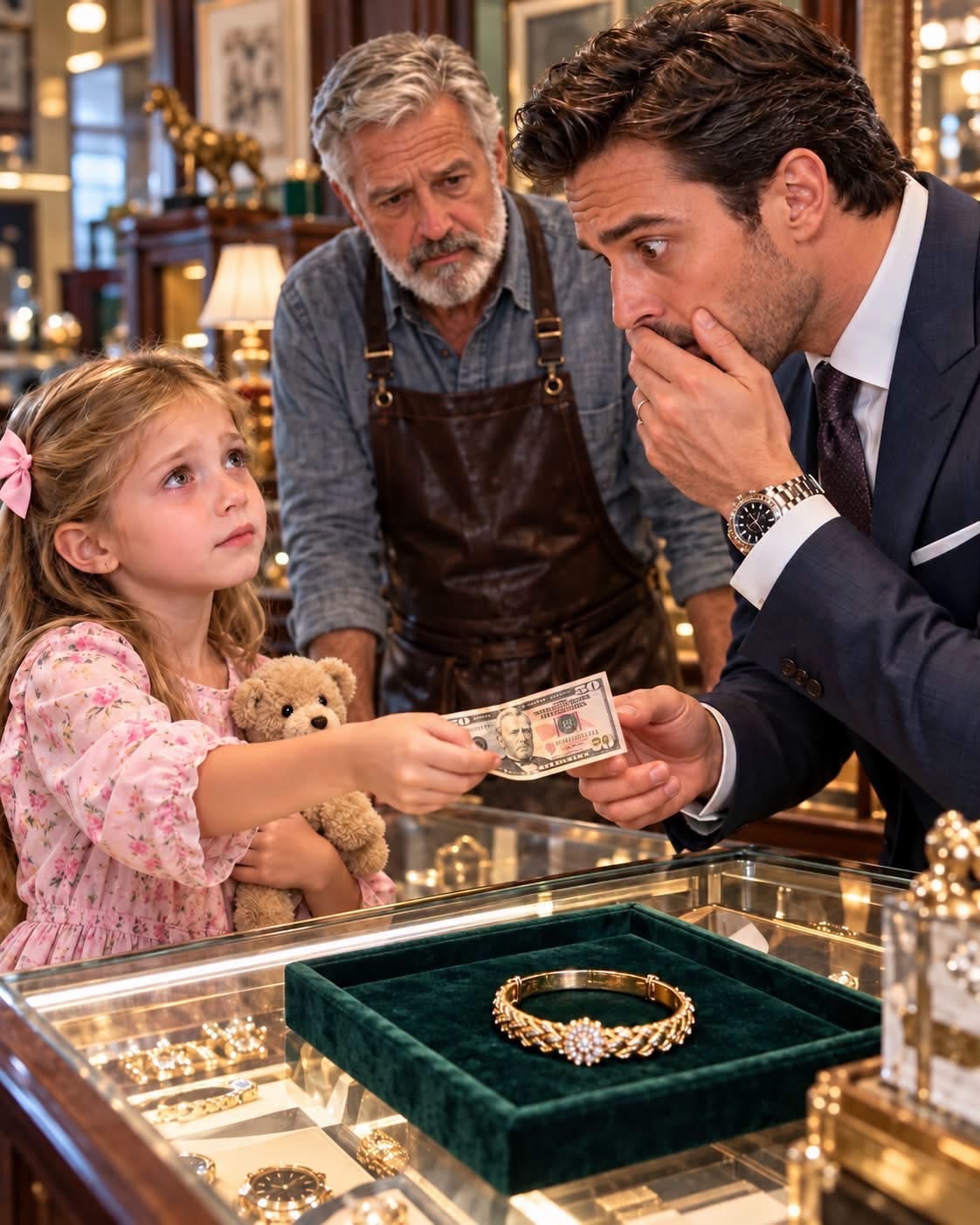
A little girl walked into a pawn shop, slipped a crumpled fifty-hryvnia bill into my hand, and asked me to help her get her mother’s bracelet back.
For years, I had believed money could put a price on almost anything.
But when she looked straight into my eyes and explained what she was willing to offer in exchange, something inside me changed forever.
“Please, sir… could you help me get my mommy’s bracelet back?”
Before I could answer, she placed the folded bill into my palm.
I stared at the worn fifty hryvnias, then at the tiny girl standing in front of me as if she had just handed me everything she owned.
“I saved it,” she whispered.
My name is Andriy Shevchuk.
I had built a multibillion-hryvnia company by questioning every deal placed in front of me. I trusted numbers, contracts, guarantees, and signatures.
Yet standing inside that little pawn shop, surrounded by dusty watches and jewelry that had once belonged to strangers, I couldn’t understand why this child had chosen me.
“I think you’ve got the wrong person,” I said, trying to return her money.
She shook her head.
“No, sir. I didn’t.”
Then she pointed toward a glass display case.
Among tangled chains, old rings, and scratched watches lay a thin gold bracelet.
It was simple. Almost ordinary.
“That one,” she whispered. “It belongs to my mommy.”
Mr. Kovalenko, the pawn shop owner, sighed behind the counter.
“This isn’t the first time she’s come here, Mr. Shevchuk. She’s been trying to buy it back.”
The girl’s name was Lilia.
She immediately opened a small cloth bag.
Coins rolled onto the counter beside several crumpled bills.
She carefully pushed everything she owned toward Mr. Kovalenko.
“I counted it,” she announced proudly. “Eighty-seven hryvnias and twenty-three kopecks.”
Mr. Kovalenko looked away.
“Lilia, we’ve already talked about this. The bracelet costs eight hundred.”
Her shoulders dropped.
That tiny movement affected me more deeply than I expected.
I knew disappointment.
I had seen it in boardrooms after failed negotiations. I had watched people lose companies, investments, and fortunes.
But I had never seen a child lose hope because of a simple gold bracelet.
“I know,” she said quietly.
She didn’t cry.
She didn’t argue.
She simply began picking up her coins one by one.
“Wait.”
She looked up.
“What happened to your mother?”
Lilia closed her fingers around a coin.
“When things became difficult, she needed money. So she pawned the bracelet.”
“And you’ve been saving to get it back?”
She nodded.
“Mommy thinks it’s gone forever.”
I looked at the bracelet again.
“Why is it so important?”
Lilia hesitated.
“My daddy gave it to her.”
That changed something.
“Where is your father?”
“He died three years ago.”
The pawn shop suddenly felt much quieter.
Lilia lowered her eyes.
“Mommy wears his wedding ring on a chain. But she had to sell almost everything else when she lost her job. The bracelet was the last present Daddy gave her before he got sick.”
I swallowed.
“And why did you choose me?”
She answered immediately.
“Because you look like someone who can help.”
I almost smiled.
She wasn’t flattering me.
She wasn’t begging.
So I asked the question that had defined almost every transaction of my adult life.
“If I help you get this bracelet back, what do I receive in return?”
Mr. Kovalenko stared at me as if I had lost my mind.
Lilia stood perfectly still.
Then she reached into her cloth bag again.
This time she pulled out a carefully folded piece of paper.
She put it in my hand.
When I opened it, my breath caught.
In crooked childlike handwriting, she had written:
I WILL REPAY THE DEBT — 712 HRYVNIAS AND 77 KOPECKS.
Below that were several uneven lines.
She promised to repay me little by little with birthday money, holiday money, and anything else she managed to save.
“Mommy says you should never take something that belongs to someone else without giving something back,” Lilia explained. “So it isn’t a gift. It’s a deal.”
I had signed contracts worth hundreds of millions.
None had ever felt as serious as that sheet of paper.
I turned to Mr. Kovalenko.
“Eight hundred?”
He nodded.
I placed the money on the counter.
Lilia immediately added her eighty-seven hryvnias and twenty-three kopecks.
“Mine too,” she insisted. “Otherwise it wouldn’t be fair.”
I didn’t argue.
Mr. Kovalenko counted the money.
But instead of opening the display case immediately, he kept his hand on the key.
“Mr. Shevchuk,” he said slowly, “there’s something else.”
Lilia turned toward him.
“Her mother came here this morning.”
“Mommy was here?”
Mr. Kovalenko nodded.
“She asked me to sell the bracelet today.”
Lilia went pale.
“What?”
“She knew you were trying to save enough to buy it back,” he continued. “She found your jar of coins.”
Lilia’s eyes filled with tears.
“She said you had started refusing lunch at school because you wanted to save the money your grandmother gave you.”
I looked at Lilia.
She stared at the floor.
“Is that true?”
She didn’t answer.
Mr. Kovalenko continued.
“Her mother said she would rather lose the bracelet forever than watch her daughter go hungry trying to recover it.”
He opened the display case and removed the thin gold bracelet.
Then, instead of giving it to Lilia, he placed it in my hand.
“She asked me to make sure Lilia never bought it.”
The little girl finally began to cry.
Not loudly.
That somehow made it worse.
“I only wanted Mommy to smile again,” she whispered.
I looked down at the bracelet.
Until that moment, I had spent most of my life calculating what things were worth.
A building.
A company.
A piece of land.
A competitor.
But no financial model in the world could calculate the value of what was happening in that room.
I crouched beside Lilia.
“Do you know where your mother is?”
She nodded.
“At home.”
“Take me there.”
Twenty minutes later, my driver stopped outside an aging apartment building on the outskirts of Kyiv.
Lilia led me up four flights of stairs.
When she knocked, a tired-looking woman opened the door.
She couldn’t have been more than thirty-five.
Her name was Olena.
When she saw Mr. Kovalenko’s pawn shop envelope in my hand, the color left her face.
“No,” she said immediately.
Then she looked at Lilia.
“I told you to stop going there.”
“Mommy—”
“I don’t want the bracelet.”
Her voice cracked.
“I want you to eat lunch. I want you to buy pencils when you need them. I want you to be a child.”
Lilia burst into tears and threw herself into her mother’s arms.
“I just wanted Daddy’s bracelet back.”
Olena closed her eyes.
For several seconds, she simply held her daughter.
Then she noticed me.
“Who are you?”
“Andriy Shevchuk.”
Recognition flashed across her face.
She looked embarrassed.
“I’m sorry. Whatever Lilia asked you for, I’ll repay it.”
I almost laughed.
Like mother, like daughter.
Instead, I asked, “Why did you pawn the bracelet?”
Olena hesitated.
“Rent.”
Then, after a moment:
“And medicine.”
“For Lilia?”
“For me.”
She looked away.
“I had pneumonia last winter. I missed work. Then the company downsized and I was laid off.”
“What kind of work?”
“Accounting.”
That caught my attention.
“For how long?”
“Eleven years.”
I took out my phone.
One of my companies had been trying to fill several bookkeeping positions for months.
“I’m not offering charity,” I told her. “But I can arrange an interview tomorrow.”
Olena’s expression hardened.
“I don’t want a job because you feel sorry for me.”
“Good,” I said. “I don’t hire people because I feel sorry for them.”
For the first time, she almost smiled.
I handed her a business card.
“Come if you want. Don’t come if you don’t.”
Then I held out the bracelet.
She stared at it.
“No.”
“It’s yours.”
“I can’t accept that.”
Before I could answer, Lilia pulled the folded debt agreement from her pocket.
“It isn’t free, Mommy.”
Olena looked at the paper.
Then at me.
“What is this?”
“A contract,” I said.
Her eyes moved across the crooked handwriting.
By the time she finished reading, tears were running silently down her cheeks.
She knelt beside her daughter.
“You were going to repay all of this?”
Lilia nodded.
“Every kopeck.”
Olena hugged her again.
That was when I made Lilia a counteroffer.
“I’m changing the terms.”
She looked suspicious.
“You can’t do that. We already agreed.”
I laughed.
“You’re going to be dangerous in business someday.”
Then I took a pen and wrote beneath her promise:
Debt to be repaid with one act of kindness to someone who cannot repay you.
Lilia read it carefully.
“That’s all?”
“That’s all.”
She frowned.
“But that could be worth more than seven hundred hryvnias.”
I looked at her.
“Exactly.”
Olena attended the interview the next morning.
She refused to mention my name until the final round.
She didn’t need to.
She scored higher on the accounting tests than every other candidate.
She was hired.
Six months later, she had been promoted to senior accountant.
She paid her own rent.
She rebuilt her savings.
And every month, Lilia still tried to give me a few hryvnias toward her “debt.”
I returned every coin.
Then, almost two years after the day we met, I received an envelope at my office.
Inside was Lilia’s original debt agreement.
On the back she had written:
DEBT PAID.
Below it was a short explanation.
A new girl had joined her class. Her father had died, and the family couldn’t afford the school trip.
Lilia had taken the money she had saved for her own birthday and quietly paid for the girl.
Underneath she had written:
She doesn’t have to pay me back. She only has to help someone else someday.
I sat behind my desk reading those words again and again.
Beside the letter was a photograph.
Lilia and her mother stood together at a school celebration.
Olena was smiling.
And around her wrist was the thin gold bracelet.
For most of my life, I believed the strongest deals were the ones in which both sides knew exactly what they would receive.
Lilia taught me something different.
Sometimes the most valuable agreement is one where kindness keeps moving forward long after the original debt has been forgotten.
I still have her handwritten contract.
It sits framed in my office between documents worth millions.
Visitors often ask why.
I tell them the truth.
Because it is the most valuable contract I have ever signed.