My Father Threw a $6,842 Dinner Bill at Me — Then the Investigator Walked In
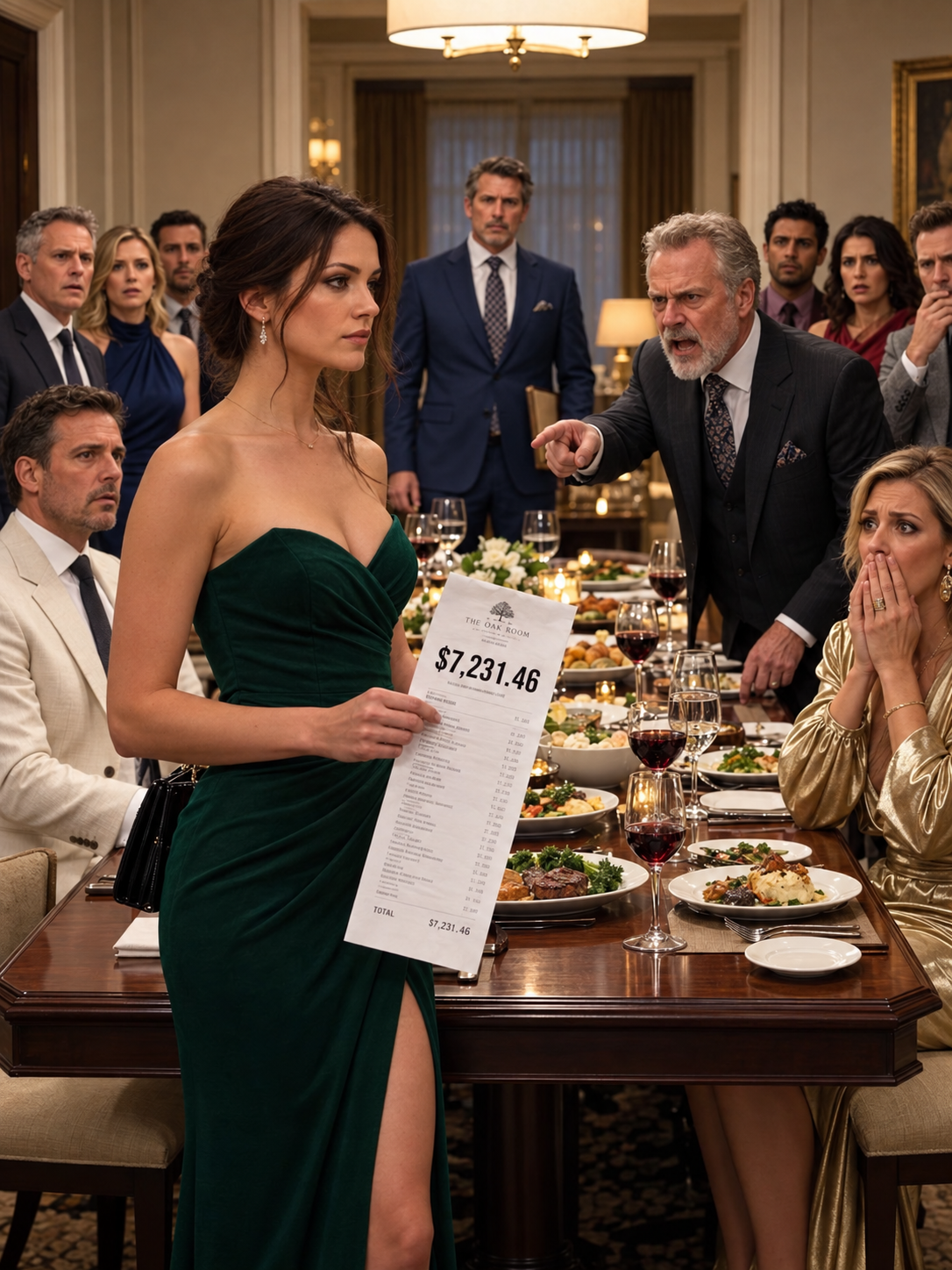
My father threw a $6,842 dinner check at me in front of seventeen relatives.
“Pay it,” he said. “That’s the only reason we invited you.”
My sister Vanessa smirked across the table.
“Be grateful we even gave you a seat.”
I didn’t argue.
I simply reached toward my purse.
Then the waiter leaned down beside me.
“Ma’am,” he whispered, “the man you asked me to call has arrived.”
My father looked toward the entrance.
The color vanished from his face.
And suddenly, Richard Harrington was no longer smiling.
Seventeen members of my family were gathered inside a private dining room at Bellamy House, one of the most expensive restaurants in downtown Chicago.
The evening was supposed to celebrate Vanessa’s thirty-eighth birthday.
Judging by the champagne, lobster, imported wine, Wagyu steaks, and extravagant floral arrangements, you would have thought she had just been crowned queen.
I had almost declined the invitation.
For years, family gatherings had followed the same pattern.
Vanessa was praised.
I was criticized.
My father reminded everyone that Vanessa had stayed loyal to the family company.
Then someone made a joke about my supposedly insignificant accounting career.
According to them, I had wasted my education.
What they didn’t know was that I had stopped correcting them years ago.
After leaving Harrington Supply Group at twenty-four, I had joined a forensic accounting firm.
Over the next fourteen years, I worked on corporate fraud investigations, embezzlement cases, tax disputes, and internal audits.
By thirty-eight, I was a senior partner.
But my father never asked.
He had already decided who I was.
And Richard Harrington rarely allowed facts to interfere with his opinions.
That evening, he waited until dessert arrived before deciding to humiliate me.
The waiter placed the leather check folder near his elbow.
Dad opened it, barely glanced at the amount, then slid it across the table so sharply that it knocked against my water glass.
The water spilled over the white tablecloth.
“Seventeen people,” he said. “Pay it.”
I stared at him.
“Excuse me?”
He leaned back.
“That’s the only reason we invited you.”
Vanessa laughed.
A few cousins joined her.
I looked at the bill.
$6,842.17.
Vanessa lifted her glass.
“You should be grateful we even let you sit here, Claire.”
Nobody defended me.
Not my aunt.
Not my uncle.
Not the cousins who had borrowed money from me over the years.
Nobody.
I felt something inside me go quiet.
Not angry.
Quiet.
I picked up the check.
Vanessa leaned toward her husband.
“Watch her check her bank balance.”
More laughter.
I opened my purse.
Dad smiled.
But I wasn’t reaching for a credit card.
I was checking whether my phone was still recording.
It was.
That was when the waiter returned.
“The man you asked me to call has arrived.”
I closed the purse.
“Perfect.”
The door opened.
Martin Graves stepped inside carrying a leather folder.
Martin was in his early sixties, silver-haired and calm, with the kind of presence that made people stop talking without being asked.
My father stood so quickly that his chair scraped across the floor.
“You.”
Martin nodded.
“Good evening, Richard.”
Vanessa frowned.
“Dad, who is that?”
I answered.
“His name is Martin Graves.”
My father turned toward me.
“You called him?”
“Yes.”
“Why?”
Martin placed the folder on the table.
“Perhaps we should discuss that somewhere private.”
Dad’s jaw tightened.
“No.”
I folded my hands.
“Then we can discuss it here.”
Vanessa stared at me.
“Discuss what?”
I looked directly at her.
“Harrington Supply Group.”
My father’s voice sharpened.
“Claire, stop.”
But for once, I didn’t.
Six months earlier, an employee from Harrington Supply’s finance department had contacted my firm.
She had noticed irregular payments to consulting companies she didn’t recognize.
At first, we assumed it might be sloppy bookkeeping.
It wasn’t.
Over five years, millions of dollars had been moved through a network of shell vendors.
Some invoices were duplicated.
Others described work that had never happened.
Several payments had eventually landed in accounts connected to companies controlled by my father.
I had immediately removed myself from the investigation because of the family conflict.
Martin Graves, an independent forensic investigator and former federal financial-crimes examiner, took over.
And the deeper he looked, the worse it became.
Martin opened the folder.
“Richard, we have now documented approximately $4.7 million in unauthorized transfers.”
The room went silent.
Vanessa slowly lowered her champagne glass.
“That’s impossible.”
Martin looked at her.
“I’m afraid it isn’t.”
Dad laughed once, but there was no humor in it.
“This is ridiculous. Claire is angry because she left the company.”
“No,” I said quietly. “I left because I saw what you were becoming.”
He slammed his palm onto the table.
“You know nothing about running a company.”
“That may be true,” I said. “But I know how to read a ledger.”
Vanessa turned toward Dad.
“Tell him he’s wrong.”
Dad didn’t answer.
That silence changed everything.
Vanessa’s expression shifted.
“Dad?”
Martin removed several pages from the folder.
“These are internal transfers authorized through executive credentials assigned to Richard Harrington.”
My uncle leaned forward.
“Unauthorized transfers to where?”
Martin looked at my father.
Dad said nothing.
So Martin answered.
“Personal investment accounts, a property holding company in Wisconsin, and a consulting entity registered under a nominee.”
My aunt covered her mouth.
Vanessa shook her head.
“No. Dad would never steal from his own company.”
Martin’s voice remained even.
“The company is not exclusively his.”
That was the detail most of my relatives seemed to have forgotten.
Harrington Supply had been founded by my grandfather.
After his death, ownership had been divided among family members through a trust.
My father controlled day-to-day operations.
But he didn’t own everything.
Which meant the money he had taken wasn’t simply corporate money.
Part of it belonged to all of us.
Including Vanessa.
Including me.
Dad pointed at Martin.
“Get out.”
Martin didn’t move.
“I’ll leave when Claire asks me to.”
My father looked at me.
“You planned this.”
“I hoped I was wrong.”
“You brought an investigator to your sister’s birthday?”
“No. I invited him after you told me yesterday that tonight would be a ‘family financial discussion.’”
That caught Vanessa’s attention.
She turned toward Dad.
“What financial discussion?”
He looked away.
And suddenly I understood.
The dinner check hadn’t been random.
The humiliation hadn’t been random either.
My father had wanted to remind everyone that I was the irresponsible outsider before making his announcement.
Martin seemed to understand at the same moment.
He opened another document.
“Richard, were you planning to request additional capital from the family trust tonight?”
My father said nothing.
Vanessa went pale.
“Dad?”
I looked around the table.
“He was going to tell all of you that the company had temporary cash-flow problems.”
My uncle pushed back his chair.
“How much?”
Martin answered.
“Based on the documents we recovered, Richard prepared a proposal requesting $3 million in emergency family funding.”
Chaos erupted.
Everyone started talking at once.
My aunt demanded answers.
One cousin asked whether the company was insolvent.
Vanessa began crying.
Dad shouted that everyone needed to calm down.
I remained seated.
Then Martin raised his voice just enough to cut through the noise.
“The company itself is still operationally healthy.”
Silence returned.
“The problem,” he continued, “is the missing money.”
Dad turned toward me.
“You think you’ve won?”
I stared at him.
“This was never a game.”
His face hardened.
“I built that company.”
“Grandpa built it.”
“I saved it.”
“And then you treated it like your personal bank account.”
Vanessa suddenly stood.
“You knew about this?”
I shook my head.
“Not until six months ago.”
“You were investigating Dad behind our backs.”
“I wasn’t investigating him. My firm received a whistleblower complaint. The moment I saw the company name, I disclosed the conflict and stepped aside.”
Her anger faded slightly.
“Then why didn’t you tell me?”
“Because Martin needed evidence first.”
Martin nodded.
“And now we have it.”
Dad looked around the table as if searching for someone who would defend him.
Nobody did.
Finally he sat down.
For the first time in my life, my father looked old.
Not powerful.
Not intimidating.
Just tired.
“There were losses,” he muttered. “Investments went bad. I planned to put everything back.”
Martin replied, “That is not what the records show.”
Dad ignored him.
He looked at me.
“You don’t understand the pressure I was under.”
I thought about all the years he had mocked me.
All the holidays he had compared me to Vanessa.
All the times he had called me selfish for leaving.
And strangely, I no longer wanted revenge.
I wanted the truth.
“You could have asked for help,” I said.
His eyes narrowed.
“From you?”
“Yes.”
He looked away.
That hurt more than I expected.
Because there it was.
Even now, after everything, his pride mattered more than his daughter.
The rest happened quickly.
The following morning, Harrington Supply’s board held an emergency meeting.
My father was removed as chief executive pending the investigation.
The family trust froze his authority over company accounts.
Attorneys were brought in.
An independent audit confirmed Martin’s findings and discovered additional questionable transactions.
Several assets my father had purchased with company funds were eventually sold.
A significant portion of the money was recovered.
My father later entered into a legal settlement that included restitution and permanently giving up control of Harrington Supply.
Vanessa resigned as vice president three weeks later.
At first, she blamed me.
Then she discovered something even more painful.
Dad had also used her signature authorization on several internal documents without fully explaining what she was signing.
For years, she had believed she was his chosen successor.
In reality, he had used her loyalty as camouflage.
One evening, almost two months after the birthday dinner, Vanessa came to my apartment.
She stood outside holding a grocery-store cake.
I almost laughed.
“Is it somebody’s birthday?”
“No.”
She looked embarrassed.
“I didn’t know what else to bring.”
I let her inside.
For several minutes, neither of us spoke.
Then Vanessa said quietly:
“I’m sorry.”
I looked at her.
“For what?”
“All of it.”
Her eyes filled with tears.
“The jokes. Dad. That dinner. Acting like you were beneath me.”
I leaned back against the kitchen counter.
“Why did you?”
She wiped her eyes.
“Because Dad made me believe there was only room for one successful daughter.”
That sentence stayed with me.
We had spent half our lives competing in a race neither of us had created.
“I should have defended you,” she said.
“Yes,” I replied.
She looked surprised by my honesty.
Then I smiled faintly.
“But you can start now.”
We cut the cheap grocery-store cake and ate it straight from paper plates.
It was the first meal we had shared in years that didn’t feel like a competition.
Six months later, Harrington Supply appointed an outside CEO.
I was offered a seat on the board.
I accepted on one condition:
I would have no involvement in daily operations.
I had built my own career.
I didn’t need my father’s company to prove anything.
Vanessa eventually started working for another company.
Without Dad constantly comparing us, we slowly became sisters again instead of rivals.
As for my father, our relationship became distant.
He called occasionally.
At first, his conversations were full of excuses.
Eventually, they became quieter.
One afternoon, almost a year after the dinner, he said something I never expected.
“I should have asked what you did for a living.”
I was silent.
Then he added:
“I should have asked a lot of things.”
It wasn’t an apology.
Not exactly.
But it was the closest he had ever come.
I never paid the $6,842 dinner bill.
After everything came out, Vanessa insisted on paying for her own birthday celebration.
She later framed a copy of the receipt.
On the back, she wrote:
The most expensive dinner our family ever had—and the cheapest lesson we could have learned.
She was wrong about one thing.
The real price of that night wasn’t $6,842.
It was seventeen people finally learning what happens when silence is mistaken for weakness.
And me finally understanding that being given a seat at someone else’s table means very little when you have already built a life of your own.