I woke up after spinal fusion surgery with a burning line of pain across my lower back, numbness in both legs, and fourteen missed calls from my sixty-eight-year-old neighbor, Martha Gable.
The first message made my blood run cold.
“Harrison, your kids are on my porch. Your parents left two hours ago. Please call me as soon as you read this.”
My son Wyatt was seven.
My daughter Harper was five.
And the two people I had trusted to care for them while I was unconscious on an operating table had simply driven away.
I called Martha immediately.
“They’re safe,” she said before I could even speak.
Then she told me what had happened.
She had been watering her lawn when she saw my parents’ SUV leave their driveway. She assumed they were taking Wyatt and Harper somewhere.
About an hour later, she heard a child crying.
When she walked over, she found Harper sitting on the concrete steps in tears while Wyatt held her hand and tried to comfort her.
The front door was locked.
My parents were gone.
My children had been left outside alone.
I lay there in the hospital bed, still half-numb from anesthesia, and suddenly years of excuses collapsed all at once.
My name is Harrison. I’m thirty-two, a structural engineer, husband to Chloe, and father to Wyatt and Harper.
Professionally, I spend my life studying pressure.
I calculate load limits, stress points, and the exact moment when a structure can no longer carry what has been placed on it.
For some reason, I had never applied that knowledge to my own family.
Growing up, I had always been the dependable son.
If something broke, I fixed it.
If paperwork was confusing, I handled it.
If someone needed money moved, furniture lifted, a car repaired, or a problem solved, I was called.
My younger brother, Preston, was different.
He was protected.
At twenty-six, Preston called himself an entrepreneur, although most of his businesses began with our parents investing their money and ended with them rescuing him from the consequences.
That had always been the pattern.
When I was sixteen, I pitched a perfect game in a high school championship. My parents missed it because Preston wanted limited-edition basketball shoes from a mall two hours away.
When I graduated from university with honors, they arrived late because Preston had overslept.
When Chloe and I got married in a simple backyard ceremony we paid for ourselves, my mother complained until they left early because Preston was bored.
A month later, my parents took out a second mortgage to buy him an expensive sports car.
Eventually, I learned to expect nothing.
Then my back injury forced me to depend on them one final time.
Four years earlier, a steel beam had shifted at a construction site and struck my lower body. I kept working, completed physical therapy, took medication, and learned to hide how much pain I was in.
But the damage progressed.
By spring, pain shot down both legs. One evening, Harper reached up for me, crying and asking to be held.
I couldn’t lift her.
That was when I knew I couldn’t delay surgery any longer.
My surgeon scheduled a spinal fusion.
Unfortunately, Chloe had to fly to Seattle that same week to present the biggest marketing campaign of her career.
She offered to cancel immediately.
I refused.
I told her I would call my parents.
I only needed them to watch Wyatt and Harper for several hours.
My mother sounded delighted when I asked.
“Of course, sweetheart. Don’t worry about a thing.”
She promised lunch, cookies, games, and assured me Dad would be home too.
I prepared everything carefully.
Emergency numbers.
Insurance cards.
Allergy information.
The pediatrician’s number.
Hospital details.
Even Martha’s phone number as a backup.
On the morning of surgery, I brought the children to my parents’ house.
My mother hugged Harper.
Then her phone buzzed.
She looked at the screen, and for one brief moment, her expression changed.
Later, I learned it was a message from Preston.
At the time, I kissed my children goodbye and drove to the hospital believing they were safe.
When I woke after surgery and saw Martha’s fourteen missed calls, that belief disappeared forever.
After speaking to her, I called my father.
He answered with music playing in the background.
“Where are my children?”
“Oh, relax, Harrison.”
“They’re at Martha’s because you left them alone. Where are you?”
He sighed.
“Your brother needed his suit fitted.”
I thought the medication had affected my hearing.
“What?”
“He has a networking event tonight. It’s a custom Italian suit. Your mother and I had to come help with the deposit.”
I stared at the ceiling.
“You abandoned my five-year-old and seven-year-old children for Preston’s suit?”
“They’re fine. Stop being dramatic.”
That sentence changed something in me permanently.
My children had been frightened and locked outside.
My seven-year-old son had been forced to become the responsible adult.
And my father was more irritated by my reaction than by what they had done.
“Do not contact my children again,” I said.
Then I hung up.
The nurses wanted me to remain in the hospital, but as soon as I was legally allowed to leave, I arranged a car home.
I arrived using a cane.
Martha was in the kitchen.
Harper sat at the table eating a peanut butter sandwich Wyatt had made for her.
Wyatt looked at me and tried to smile.
“I took care of her, Dad.”
Those words hurt more than my surgery.
I slowly lowered myself beside them.
“You did a brave thing,” I told him. “But you should never have had to do it.”
I held both children until Harper stopped trembling.
That night, after they went to sleep, I opened Preston’s social-media page.
There was a photograph from an expensive tailor shop.
Preston stood in front of a mirror wearing a dark suit.
My parents sat behind him on a velvet sofa, holding sparkling wine.
The caption read:
“Mom and Dad funding the $1,000 look for the new empire.”
The photo had been posted at 1:00 p.m.
At exactly that time, my daughter had been crying outside a locked house.
I saved the photograph.
The next morning, Chloe flew home early despite my protests.
When I told her everything, she didn’t argue or try to minimize it.
She simply said, “They don’t get another chance to do this.”
For once, I agreed without hesitation.
We documented everything.
Martha wrote down what she had seen.
I saved the messages and call records.
I saved Preston’s photo.
Then I sent one final email to my parents.
I explained that they were no longer permitted to pick up our children from school, babysit them, take them anywhere alone, or enter our home without invitation.
I also removed them from every emergency contact list.
My father responded within twenty minutes.
He accused me of humiliating them.
My mother called Chloe cruel.
Preston sent me a message saying I was “destroying the family over one mistake.”
I didn’t answer any of them.
Because it wasn’t one mistake.
It was thirty-two years of the same decision, repeated again and again:
Preston first.
Everyone else later.
The only difference was that this time, my children had paid the price.
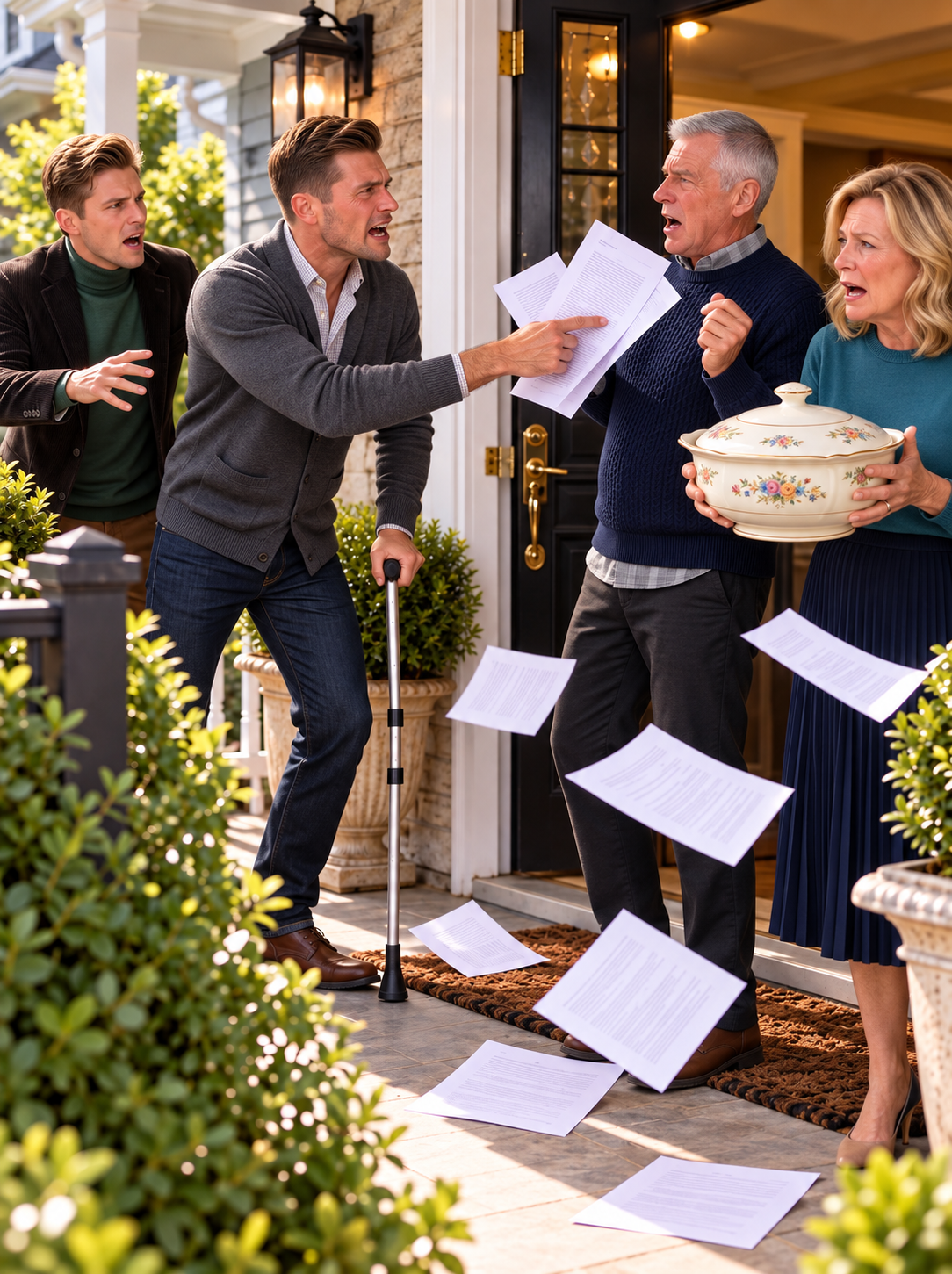
Three weeks later, my parents appeared at our front door.
Dad looked angry.
Mom was crying.
They demanded to see Wyatt and Harper.
I stepped onto the porch and closed the door behind me.
My father immediately began talking about forgiveness.
“We’re family,” he said. “You can’t keep children away from their grandparents forever.”
“I’m not keeping them away because I’m angry,” I replied. “I’m keeping them safe because you proved I cannot trust you.”
Mom started crying harder.
“We said we were sorry.”
“No,” I said. “You said I was overreacting.”
Neither of them had an answer.
I realized then that for most of my life, I had confused forgiveness with continued access.
They were not the same thing.
I could forgive them someday.
But forgiveness would not make them reliable.
It would not erase the fear Harper remembered.
It would not give Wyatt back the hour when he believed he was responsible for protecting his sister because no adult was coming.
My parents left.
For several months, we had almost no contact.
Preston stopped speaking to me entirely after my parents finally refused to fund another one of his businesses.
Apparently, once I was no longer around to absorb the family’s problems, some of those problems became harder to ignore.
My recovery took months.
At first, I needed a cane.
Then physical therapy.
Then slow walks around the block.
One evening, almost six months after surgery, Harper ran toward me in the living room and lifted both arms.
“Daddy, pick me up.”
For a second, I froze.
Then I bent my knees carefully and lifted her.
She wrapped her arms around my neck and laughed.
I looked across the room at Chloe.
She had tears in her eyes.
So did I.
That was when I understood something I should have learned years earlier.
Strength does not mean carrying everything people place on you.
Sometimes strength means knowing when a load has become dangerous.
Sometimes it means reinforcing the foundation.
And sometimes it means removing the weight entirely.
My parents had spent my whole life teaching me that being dependable meant accepting whatever they gave me.
My children taught me something different.
Being dependable meant protecting the people who depended on me.
Even when that protection had to be from my own family.