“This resort is meant for successful people,” Mom declared as we crossed the enormous lobby of Azure Heights.
My sister Vanessa gave a smug little smile.
“Exactly. Not people who spend their days working in warehouses.”
I said nothing.
I had learned years ago that arguing with my family was useless.
A few minutes later, the general manager would walk straight past both of them, stop in front of me, and say:
“Ms. Williams, we need your authorization regarding your family’s reservation.”
But before that happened, my mother and sister had a little more humiliation planned for me.
And neither of them had any idea who actually owned the resort.
My name is Maya Williams. I’m thirty-seven years old, and for most of my adult life, my family has believed I failed.
My mother, Diane, built a successful consulting business after my father died.
My younger sister Vanessa became a luxury real-estate broker and made sure everyone knew exactly how much her commissions were.
I took a different path.
At twenty-four, I left a comfortable corporate job and invested almost everything I had in a small logistics company with two friends.
We rented half of an old warehouse outside Denver.
For the first few years, I did everything.
I loaded trucks.
I repaired damaged pallets.
I drove forklifts.
I answered customer calls.
When an employee called in sick, I covered the shift.
When a truck arrived at three in the morning, I was there.
My mother hated it.
“You have a university degree,” she reminded me constantly. “Why are you wearing steel-toed boots?”
Vanessa found it even funnier.
At family dinners, she referred to me as “the warehouse girl.”
Neither of them ever asked what company I worked for.
They simply assumed I was an employee.
I never corrected them.
At first, I wanted to.
Then something changed.
Our little logistics company grew.
One warehouse became four.
Four became twelve.
We expanded into cold storage, distribution, commercial property, and eventually hospitality.
By thirty-three, I no longer needed to work on the warehouse floor.
But I still visited our facilities regularly because I believed executives should understand what their employees actually did.
I wore safety boots.
I wore reflective vests.
Sometimes I helped unload shipments.
My mother saw photographs of me dressed like that and reached the conclusion she wanted to reach.
Maya was still moving boxes.
Meanwhile, our company had become worth hundreds of millions of dollars.
Three years earlier, I had purchased a struggling lakeside hotel through one of our property subsidiaries.
The hotel had been outdated, poorly managed, and close to bankruptcy.
I saw potential.
We demolished most of it and rebuilt the property from the ground up.
I personally approved the architectural plans.
The stone.
The lighting.
The timber beams.
The furniture.
Even the shape of the reception desk.
We renamed it Azure Heights.
Within eighteen months of reopening, it became one of the most successful luxury resorts in the region.
And somehow my family still had no idea it belonged to me.
That was partly intentional.
After years of listening to them measure people by job titles, clothes, cars, and bank accounts, I stopped feeling any need to prove myself.
Then Mom announced she was organizing a family reunion.
She chose Azure Heights.
Of all places.
Vanessa had apparently recommended it after one of her wealthy clients stayed there.
Mom called me two months before the reunion.
“I know it may be slightly outside your budget,” she said carefully.
“I’ll manage.”
“There are cheaper hotels twenty minutes away.”
“I’ll stay with everyone else.”
She sighed.
“All right. Just don’t feel pressured to participate in every activity. Some of them are expensive.”
I almost laughed.
Instead, I said, “Thanks for the warning.”
What neither of them knew was that their reservation had been flagged the moment their last name entered the system.
My general manager, Daniel Brooks, called me personally.
“Your family booked the lakeview villas.”
“I know.”
“Should we tell them?”
“No.”
There was silence.
Then Daniel laughed.
“You want them to find out here, don’t you?”
“I don’t particularly care when they find out.”
That wasn’t entirely true.
A small part of me was curious.
So on Friday afternoon, I drove to Azure Heights in my eight-year-old SUV.
Vanessa arrived fifteen minutes later in a new Mercedes.
Mom arrived in a chauffeured town car.
Vanessa looked at my SUV and shook her head.
“You still have that thing?”
“It still runs.”
“You could at least lease something presentable for the weekend.”
“I’ll survive.”
She glanced toward the valet.
“Just don’t park next to me.”
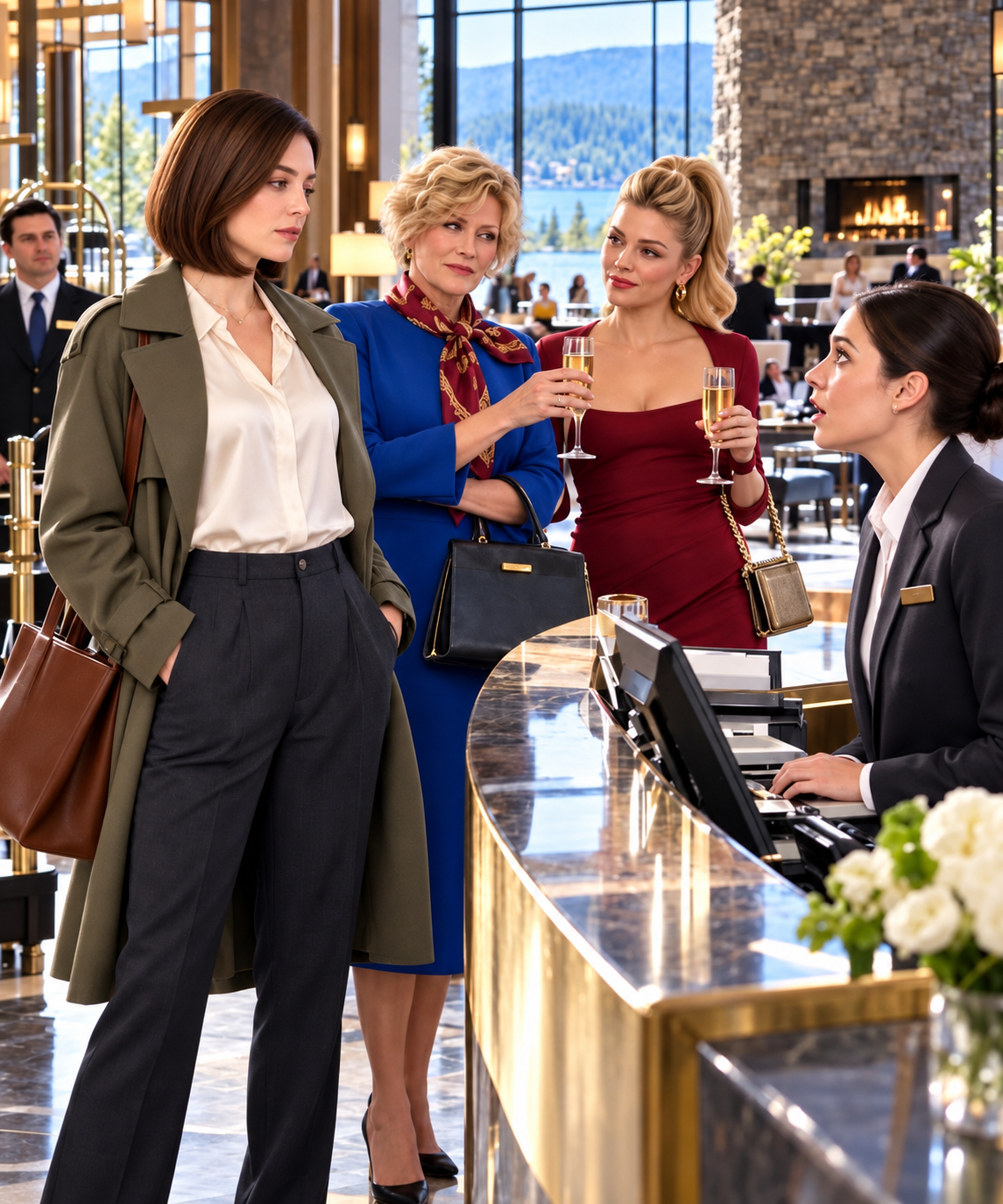
Inside, the lobby still took my breath away.
The vaulted ceiling stretched several stories overhead. Massive wooden beams crossed above us. A giant stone fireplace stood in the center, and the western wall was entirely glass, revealing the lake beyond.
“Impressive, isn’t it?” Vanessa said.
She slowly turned in a circle.
“You should pay attention, Maya. This is what real success looks like.”
She smiled.
“Not clocking into some freezing warehouse every morning.”
“I’m glad you like it.”
Mom adjusted the silk scarf around her neck.
“I warned you years ago that those unrealistic business dreams would catch up with you.”
She nodded toward Vanessa.
“Your sister handles multimillion-dollar properties.”
Then she touched her own chest.
“I built a respected consulting company.”
Finally, she looked at me.
“And you move cardboard boxes.”
Before I could answer, a server approached with complimentary champagne.
Vanessa took three glasses.
She gave one to Mom and kept one for herself.
Then she looked at the third.
“Oh, Maya.”
She pulled it back dramatically.
“I forgot. You probably don’t want to worry about tipping at a place like this.”
“The champagne is complimentary,” I said.
Vanessa laughed.
“Perfect. Free things have always fit your budget.”
I smiled.
There was no reason to argue.
Mom marched toward reception.
A young employee named Jessica stood behind the desk.
“Good afternoon,” Mom began. “We’re here for the Williams family reservation, and I’d like to discuss upgrading—”
Jessica looked up.
Then she saw me.
She immediately stood.
“Ms. Williams!”
Mom stopped speaking.
Vanessa lowered her champagne glass.
“Hello, Jessica,” I said.
Mom looked between us.
“You know her?”
Before I could respond, Daniel, the general manager, crossed the lobby quickly.
“Ms. Williams. Welcome back.”
He walked straight past my mother and sister.
Mom frowned.
Daniel opened the folder in his hands.
“We need your authorization regarding the family reservation.”
Mom blinked.
“Her authorization?”
Daniel looked confused.
“Yes.”
“Why would my daughter need to authorize my reservation?”
Daniel glanced at me.
I could see the exact moment he realized they didn’t know.
I finally answered.
“Because Azure Heights belongs to my company.”
Silence.
Vanessa stared at me.
Mom actually laughed.
Not because she found it funny.
Because she believed I was joking.
“Your company?”
“Yes.”
Vanessa folded her arms.
“What company?”
“NorthPeak Holdings.”
Her expression changed.
She knew the name.
Anyone working in commercial real estate did.
NorthPeak owned distribution centers, commercial property, restaurants, and several boutique hotels across five states.
Vanessa’s face lost its color.
“No.”
I nodded.
“Yes.”
“But the founder of NorthPeak is M. Williams.”
“That’s me.”
Mom stared at me.
“You own NorthPeak?”
“I founded the logistics division thirteen years ago.”
Vanessa looked genuinely stunned.
“You said you worked in a warehouse.”
“I did.”
“As what?”
“Everything.”
I shrugged.
“Loader. Driver. Supervisor. Operations manager. Owner.”
Daniel wisely remained silent.
Mom’s expression hardened.
“You let us believe you were struggling.”
“No.”
My voice remained calm.
“You decided I was struggling. I stopped correcting you.”
“That’s the same thing.”
“It really isn’t.”
Vanessa suddenly looked toward the lobby around us.
“So you own this entire resort?”
“NorthPeak Hospitality owns it. I’m the majority shareholder of NorthPeak.”
She stared at the fireplace.
The reception desk.
The chandeliers.
The lake.
Everything she had spent the last twenty minutes using as evidence of her superior lifestyle.
Then she asked quietly:
“Why does he need your approval for our reservation?”
Daniel cleared his throat.
“There’s an issue with the payment authorization.”
Mom turned toward him immediately.
“What issue?”
Daniel showed me the paperwork.
I recognized the problem.
Mom had booked three villas for the family reunion but had only paid the initial deposit.
The remaining balance was due that afternoon.
Apparently her business card had been declined twice.
Daniel had planned to ask whether I wanted the resort to extend the payment deadline as a courtesy because they were my relatives.
Mom’s face reddened.
“That card should work.”
Daniel remained professional.
“It was declined by the issuing bank.”
Vanessa looked embarrassed.
Mom turned to me.
“Well, obviously there’s been a mistake.”
“Probably.”
“You can tell them to keep the reservation.”
“I can.”
She relaxed slightly.
Then Vanessa smiled nervously.
“See? Problem solved.”
I looked at Daniel.
“Give them until tomorrow morning to resolve the payment.”
Mom’s head snapped toward me.
“Tomorrow morning?”
“That’s the standard courtesy extension.”
“You own the place.”
“Yes.”
“Then why should we have to pay?”
That sentence changed everything.
For years, I had wondered whether knowing the truth would change the way my family treated me.
Now I had my answer.
They didn’t apologize.
They simply changed what they expected from me.
Vanessa recovered quickly.
“Well, since you own it, we should probably move into the presidential villas.”
Mom nodded.
“And dinner should be arranged privately. We’re family.”
I stared at both of them.
Ten minutes earlier, they had mocked me for supposedly being too poor to afford champagne.
Now they wanted free luxury accommodation.
“No.”
Vanessa blinked.
“No?”
“You booked lakeview villas. That’s what you’ll receive after payment.”
Mom lowered her voice.
“Maya, don’t embarrass us.”
“I’m not embarrassing anyone.”
“You could give your own mother a better room.”
“I could.”
“Then do it.”
I looked at her for a long moment.
“When you thought I was a warehouse employee, you suggested I stay at a cheaper hotel twenty minutes away.”
Mom looked away.
“When Vanessa thought I couldn’t afford champagne, she mocked me in the middle of the lobby.”
Vanessa crossed her arms.
“It was a joke.”
“It wasn’t.”
Neither of them answered.
I handed the folder back to Daniel.
“Keep their original reservation. No complimentary upgrades.”
“Of course.”
“And charge the same rates every other guest pays.”
Mom looked furious.
“You would treat your own family like strangers?”
“No.”
I shook my head.
“I’m treating you like guests.”
Then I walked toward the elevator.
The reunion lasted three days.
It was the strangest family weekend of my life.
By dinner that evening, every relative knew.
An uncle I hadn’t heard from in six years suddenly wanted investment advice.
A cousin asked whether I could help him find a job.
Vanessa spent most of Friday avoiding me.
Mom barely spoke.
On Saturday morning, I found her alone on the terrace overlooking the lake.
For once, she wasn’t wearing the confident expression she showed everyone else.
“Why didn’t you tell me?” she asked.
“I tried.”
“When?”
“Years ago.”
She frowned.
I reminded her.
The dinner when I told her we had signed our first major distribution contract.
The Christmas when I mentioned buying a second warehouse.
The phone call when I told her we were expanding into commercial property.
Every time, she had dismissed it.
“That warehouse thing again.”
That was always her response.
Eventually, I stopped sharing.
Mom stared across the water.
“I thought you were wasting your life.”
“I know.”
“I thought Vanessa was the successful one.”
“This isn’t about Vanessa.”
“She always seemed so polished.”
“And I wore work boots.”
Mom gave a small, uncomfortable smile.
“I suppose I judged appearances.”
“You judged more than appearances.”
She looked at me.
I continued.
“You treated my work as something embarrassing. Not because you knew what I earned. Not because you knew what I had built. You simply thought warehouse work made me less successful.”
Mom looked down at her hands.
“I was wrong.”
It was the first time I had ever heard her say those words.
Then she added:
“I’m sorry.”
I didn’t immediately forgive thirteen years of condescension.
But I appreciated the apology.
Vanessa’s came later.
Much later.
That evening she found me walking near the marina.
“I checked,” she admitted.
“Checked what?”
“NorthPeak.”
I laughed.
“Of course you did.”
Her cheeks reddened.
“I thought maybe you owned a small percentage.”
“I figured.”
She kicked lightly at a pebble.
“Your company purchased a building I sold two years ago.”
“I know.”
Vanessa stopped walking.
“You knew?”
“I approved the acquisition.”
For once, my sister had absolutely nothing to say.
Finally, she laughed.
A genuine laugh.
“I might actually die of embarrassment.”
“You’ll survive.”
She became serious.
“I was awful to you.”
“Yes.”
“I’m sorry.”
I looked at her.
“You don’t need to respect me because you discovered I have money.”
She nodded slowly.
“I know.”
“You should have respected me when you thought I loaded boxes for a living.”
That hurt her more than anything else I could have said.
Because she knew it was true.
After the reunion, things changed.
Not magically.
Mom still cared too much about appearances.
Vanessa still loved expensive things and liked talking about her deals.
But they stopped using job titles as a measure of someone’s value.
And they never again made jokes about warehouse workers around me.
Three months later, Vanessa called.
One of her clients needed a large distribution facility.
“Do you know anyone in industrial logistics?” she asked.
I smiled.
“A few people.”
Before hanging up, she added:
“And Maya?”
“Yes?”
“For what it’s worth, I think what you built is incredible.”
I looked through my office window at the warehouse where everything had started.
Workers in reflective vests moved shipments across the floor.
Forklifts beeped.
Trucks lined up at the loading bays.
Thirteen years earlier, my mother had looked at that world and seen failure.
I had looked at it and seen a beginning.
That was the difference.
Success had never been about marble floors, luxury resorts, designer clothes, or impressive titles.
Sometimes success wore steel-toed boots.
Sometimes it worked overnight.
Sometimes it carried boxes.
And sometimes the person everyone underestimated was quietly building the very place they were using to look down on her.