I was nineteen, terrified, and not even three weeks into my pregnancy when I finally told my parents the truth.
The moment the words left my mouth, I knew my life would never be the same.
We were sitting in the living room of our modest Ohio home. My hands trembled around the positive pregnancy test. My mother, Eleanor, stared at it as though it were something dangerous, while my father, Richard, slowly leaned forward in his recliner.
“Who’s the father?” he asked.
I swallowed.
“I can’t tell you.”
The room went completely silent.
My mother’s face changed first.
“What do you mean you can’t tell us?” she demanded. “Is he married? Is he older than you? Is he some criminal?”
“No.”
“Then tell us his name.”
“I can’t.”
My father stood.
His expression hardened in a way I had never seen before.
“As long as you live in this house, you follow our rules,” he said. “You are nineteen years old. You have no degree, no money, and no idea how to raise a child.”
“I know.”
“Then you know what has to happen.”
My stomach twisted.
“No.”
His eyes narrowed.
“No?”
“I’m keeping my baby.”
My mother covered her mouth.
My father’s voice rose.
“You’re throwing your entire future away!”
“You don’t understand.”
“Then explain it!”
I stared at both of them, fighting tears.
“I can’t explain everything right now. But if I end this pregnancy, it won’t just affect me. One day you’ll understand.”
That sentence made everything worse.
My father pointed toward the hallway.
“You have one hour.”
I thought I had misunderstood him.
“For what?”
“To pack.”
“Dad…”
“Either you make the responsible decision, or you get out of my house.”
My mother whispered his name.
“Richard…”
But she didn’t stop him.
Forty-eight minutes later, I was standing on the porch with a duffel bag, $143 in my checking account, and nowhere to go.
My mother stood behind the screen door crying.
My father wouldn’t even look at me.
I remember placing one hand over my stomach and thinking that my baby was smaller than a seed.
Then I walked away.
That was the last time I saw my parents for ten years.
I stayed with a friend for several weeks before leaving Ohio altogether.
I changed my phone number.
I found a tiny apartment in Indiana above a laundromat where the pipes knocked all night and the windows leaked cold air every winter.
I worked mornings at a diner and evenings at a grocery store.
When my daughter was born, I named her Grace.
Because after everything that had happened, that was what she felt like.
Grace.
Something beautiful that had arrived in the middle of chaos.
The first few years nearly broke me.
There were nights when I ate toast for dinner so Grace could have fruit and milk.
I attended community college during the day and worked whenever I could find someone trustworthy to watch her.
I studied after she fell asleep.
Sometimes I woke up at two in the morning with my face resting on an open textbook.
Eventually, I earned my nursing degree.
Then I became a registered nurse.
By the time Grace was seven, we had moved into a small house with a blue front door and a maple tree in the backyard.
We weren’t wealthy.
But we were safe.
And we were happy.
Grace grew into an intelligent, observant child with dark brown eyes and a strange habit of noticing when adults were lying.
She also began asking questions.
“Do I have grandparents?”
“Yes.”
“Where are they?”
“Ohio.”
“Why don’t we visit them?”
At first, I gave her vague answers.
“It’s complicated.”
“They live far away.”
“Maybe someday.”
But children grow.
And eventually, “someday” stops being enough.
On Grace’s tenth birthday, after the cake had been eaten and the last guest had left, she climbed onto the couch beside me.
“Mom?”
“Yes?”
“I want to meet Grandma and Grandpa.”
I stared at her.
She had never asked so directly before.
“Why now?”
She shrugged.
“Because they’re getting older. And I don’t want you to wait until it’s too late and then wish you hadn’t.”
The words hit me harder than she could have known.
Grace was right.
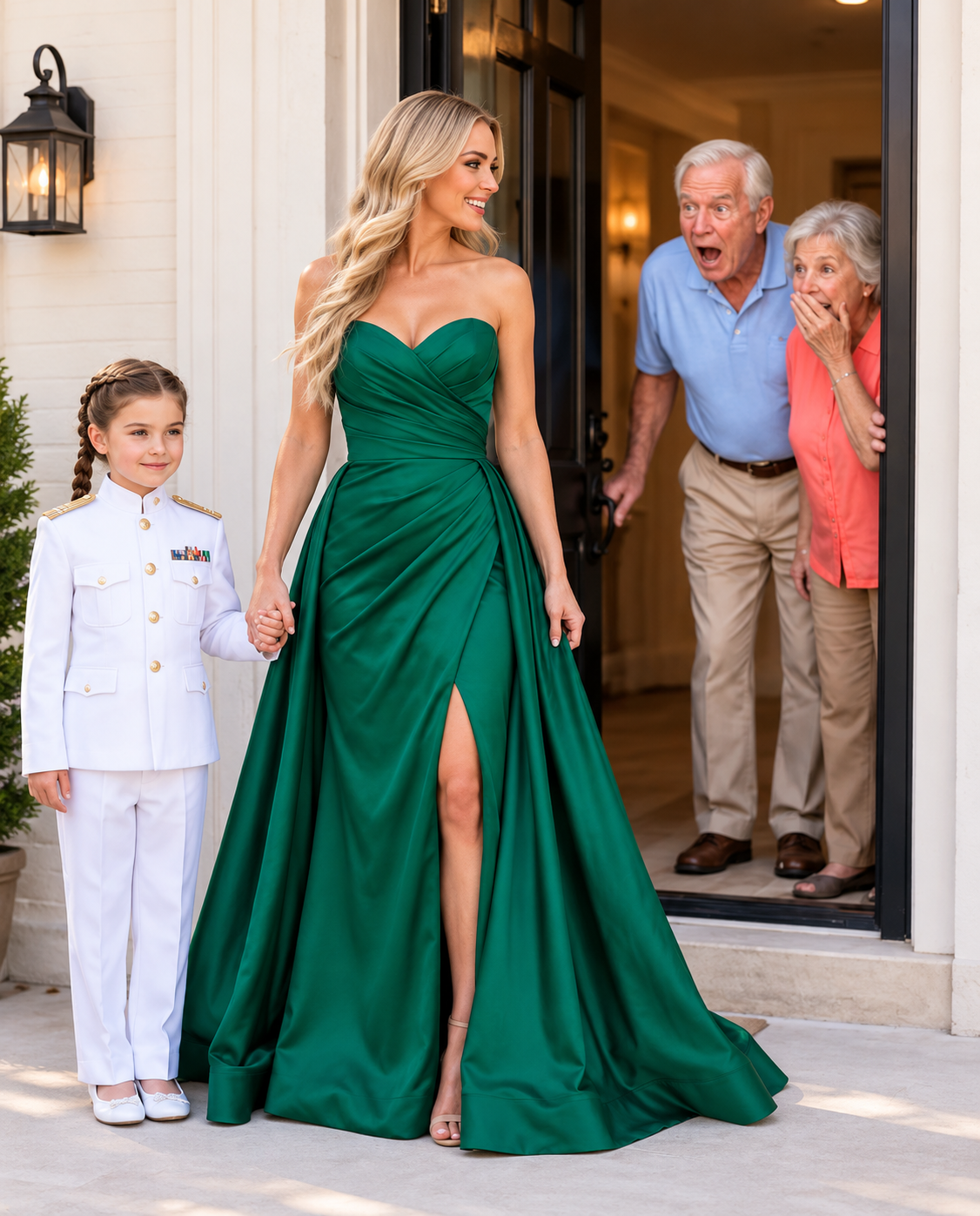
So two weeks later, we packed an overnight bag and drove eight hours back to Ohio.
My parents had no idea we were coming.
The neighborhood looked smaller than I remembered.
The oak tree in the front yard was taller.
The porch railing had been repainted.
But the house was the same.
The same house I had left at nineteen with a duffel bag and a secret.
I stood at the door for almost a minute before knocking.
Footsteps approached.
Then the door opened.
My father stared at me.
For several seconds, he said nothing.
“Evelyn?”
I hadn’t heard him say my name in ten years.
My mother appeared behind him.
She had more gray in her hair now.
Then she saw Grace.
Her hand flew to her mouth.
“Oh my God.”
Grace moved slightly closer to me.
I took her hand.
“This is Grace.”
My mother’s eyes filled with tears.
My father simply stared.
Grace had my smile.
But everything else about her face came from her father.
Especially her eyes.
And my parents recognized them.
That was when my father’s hands began to shake.
“Come inside,” my mother whispered.
We sat in the same living room where everything had fallen apart a decade earlier.
Nobody knew where to begin.
Finally, my father looked at me.
“You said you came to tell us the truth.”
“I did.”
“About her father?”
“Yes.”
Grace looked at me.
I had already explained that there were parts of the story she would hear for the first time too.
I reached into my bag and removed a worn envelope.
Inside was a photograph.
I placed it on the coffee table.
My mother gasped.
My father went pale.
The photograph showed a nineteen-year-old boy standing beside me at our high school graduation.
His name was Daniel Mercer.
My father stared at it.
“No.”
I nodded.
“Yes.”
Daniel had practically grown up in our house.
His father, Thomas Mercer, had been my father’s best friend for more than twenty years.
Our families spent holidays together.
Daniel and I had been friends since childhood.
Then, during our senior year, that friendship became something more.
We kept it secret because both families had always treated us like siblings, and we were terrified of how they would react.
But that wasn’t the reason I had refused to name him ten years earlier.
The truth was much worse.
Three weeks before I discovered I was pregnant, Daniel had died in a car accident.
My mother began crying instantly.
Everyone in town remembered that accident.
Daniel had been driving home from a summer job when another vehicle crossed the center line during heavy rain.
He died at the scene.
I had attended his funeral knowing I was late but not yet knowing why.
Four days later, I took the pregnancy test.
“I wanted to tell you,” I said quietly. “But Daniel’s mother begged me not to.”
My father frowned.
“What?”
I opened the envelope again and removed a letter.
“After Daniel died, his mother found his journal. He had written about us. She came to see me before I told you I was pregnant.”
My mother wiped her tears.
“Why would she tell you to hide it?”
“Because Daniel’s father didn’t know.”
My father stared at me.
I continued.
“Thomas had been drinking heavily after Daniel died. He blamed himself for letting Daniel drive in the storm. Daniel’s mother was terrified that learning about the pregnancy would push him over the edge.”
My father closed his eyes.
“But that’s not the entire secret.”
He looked at me again.
I placed another document on the table.
It was a DNA report.
My father’s face went blank.
“What is this?”
“Three years ago, Grace needed additional genetic testing after a routine medical screening. Nothing was wrong, but the results showed something unexpected.”
My mother looked from the document to me.
“What?”
I took a breath.
“Daniel wasn’t Thomas Mercer’s biological son.”
Silence.
My father stared at me.
Then his eyes moved toward Grace.
I could see the moment he understood.
“No.”
My mother whispered, “Richard?”
My father stood so suddenly his knees struck the coffee table.
I continued before I lost my courage.
“The genetic results showed that Grace was closely related to someone in our family in a way that couldn’t be explained through me alone.”
My mother looked terrified.
I turned toward my father.
“Dad, Daniel was your biological son.”
My mother made a broken sound.
My father looked as though the room had tilted around him.
“That’s impossible.”
“I thought so too.”
I handed him another letter.
It had been written by Daniel’s mother, Susan, six months before she died of cancer two years earlier.
She had contacted me after Grace’s genetic results raised questions.
Susan confessed everything.
Twenty years before Daniel was born, during a brief separation between my parents, she and my father had spent one night together.
My father had never known she became pregnant.
Susan had reconciled with Thomas before discovering the pregnancy, and Thomas had assumed Daniel was his child.
She never corrected him.
My mother slowly sat down.
“I remember that separation,” she whispered.
My father’s face had gone gray.
I quickly said the part that mattered most.
“Daniel and I were not biologically related.”
Both my parents stared at me.
I explained that I was adopted.
That was another secret my parents had kept from me until I accidentally discovered the paperwork when I was seventeen.
They had asked me never to mention it outside the family.
Daniel had been my father’s biological son.
But I had no biological relationship to Richard.
Grace was not the result of incest.
She was simply my daughter and Richard’s biological granddaughter.
And that was why, at nineteen, I had told my parents that ending my pregnancy would affect all of us.
I had known only part of the truth then.
Susan had told me shortly after Daniel’s funeral that she believed Richard might be Daniel’s biological father.
She begged me for time before revealing it.
I had been terrified that telling my parents would destroy two families while everyone was grieving.
Then my father gave me an ultimatum before I had the courage to explain.
“I tried to tell you there was more to the story,” I whispered. “But you gave me one hour.”
My father sank into his chair.
For a long time, nobody spoke.
Finally, he looked at Grace.
“My son had a daughter.”
Grace watched him carefully.
“Yes,” I said.
Tears filled his eyes.
Then he looked at me.
“And I threw both of you away.”
I could have told him it was okay.
But it wasn’t.
I had spent too many years pretending the past didn’t hurt.
“You did,” I said.
My mother started crying harder.
“We were scared,” she said. “We thought you were ruining your life.”
“So you decided to ruin it for me?”
She had no answer.
“I needed parents,” I continued. “I needed help. I needed someone to tell me we would figure it out together. Instead, you gave me a duffel bag and a deadline.”
My father lowered his head.
“I was wrong.”
It was the first apology I had ever heard him give without an excuse attached.
“I was cruel. And I was wrong.”
Grace squeezed my hand.
Then she surprised all of us.
“Mom says forgiving someone doesn’t mean pretending they didn’t hurt you.”
My father looked at her.
“She’s right.”
“And it doesn’t mean everything becomes normal right away.”
“No,” he whispered. “It doesn’t.”
Grace thought about that.
“But people can try?”
My father’s face crumpled.
“If they’re allowed to.”
I looked at my daughter.
Then at my parents.
“I didn’t come here to punish you,” I said. “And I didn’t come here to erase what happened. I came because Grace deserved the truth.”
My mother nodded.
“And what happens now?”
“Now you earn whatever relationship we build.”
There would be no instant happy ending.
No magical dinner that erased ten years.
But something began that afternoon.
My parents started calling once a week.
At first, the conversations were awkward.
Then they became easier.
My father attended therapy after learning the truth about Daniel.
He later met with Thomas Mercer and told him everything.
Thomas was devastated, but he said something my father never forgot.
“I raised Daniel. You gave him life. Both things can be true.”
Grace began exchanging letters with Thomas too.
To her, he was another grandfather.
A year later, my parents visited our home for Grace’s eleventh birthday.
My father stood in my kitchen watching her decorate cupcakes.
At one point, she laughed.
He froze.
“What?” I asked.
He smiled sadly.
“Daniel laughed exactly like that.”
For the first time, hearing his name didn’t feel like reopening a wound.
It felt like keeping someone alive.
Before my parents left, my father handed me an old photograph.
It showed Daniel at six years old, sitting on the porch steps of our house with a missing front tooth and grass stains on both knees.
On the back, my father had written:
For Grace.
So she knows where part of her story began.
I kept the photograph.
Not because everything was forgiven.
Not because the past had disappeared.
But because I had finally learned something important.
Family is not defined only by blood.
And forgiveness is not the same as forgetting.
Sometimes the bravest thing you can do is return to the door that once closed behind you—not to beg to be let back in, but to show the people on the other side who you became without them.
Ten years earlier, I had left that porch as a frightened pregnant teenager carrying one bag.
When I returned, I was a nurse, a mother, and a woman who had built a life with her own hands.
And beside me stood Grace.
The child they once demanded I give up.
The child who turned out to be the final living piece of a son my father never knew he had.
My parents had believed my pregnancy would destroy my future.
Instead, Grace became the reason I fought for one.