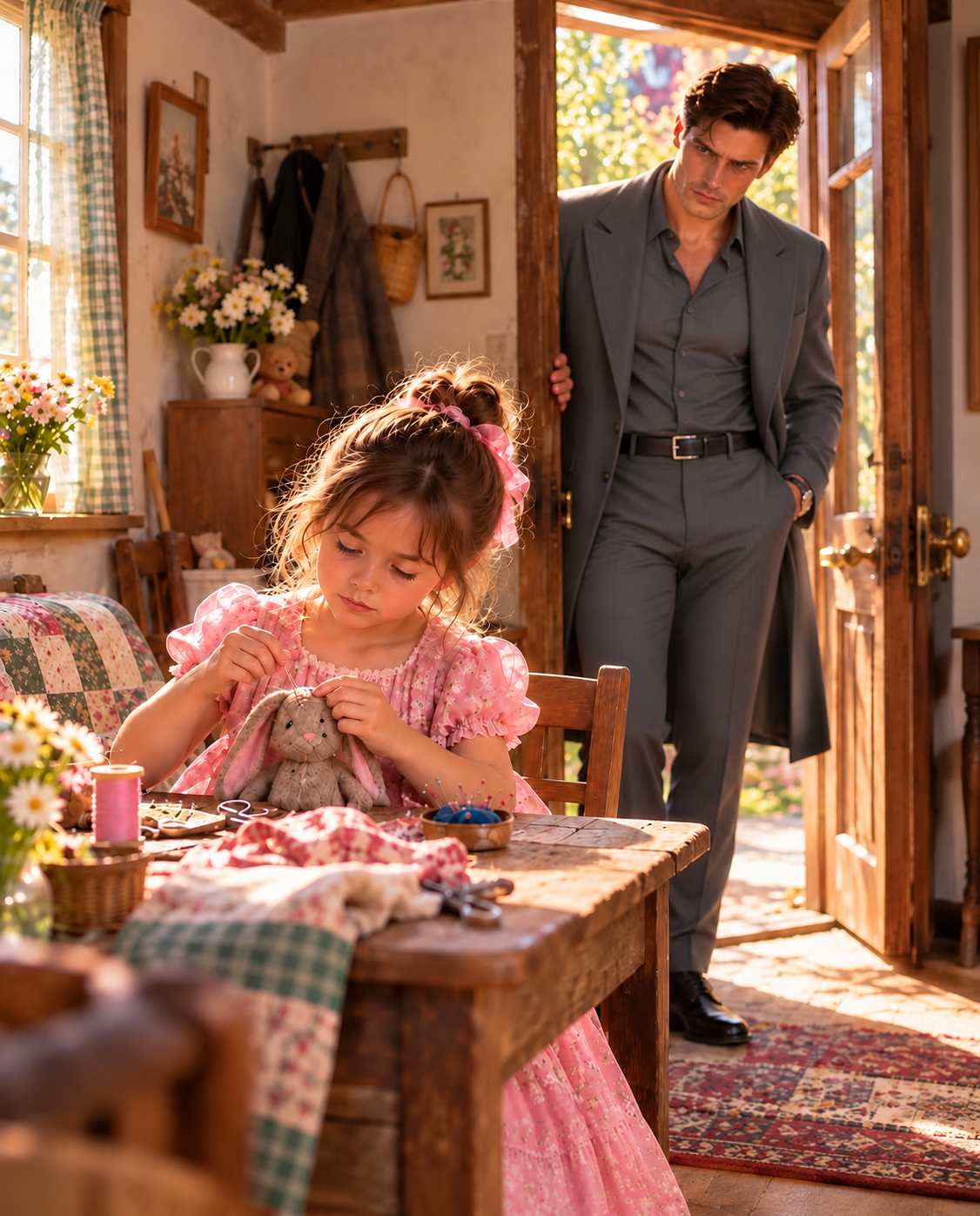
I Went to Evict a Woman Who Owed Me Three Months’ Rent—Then Her Daughter Opened the Door With Bleeding Fingers
My name is Nathan Moretti.
In Chicago, people knew my name.
More importantly, they knew what happened when someone owed me money.
I owned restaurants, clubs, apartment buildings, warehouses, and several businesses that were better left off official paperwork. I had spent thirty years building an empire from almost nothing, and I had survived by following one rule.
Debts got paid.
No excuses.
No stories.
No second chances.
Apartment 4B owed me three months’ rent.
The property manager had already sent notices. Calls had gone unanswered. Promises had been made and broken.
So on a freezing Tuesday afternoon, I decided to handle it myself.
I expected tears.
Maybe excuses.
Possibly an argument.
I did not expect a seven-year-old girl to open the door.
She was tiny, with tangled brown hair falling across a pale face. An oversized sweatshirt hung from her shoulders, and her fingertips were wrapped in scraps of tissue.
Several of them were bleeding.
I looked down at her.
“Where’s your mother?”
The girl hesitated.
“She’s sick.”
“What’s your name?”
“Lily.”
I glanced past her into the apartment.
It was painfully clean but nearly empty.
A mattress lay on the living-room floor.
Medicine bottles covered a small table.
The refrigerator door stood slightly open, showing half a carton of milk, mustard, and two apples.
Near the window sat an old sewing machine.
“What happened to your fingers?” I asked.
Lily hid her hands behind her back.
“Nothing.”
I knew enough frightened people to recognize a lie.
“And the rent?”
Her expression changed immediately.
“I have some.”
She ran toward the kitchen and returned with a crumpled white envelope.
She handed it to me with both hands.
Inside were twenty-dollar bills, ones, and loose change.
Forty-three dollars.
I stared at her.
“The rent is nearly four thousand dollars.”
“I know.”
“Where did this come from?”
“I made it.”
I looked toward the sewing machine.
Lily pointed at it.
“Mrs. Alvarez downstairs gives me five dollars to fix buttons. Mr. Coleman gives me money when I sew his work shirts. Sometimes people leave clothes outside the door.”
“You do the sewing?”
She nodded.
“My mom showed me before she got too sick.”
She walked back to the machine, climbed onto a wooden chair, and began feeding a torn sleeve beneath the needle.
Her legs were too short to comfortably reach the pedal.
She stretched one foot down.
The machine rattled.
Then the needle came down.
Lily jerked.
A bright drop of blood appeared on her finger.
She wiped it on her sweatshirt and immediately reached for the fabric again.
“Stop.”
She looked at me.
“I have to finish.”
“No, you don’t.”
“Mom needs medicine.”
Something inside me tightened.
For a moment, the apartment disappeared.
I was nine years old again.
I saw my mother, Elena Moretti, sitting beneath a yellow kitchen light in our tiny apartment on the South Side.
She used to sew dresses for wealthy women who never knew her name.
Night after night, she bent over an old machine until her back hurt and her eyes burned.
Whenever I asked whether we were poor, she smiled.
“We have each other, Nate. That makes us rich.”
I hadn’t thought about that sentence in years.
I took several hundred-dollar bills from my wallet and placed them on the table.
Lily stared at them.
“I can’t take that.”
“Yes, you can.”
“Mom says we don’t take money we didn’t earn.”
“Then consider it payment for the shirt you just bled on.”
For the first time, Lily almost smiled.
Then I looked toward the closed bedroom door.
“I need to speak to your mother.”
The smile disappeared.
“No.”
Her answer came too quickly.
I narrowed my eyes.
“Why?”
Lily stepped between me and the hallway.
“Mom said if Mr. Moretti ever came here, I couldn’t let him see her.”
My hand went still.
“What exactly did she say?”
Lily swallowed.
“She said you must never know we were here.”
Before I could ask another question, something crashed inside the bedroom.
A glass, maybe.
Then came a weak cough.
I stepped toward the hallway.
Lily grabbed my sleeve.
“Please.”
I looked down at her frightened face.
Then I heard a woman’s voice from behind the door.
“Nate?”
I stopped breathing.
Nobody called me Nate anymore.
Not my employees.
Not my friends.
Not even my sister.
Nathan was the businessman.
Mr. Moretti was the landlord.
Moretti was the name people whispered when they were afraid.
Only people from another life called me Nate.
I opened the bedroom door.
A woman lay beneath a thin gray blanket.
She was pale and painfully thin.
Her hair, once dark and thick, was streaked with silver.
But the eyes were the same.
Green.
Defiant.
Unforgettable.
“Sarah?”
Her lips trembled.
“Hello, Nate.”
Thirty years collapsed between us.
Sarah Bennett.
The girl I had loved before money.
Before power.
Before my name became something people feared.
The girl who had disappeared without saying goodbye.
I took one step into the room.
Then something beside the bed caught my eye.
The sewing machine.
Not just any sewing machine.
Carved into the wooden base was a tiny silver rose.
My mother’s mark.
I crossed the room and touched it.
My mother had carved that rose herself.
She had sold the machine thirty years earlier, when we desperately needed money.
The same week Sarah vanished.
I slowly turned.
“How did you get this?”
Sarah closed her eyes.
“Your mother gave it to me.”
“No.”
“She did.”
“My mother told me she sold it.”
“She lied.”
I felt the old anger rise.
“Why?”
Sarah looked toward the doorway.
Lily stood there, watching us.
Then Sarah whispered, “Because she wanted me to leave Chicago.”
The room became completely silent.
“Why would my mother do that?”
Sarah’s eyes filled with tears.
“Because I was pregnant.”
I stared at her.
For several seconds, I couldn’t understand the words.
Then my eyes moved toward Lily.
Seven years old.
The numbers didn’t make sense.
Sarah noticed.
“She isn’t your daughter.”
I exhaled.
But Sarah wasn’t finished.
“She’s your granddaughter.”
The floor seemed to shift beneath me.
“What?”
Sarah looked at Lily.
“Sweetheart, would you give us a minute?”
Lily hesitated.
“It’s okay.”
The girl quietly left the room.
Sarah waited until the door closed.
Then she looked directly at me.
“Thirty years ago, when I disappeared, I was pregnant with your son.”