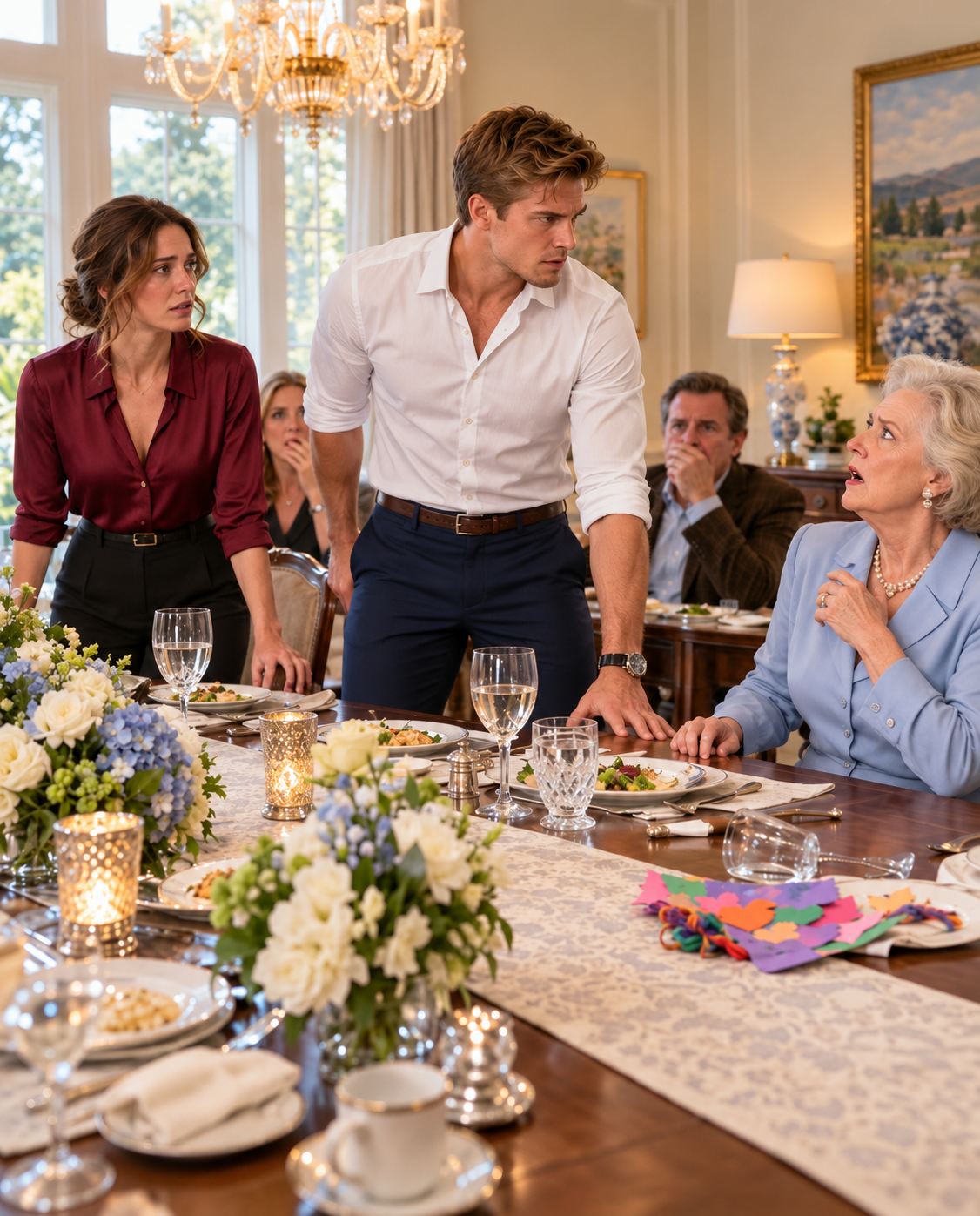
My mother pushed my six-year-old daughter’s handmade card away from her plate as though it were something dirty.
“I told you already,” she said, loud enough for everyone at the dinner table to hear. “Children from poverty don’t call me Grandma.”
For several seconds, nobody moved.
My daughter Lily was still standing beside her chair, one small hand stretched toward the card she had spent two evenings making.
Pink construction paper.
Crayon flowers.
A crooked red heart.
And inside, written in careful six-year-old handwriting:
I love you, Grandma.
Lily slowly pulled her hand back.
Her eyes filled with tears.
“Mommy,” she whispered, “did I make it wrong?”
Something inside me went cold.
“No, sweetheart,” I said, standing. “You made it perfectly.”
My mother, Margaret, took a sip of wine as though nothing unusual had happened.
My father stared down at his plate.
My sister looked uncomfortable but said nothing.
Only my fifteen-year-old son, Ethan, kept staring directly at his grandmother.
And the expression on his face told me something was about to happen.
My mother had never approved of my husband, Daniel.
When we met, Daniel was working as an electrician for the city. He was hardworking, kind, and dependable.
But none of that mattered to Mom.
Daniel had grown up in foster care.
To my mother, that was enough to make him unsuitable.
“You don’t know where people like that come from,” she once told me.
I had answered, “I know exactly where Daniel came from. He came from a difficult childhood and built a good life anyway.”
She never forgave me for marrying him.
Years later, when Daniel and I decided to adopt Lily, her attitude became even worse.
Lily had been four when she came into our family permanently.
She had enormous brown eyes, a shy smile, and a habit of holding my hand whenever she entered a room full of strangers.
From the beginning, Ethan adored her.
He called her his little shadow because she followed him everywhere.
He taught her how to ride a bicycle.
He read bedtime stories when Daniel and I were exhausted.
When Lily had nightmares, Ethan was sometimes the first person she called.
To Ethan, there was never any difference between his biological family and his adopted sister.
To my mother, there was.
Mom never openly announced that Lily wasn’t part of the family.
Instead, she found smaller ways to make sure Lily understood.
She forgot Lily’s birthday while remembering every birthday of my sister’s children.
She attended Ethan’s school events but always had an excuse when Lily performed.
At Christmas, she bought expensive presents for the other grandchildren and gave Lily a sweater that still had the clearance sticker attached.
When I confronted her, she always gave the same response.
“You’re too sensitive.”
Eventually, I stopped expecting anything from her.
But Lily didn’t understand adult cruelty.
She still wanted my mother to love her.
That was why she made the card.
The dinner was being held at my parents’ home for my father’s seventieth birthday.
I had almost refused to attend.
Then Ethan surprised me.
“Let’s go,” he said.
“Why?”
He shrugged.
“Maybe Grandma will finally behave normally.”
There had been something strange about his tone, but I didn’t question it.
Now, watching him across the dinner table, I realized he had known something I didn’t.
My father finally spoke.
“Margaret, that was unnecessary.”
Mom put down her glass.
“What exactly was unnecessary?”
“What you said to Lily.”
My mother sighed dramatically.
“I’m being honest. Family has standards.”
That was enough.
I pushed my chair back.
“We’re leaving.”
Daniel immediately stood.
Lily looked at the rejected card.
“Can I take it?”
I bent down and picked it up.
“Of course.”
But before we could move, Ethan stood.
He didn’t shout.
He didn’t look angry.
He simply looked at my mother and said:
“She owns this house.”
My mother froze.
I stared at my son.
“What did you say?”
Ethan reached inside his jacket and removed a thick folder.
He placed it on the dining table directly beside Lily’s handmade card.
My mother’s face suddenly lost its color.
Dad frowned.
“Ethan, what is this?”
“Open it.”
My father pulled the folder toward him.
The first document was a copy of a property deed.
He read the first page.
Then the second.
His expression changed completely.
“Where did you get this?”
“Grandpa’s attorney.”
That was when I remembered the meeting.
Two months earlier, Ethan had asked me if he could attend a meeting with my late grandfather’s attorney.
Grandpa had died the previous spring.
He and Ethan had always been close, and Grandpa had left Ethan money for his education.
I assumed the meeting concerned that inheritance.
Apparently, I had been wrong.
Dad looked at me.
“The house isn’t in your mother’s name.”
Mom slammed her hand against the table.
“Of course it is!”
Dad slowly shook his head.
“It belongs to a trust.”
My heart started pounding.
“For whom?”
He looked toward Lily.
“For her.”
Nobody spoke.
My six-year-old daughter stood beside me clutching my hand, completely unaware of what everyone was discussing.
My mother laughed, but there was panic underneath it.
“That’s ridiculous.”
Ethan removed another sheet from the folder.
“It isn’t.”
He placed it in front of her.
“Grandpa transferred ownership years ago. You and Grandpa were allowed to live here, and after he died, Grandma and Grandpa’s legal beneficiaries could continue living here under the conditions of the trust.”
Mom’s lips tightened.
“My father would never leave this house to an adopted child.”
Ethan’s voice changed.
Not louder.
Just colder.
“He did.”
Then he removed an envelope.
The handwriting on the front was unmistakable.
It belonged to my grandfather.
The envelope said:
For Lily, when the truth about the house becomes necessary.
My father opened it.
Inside was a handwritten letter.
He read silently for almost a minute.
Then he looked toward my mother.
“You need to hear this.”
Mom said nothing.
Dad began reading.
“My dear Lily,
You came into our family by choice rather than by blood, but I have lived long enough to understand that blood is one of the least important things that makes a family.
Family is the person who stays.
The person who protects you.
The person who makes room for you at the table.
And the person who never makes a child feel she must earn the right to be loved.
I have watched you bring happiness into this family.
You deserve to know that there will always be one place where nobody can tell you that you do not belong.
For that reason, this house will belong to your trust.”
My mother stood abruptly.
“That’s enough.”
Dad continued.
“There are conditions.”
Mom turned toward him.
“What conditions?”
Ethan already knew.
“The beneficiary and her guardians cannot be deliberately excluded, harassed, threatened, or prevented from accessing the property.”
Mom stared at him.
“You’re trying to throw me out of my own home?”
I finally found my voice.
“No.”
She turned toward me.
“This is exactly what you’ve wanted, isn’t it?”
I almost laughed.
“What I wanted?”
I held up Lily’s little pink card.
“All she wanted tonight was for you to accept this.”
Mom looked away.
“This has nothing to do with the house.”
“You’re right,” I said. “It doesn’t.”
I stepped closer.
“This is about three years of you pretending my daughter is less important than the other grandchildren.”
“That isn’t true.”
“You forgot her birthdays.”
“I’m busy.”
“You skipped her school play.”
“I had another commitment.”
“You bought every grandchild a Christmas present except her.”
“I didn’t know what she wanted.”
“She wanted to belong.”
My mother went silent.
Then a voice came from behind me.
“She noticed everything.”
It was Ethan.
Mom looked at him.
He continued.
“Every time you treated Lily differently, she asked me why.”
His jaw tightened.
“She thought something was wrong with her.”
For the first time that evening, my mother looked genuinely shaken.
Ethan pointed toward the card.
“She spent two days making that for you.”
Mom whispered, “Ethan, you don’t understand.”
“No,” he said. “I understand perfectly.”
He looked around the room.
“I’m the biological grandchild. I’m the one Grandma always treated well.”
Then he looked at Lily.
“And that’s exactly why I should have said something sooner.”
Lily squeezed my hand.
My father suddenly pushed back his chair.
Everyone turned toward him.
My father had spent most of his marriage avoiding confrontation.
When Mom was cruel, he changed the subject.
When she insulted someone, he tried to smooth things over.
That night, for the first time I could remember, he didn’t.
“Margaret,” he said, “I let you do this.”
She stared at him.
“What?”
“I watched you exclude that child.”
“I never—”
“Yes, you did.”
His voice remained calm.
“And I stayed quiet because I told myself keeping peace was more important.”
He looked at Lily.
“I was wrong.”
My sister slowly stood next.
Mom looked at her in disbelief.
“Not you too.”
My sister took her children by the hands.
“Mom, my children noticed how you treated Lily too.”
She swallowed.
“And I should have stopped it.”
Suddenly, my mother was standing alone at the head of the table.
Nobody was defending her.
She looked at Ethan.
“You brought those documents here deliberately.”
Ethan nodded.
“Yes.”
“So you planned to humiliate me.”
“No.”
He picked up Lily’s handmade card.
“I brought them because I hoped I wouldn’t need them.”
Then Ethan crouched beside Lily.
He handed her the card.
“This is really good, Lil.”
She gave him a tiny smile.
“You like the flowers?”
“They’re the best flowers here.”
She looked toward my mother.
“Grandma didn’t like them.”
Ethan glanced at Mom.
“Then maybe you should give the card to somebody who deserves it.”
That was the moment we left.
Daniel carried Lily to the car.
My sister left with her children.
Dad stayed behind.
My mother called me fourteen times that night.
I didn’t answer.
The following morning, Grandpa’s attorney called.
Ethan had contacted him after dinner.
The attorney confirmed everything.
Grandpa had placed the house in a trust for Lily three years earlier, shortly after our adoption became final.
Because Lily was a minor, Daniel and I would oversee the trust until she reached adulthood.
My mother and father retained the right to live in the property, but that right was conditional.
We could legally have challenged Mom’s continued occupancy if her treatment of Lily continued.
Daniel looked at me after the attorney finished explaining.
“What do you want to do?”
For several minutes, I didn’t know.
Part of me wanted Mom out immediately.
But revenge wasn’t what I wanted Lily to learn from this.
So I gave my mother a choice.
She could remain in the house.
But things were going to change.
No more cruel comments.
No more exclusion.
No more pretending Lily wasn’t a real member of our family.
If Mom couldn’t accept those terms, she would have to find another place to live.
For almost three weeks, I heard nothing from her.
Dad visited twice.
He apologized to Lily.
Not with excuses.
Not with gifts.
He simply admitted he had failed her by staying silent.
Lily forgave him almost immediately.
Children sometimes possess more grace than adults deserve.
Mom was different.
Then, one Saturday morning, someone knocked on our door.
I opened it.
My mother stood outside.
She wasn’t wearing her usual expensive clothes.
There was no jewelry around her neck.
And in her hands was Lily’s pink card.
Apparently, she had taken it from the dining table after we left.
“Is Lily home?” she asked.
I hesitated.
Then I called her.
Lily came downstairs.
When she saw my mother, she stopped.
Mom slowly knelt so they were at the same height.
For once, she didn’t defend herself.
She didn’t say she had been misunderstood.
She didn’t blame me.
She simply said:
“I was cruel to you.”
Lily looked at me.
I stayed silent.
This was her decision.
Mom continued.
“You didn’t do anything wrong. Your father didn’t do anything wrong. Your mother didn’t do anything wrong.”
Her voice began to shake.
“I did.”
Lily looked at the old card in Mom’s hands.
“You kept it?”
Mom nodded.
“Yes.”
“Why?”
My mother’s eyes filled with tears.
“Because somebody made it for me with love, and I treated it like it meant nothing.”
Lily thought for a few seconds.
Then she asked:
“Do you want me to make you another one?”
My mother covered her mouth.
“Yes,” she whispered. “But only if you want to.”
That wasn’t the day everything magically became perfect.
Some wounds take time.
My mother had spent years believing money, education, bloodlines, and social status determined a person’s worth.
One apology didn’t erase that.
But her behavior began changing.
She came to Lily’s next school performance and sat in the front row.
For Lily’s seventh birthday, she didn’t buy the most expensive present.
Instead, she asked Lily what she wanted.
Lily requested a day at the zoo.
Mom went.
She walked for five hours, bought overpriced ice cream, took dozens of pictures, and listened to Lily explain every animal she saw.
At Christmas, all the grandchildren received gifts of similar value.
More importantly, all of them received the same attention.
Ethan remained suspicious for a long time.
Whenever Mom slipped into an old habit, one look from him was usually enough to stop her.
As for the house, legally nothing changed.
It remained in Lily’s trust.
When Lily eventually becomes an adult, the decision about its future will belong to her.
Years later, she still keeps Grandpa’s letter in a wooden box in her bedroom.
Beside it is the original pink card.
My mother eventually framed the second card Lily made for her.
It hangs near the entrance of the house.
Visitors probably think it is simply a child’s drawing.
But our family knows what it represents.
It marks the night a six-year-old girl was told she didn’t belong.
The night a fifteen-year-old boy refused to stay silent.
And the night an entire family finally learned that blood may make people relatives, but kindness is what makes them family.
A house can be inherited.
Money can be inherited.
A family name can be inherited.
But the right to be called Grandma has to be earned.