For Eight Years, My Parents Made Me Disappear Whenever My Brother’s Fiancée Visited—Then One Weekend, I Never Came Back
At 10:52 on a Saturday morning, my mother stood six feet away from me and sent me a text instead of speaking.
Every weekend be gone by 11.
I looked from my phone to the duffel bag lying open on my bed.
She was standing in the doorway with her arms folded.
“She comes from a good family,” Mom said. “Don’t embarrass us.”
In the kitchen, my father sat drinking coffee.
He didn’t look at me when I walked in.
He simply placed my car keys beside the sink.
“Just disappear for the weekend.”
That was the rule.
My older brother Mitch was bringing his girlfriend, Avery Lockheart, home, and somehow that meant I had to vanish.
I was eighteen years old.
I had been home from the hospital for nine weeks and was finishing my senior year from the kitchen table while recovering from what my mother called “your situation.”
She never used the words the doctors used.
She never asked how I was sleeping.
She never asked whether I was frightened.
She only seemed interested in making sure nobody else knew.
Two days before Avery’s first visit, six photographs disappeared from our hallway.
Pictures from birthdays.
School events.
A family vacation.
Every photograph that included me.
Mom moved my junior-year portrait to the center of a shelf in the living room and placed a white pillar candle beside it.
“What’s that for?” I asked.
“Decoration.”
Then she hid my medication in the silverware drawer.
On Friday evening, Mitch found me folding clothes into a duffel bag.
“I’m sorry about all this, Stace.”
It was the kindest thing anyone in our family had said to me in weeks.
“Sorry for what?”
But he was already walking away.
The next morning, I left at 10:59.
As I drove away, Mitch’s Jeep turned onto our street.
Avery was in the passenger seat.
She was laughing.
She never saw me.
That was the point.
I drove forty-five minutes south to a peach farm owned by Ruth Bennett, my best friend Casey’s grandmother.
Ruth took one look at my duffel bag and didn’t ask a single question about the hospital.
She wiped her hands on her jeans.
“Come on.”
“Where?”
“Orchard.”
That afternoon, she taught me how to thin peach trees.
At one point, we stopped beside a tree that looked completely dead.
The bark was dark and cracked, and several branches had been damaged during winter.
“Everyone told me to cut this one down,” Ruth said.
She scraped a small section of bark with her thumbnail.
Bright green appeared beneath it.
“See?”
I nodded.
“Brown means dead. Green means she’s living.”
I remembered those words.
For years.
Because the weekends didn’t stop.
Whenever Avery visited, I disappeared.
Sometimes I slept at Ruth’s farm.
Sometimes with Casey.
Sometimes I rented a cheap motel room using money from my part-time job.
The instructions always arrived by text.
Be gone by eleven.
Don’t come back before Sunday evening.
Once, before a Fourth of July cookout:
Out by nine. Lockhearts arriving early.
Eventually, my parents installed a lock on the outside of my bedroom door.
My toiletries had to disappear.
My mail was hidden.
My shoes couldn’t remain near the entrance.
My car couldn’t be parked on our street.
I started recording every weekend in a yellow notebook.
At first, I made tally marks.
Then I started writing dates.
When I turned twenty, Mom announced that I needed to start paying $400 a month in rent.
I almost laughed.
I was paying rent for a bedroom I was periodically forbidden to enter.
One evening, I finally asked her the question that had been bothering me for years.
“What does Avery think about me?”
Mom continued drying a plate.
“She thinks you live in Atlanta.”
I stared at her.
“What?”
“You work there. You’re busy.”
“And Mitch told her that?”
“We both did.”
Mom handed me the plate.
“Don’t make me a liar.”
Cruel as it was, the explanation made sense.
It explained why Avery never asked where I was.
Why she never noticed my car.
Why my bedroom stayed locked.
Why family photographs were rearranged before every visit.
So I believed it.
Years passed.
I worked at a garden center and discovered that I was good at saving things other people thought were beyond repair.
Ruth taught me grafting.
She taught me how to diagnose root rot, repair storm damage, identify disease, and determine whether a tree that looked ruined still had life underneath.
Contractors eventually started asking for me by name.
Customers returned and requested “the girl who saves trees.”
At home, however, nothing changed.
I kept disappearing.
At my grandmother’s funeral, I stood near the back of the church because Avery was attending with Mitch.
After the service, I sat alone in my car and unfolded the printed obituary.
My grandmother was listed as being survived by one daughter and one grandson.
My mother.
And Mitch.
My name wasn’t there.
I read it twice.
Then I folded the paper and put it into my coat pocket.
I should have left my family then.
But I didn’t.
Some part of me still believed that if I remained quiet enough, useful enough, and undemanding enough, eventually they would stop being ashamed of me.
Then something happened that should have exposed everything.
One Tuesday afternoon, Avery walked into my garden center.
I recognized her immediately.
She was wearing scrubs and a student badge.
She had been in family photographs for years.
She had never seen me.
“I’m looking for a dogwood,” she said.
“What size?”
“A good one. Healthy. It’s for our church memorial garden.”
I helped her choose one.
While I checked the trunk, she explained that someone close to her boyfriend’s family had died.
I assumed she meant my grandmother.
Before she left, I wrote a note on the plant tag.
Graft is good. Water deeply the first summer. She’ll bloom.
Avery read it and smiled.
Then she studied my face.
“You look like someone I should know.”
My heart stopped for half a second.
I almost told her.
Instead, I smiled.
“People say that sometimes.”
She left with the tree.
Three years later, on the Saturday before Easter 2022, another message arrived from Mom.
Lockhearts for supper Saturday. Sunrise service Sunday. Be gone by 10:00.
I left at 9:40 and drove to Ruth’s.
That evening, as I prepared for bed, I opened my bag and realized I had forgotten my medication.
It was still inside my bedroom.
“I’ll skip it,” I said.
Ruth shook her head.
“No.”
“I can get it tomorrow.”
“Go get what’s yours.”
So I drove back.
It was almost ten at night.
The Lockhearts’ SUV was still in our driveway.
I parked down the street beneath a magnolia tree.
I planned to wait.
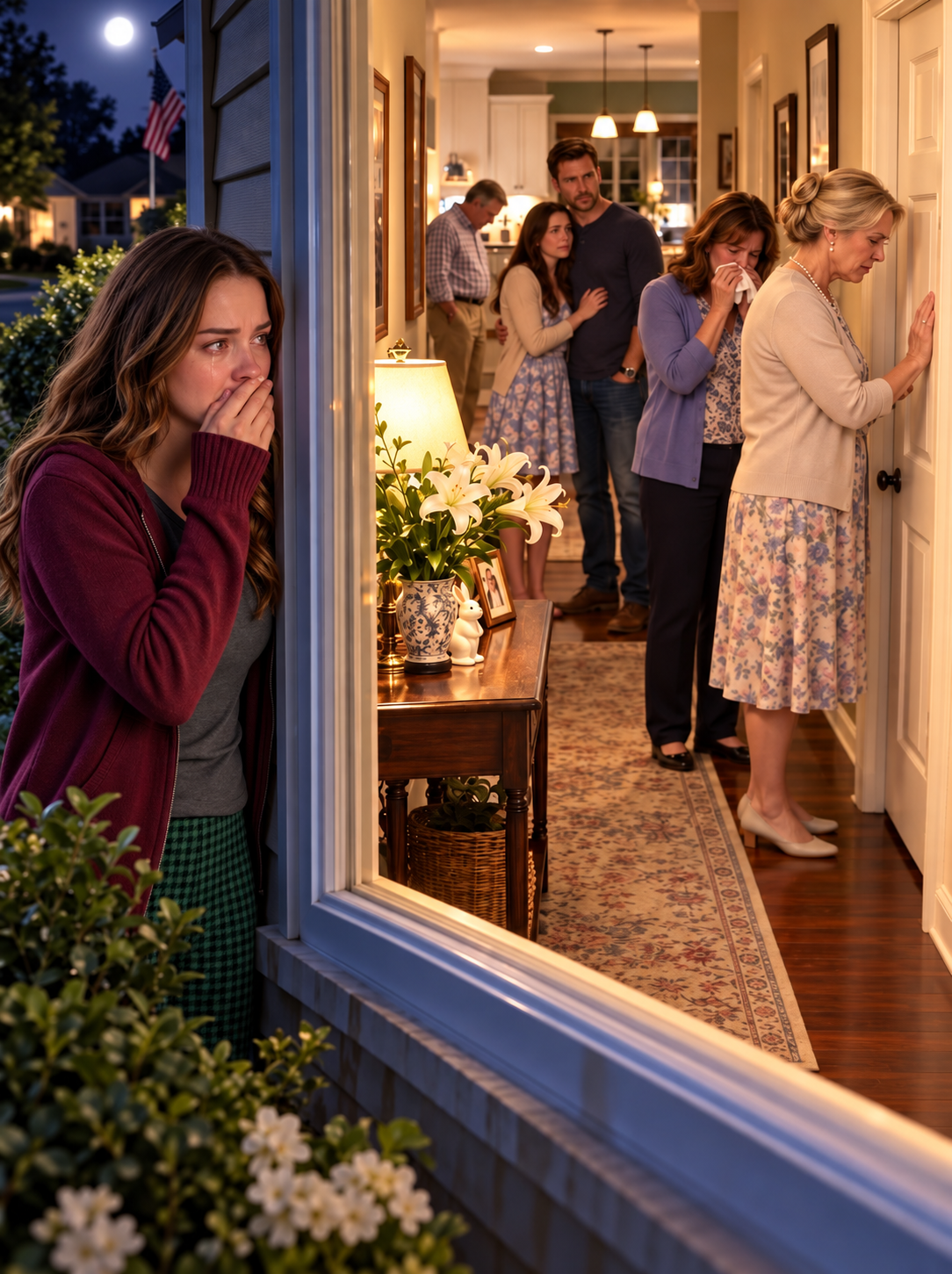
Then I noticed the hallway curtains were open.
Through the window, I could see Suzanne Lockheart—Avery’s mother—standing outside my bedroom.
Mom was beside her holding a tissue.
Avery stood next to Mitch.
My father stared at the floor.
Suzanne placed her palm against my bedroom door.
“May I?”
Mom nodded.
Suzanne lowered her head.
And began to pray.
I stood in the darkness outside my own house, completely motionless.
A stranger was praying outside my bedroom as if the person who belonged there could never return.
Something inside me turned cold.
I waited.
Eventually, the Lockhearts left.
Around midnight, I entered through the back door.
The house was silent.
Then I saw something on the dining-room table.
A framed photograph.
My photograph.
My junior-year school portrait.
Beneath it was a small brass plaque.
I leaned closer.
STACY COLLINS
And underneath my name were two years.
A birth year.
And a death year.
Except I wasn’t dead.
Beside the frame was the Easter bulletin from the Lockhearts’ church.
My hands shook as I opened it.
There was a list titled:
IN LOVING MEMORY
Near the bottom was my name.
For several seconds, I couldn’t understand what I was seeing.
Then everything from the last eight years began rearranging itself.
The hidden photographs.
The candle.
The locked bedroom.
The missing mail.
My grandmother’s obituary.
The memorial dogwood Avery had purchased.
My parents hadn’t told Avery that I lived in Atlanta.
They had told her I was dead.
I heard footsteps.
Mom appeared in the hallway.
Her face changed the moment she saw the frame in my hands.
“Stacy…”
“What is this?”
“Keep your voice down.”
I laughed.
That was her first concern.
Not that I had discovered my own memorial.
That I might wake someone.
“What is this?”
Dad came downstairs.
Then Mitch.
I looked directly at my brother.
“You told Avery I was dead?”
His face crumpled.
“Stace…”
“Yes or no?”
“Mom started it.”
Mom spun toward him.
“Mitch!”
“No,” I said. “Let him talk.”
He sat down heavily.
“When Avery first came over, Mom told her family that we had another daughter who had died.”
“Why?”
Nobody answered.
“Why?”
Mom finally spoke.
“The Lockhearts were respected people.”
I stared at her.
“And?”
“Suzanne was involved with the hospital foundation. Her husband knew everyone in town. Avery had been raised differently.”
“Differently from what?”
Mom swallowed.
“We didn’t know how they would react if they knew you had been hospitalized.”
For a moment, the room was silent.
Then I started laughing.
I couldn’t stop.
Not because it was funny.
Because the alternative was screaming.
“So instead of telling them I had spent time in a hospital, you told them I died?”
“It wasn’t supposed to go this far.”
“Eight years, Mom.”
Dad finally spoke.
“After the first year, correcting it became complicated.”
“Complicated?”
I lifted the memorial frame.
“You gave me a death date!”
Mom began crying.
“We were protecting Mitch.”
I turned toward him.
“And you let them?”
He looked down.
“I was scared Avery would leave.”
“So you let her mourn me?”
His silence answered me.
Suddenly, I remembered the dogwood.
“Avery bought a memorial tree from me.”
Mitch closed his eyes.
I felt sick.
“She told me it was for someone in her boyfriend’s family.”
“It was.”
“For me.”
Nobody spoke.
I set the frame on the table.
Then Mom said something I will never forget.
“Please don’t tell Avery tonight.”
I stared at her.
“Excuse me?”
“She and Mitch are supposed to marry in September. If the Lockhearts find out—”
That was the moment something in me finally broke free.
Even after everything, she was still worried about them.
Their reputation.
Mitch’s wedding.
What people would think.
Never me.
I walked upstairs.
Mom followed.
“What are you doing?”
“Packing.”
“Don’t be ridiculous.”
I put my medication into my bag.
Then my documents.
Clothes.
Laptop.
The yellow notebook.
My grandmother’s obituary.
I packed everything important.
Dad was standing near the front door when I came downstairs.
“Where are you going?”
“Somewhere I’m alive.”
Mom began crying harder.
“We made mistakes.”
“No.”
I looked at all three of them.
“A mistake is something you do once.”
I held up the yellow notebook.
“This has eight years of dates in it.”
I opened a page.
“July Fourth. Out by nine.”
Another.
“Christmas weekend. Don’t come home until Monday.”
Another.
“Easter. Be gone by ten.”
I closed the notebook.
“This wasn’t a mistake. This was a system.”
Nobody answered.
I left that night.
Ruth was sitting on her porch when I arrived after one in the morning.
She saw the bags in my car.
“Permanent?”
“Yes.”
She nodded once.
“Then bring them inside.”
I never slept in my parents’ house again.
Two days later, I redirected my mail.
I changed my phone number.
Within a month, I rented a small apartment above a hardware store.
Then one afternoon, Avery walked into the garden center.
This time, she knew who I was.
Her eyes filled with tears the moment she saw me.
“Stacy?”
“Yes.”
She covered her mouth.
“I thought you were dead.”
“I know.”
Mitch had confessed after I left.
He had told her everything.
The weekends.
The lies.
The fake story about Atlanta.
The memorials.
Avery called off their wedding.
I didn’t ask her to.
I didn’t encourage her.
That was her decision.
But she told me why.
“I spent years praying for you,” she said. “Your mother cried while telling me stories about you. Mitch stood beside her and let me believe every word.”
She shook her head.
“I kept thinking—if he could lie to me about something this enormous for eight years, what else could he lie about?”
I had no answer for her.
Before leaving, she pulled something from her purse.
The old plant tag.
My handwriting was still visible.
She’ll bloom.
“I kept this,” she said.
Then Avery asked the question I had expected.
“Why didn’t you tell me that day at the garden center?”
I thought carefully before answering.
“Because my family spent years teaching me that your comfort mattered more than my existence.”
She started crying again.
“I’m sorry.”
“You didn’t know.”
And I meant it.
Ruth helped me rebuild.
Eventually, I stopped working at the garden center and started doing private restoration work.
Storm-damaged trees.
Old orchards.
Historic properties.
Trees that contractors wanted to remove because saving them seemed too difficult.
I built a reputation.
Then Ruth offered to sell me five acres at the edge of her farm.
I opened a small nursery.
I named it Collins Restoration Nursery.
During the first year, I barely broke even.
During the second, we hired two employees.
By the fourth year, we were supplying mature restored trees to schools, parks, universities, estates, and commercial projects across three states.
We built two greenhouses.
Then a third.
I bought another parcel of land.
We eventually employed more than twenty people.
Near the entrance, I placed a wooden sign with our company motto:
GREEN MEANS SHE’S LIVING.
My family knew none of it.
I didn’t post personal updates online.
I had changed my number.
I had no reason to contact them.
For four years, they didn’t know where I lived or what I was doing.
Then, one spring, a tornado tore through several communities in our county.
Our nursery donated hundreds of young trees to families who had lost their homes.
A local television reporter came to interview me.
The segment aired statewide.
My name appeared on the screen beneath my face.
STACY COLLINS — OWNER, COLLINS RESTORATION NURSERY
Behind me stood my greenhouses.
Two days later, a black SUV pulled into the parking area.
I recognized it before anyone stepped out.
Mom.
Dad.
Mitch.
I hadn’t seen them in four years.
Mom stood staring at everything.
Employees moved between rows of trees.
A forklift carried a mature maple toward a truck.
Our company logo was printed on trailers and work uniforms.
“You own this?” Mom asked.
“Yes.”
“All of it?”
“Most of it.”
Dad looked toward the greenhouses.
“We didn’t know.”
“You weren’t supposed to.”
Mom pressed her lips together.
“We tried to find you.”
“You knew Ruth’s address.”
“We thought you would contact us when you calmed down.”
I almost laughed.
Four years.
And they still believed my silence had been a tantrum.
Mitch stayed several feet behind them.
Finally, he said, “I’m sorry, Stace.”
I looked at him.
He had changed.
Older.
Quieter.
No wedding ring.
“I know.”
“I should have stopped it.”
“Yes.”
“I kept telling myself I was protecting my relationship.”
He looked down.
“But really, I was protecting myself.”
It was the first apology he had ever given me that didn’t contain an excuse.
Mom started crying.
“We made one terrible mistake.”
I went into my office.
When I returned, I was holding the yellow notebook.
I opened it.
“June 12. Out by eleven.”
Another page.
“September 3. Don’t come home before Sunday.”
Another.
“Fourth of July. Leave by nine.”
I closed the notebook.
“Eight years is not one mistake.”
Mom wiped her face.
“We were ashamed.”
There it was.
Finally.
The truth.
She quickly added, “Not ashamed of you. Ashamed of what people might think.”
“When you erase your daughter because of what people might think, there isn’t much difference.”
Dad stared at the rows of trees.
“Can we fix this?”
I followed his gaze.
Years earlier, Ruth had shown me a damaged peach tree.
Everyone thought it was dead.
But underneath the bark, it was green.
“Maybe,” I said.
Mom looked hopeful.
“But fixing something doesn’t mean pretending the damage never happened.”
They were allowed back into my life slowly.
On my terms.
No surprise visits.
No lies.
No pretending the past had been misunderstood.
Mitch came most often.
My parents came less.
Some relationships healed more than others.
And eventually, I stopped measuring my recovery by whether my family understood what they had done.
Years later, Ruth died peacefully at eighty-seven.
After her memorial service, I walked to the old peach tree she had shown me when I was eighteen.
It was still standing.
Crooked.
Scarred.
Several branches had been lost over the years.
But every summer, it still produced fruit.
Beside it, I planted another peach tree.
Then I placed a small plaque between them.
No fake death date.
No memorial photograph.
Just five words.
GREEN MEANS SHE’S STILL LIVING.
For eight years, my family taught me that I had to disappear so other people could feel comfortable.
I used to think healing meant earning my place back at their table.
It didn’t.
Healing was realizing that I could build my own table.
My own home.
My own family.
My own life.
A life where nobody had to hide the medication before company arrived.
Nobody removed my photographs.
Nobody locked my bedroom.
Nobody asked me to disappear.
And nobody ever again got to decide whether I was worth seeing.