For nine years, my family acted as though I no longer existed because I married a Black man.
No phone calls.
No birthday messages.
Not even a card when our son was born.
Then my husband’s face appeared across major business magazines, and suddenly my mother was standing outside our gate holding a handwritten list of everything she believed we owed her.
“Family forgives,” she said with a smile, as though the last nine years had been nothing more than a misunderstanding.
I glanced toward the security camera above the gate.
“Good,” I said quietly. “Then I’m sure you’ll forgive what I do next.”
Nine years earlier, my mother had accused me of “burying the family name” because I chose to marry Julian.
She refused to attend our wedding.
My father came only long enough to tell me that I was making the biggest mistake of my life.
My younger sister, Elise, sent me a message the night before the ceremony.
You’re really choosing him over all of us?
I answered with one sentence.
I’m choosing the man I love.
That was the last time she contacted me for years.
Julian never asked me to choose between him and my family.
They made that choice themselves.
When our son Noah was born, I tried once more.
I mailed my parents a photograph of their grandson.
Two weeks later, the envelope came back unopened.
Across the front, in my mother’s handwriting, were three words:
Not our blood.
I cried in Julian’s arms that night.
Then I put the envelope into a box and promised myself that Noah would never grow up begging for love from people who had already decided he was unworthy of it.
We built our own family instead.
The early years were not glamorous.
Julian started his logistics company in a rented warehouse with four employees, two aging delivery vans, and more debt than either of us liked to admit.
I handled payroll at the kitchen table.
He slept three hours a night.
We missed vacations, postponed buying furniture, and once celebrated our anniversary with takeout because every spare dollar had gone into keeping the company alive.
But Julian never forgot who he was.
When the company began succeeding, he created scholarships for employees’ children.
When profits increased, he expanded health benefits.
When investors pressured him to cut hundreds of warehouse jobs, he found another solution.
By the time Noah turned seven, Julian’s company had expanded across three continents.
Then came the public offering.
Suddenly his photograph was everywhere.
Forbes called him one of the most innovative executives in the logistics industry.
Fortune profiled the company’s growth.
Black Enterprise published a feature about the obstacles Julian had faced building a national company as a Black founder.
Apparently, that was when my family remembered I was alive.
The morning they appeared at our gate, Noah was sitting at the kitchen island doing his homework.
Julian stood behind my chair while I watched the security monitor.
My mother wore a cream suit and pearl earrings.
My father stood beside her, stiff and uncomfortable.
Elise was scrolling through her phone.
Mom leaned toward the intercom.
“Family forgives.”
Julian looked at me.
“Do you want security to send them away?”
I thought about the unopened envelope.
I thought about my wedding.
I thought about nine silent birthdays.
Then I noticed the yellow legal pad in my mother’s hand.
“No,” I said.
“Let them in.”
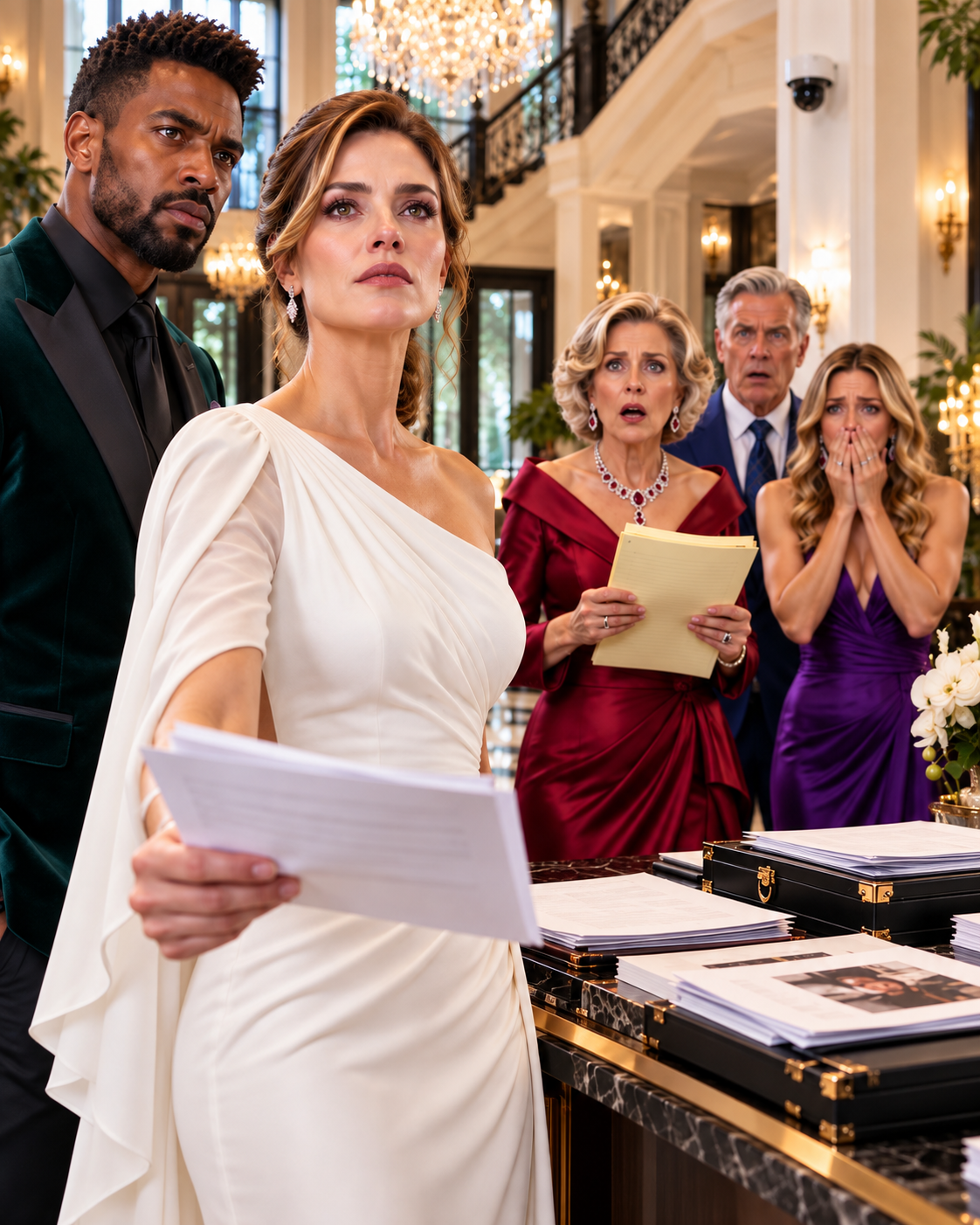
Twenty minutes later, she entered our foyer and looked around at the marble staircase, the glass walls, and the garden beyond them.
“Well,” she said slowly. “At least you’re comfortable.”
Elise actually laughed.
“Comfortable? Mom, this place is insane.”
My father cleared his throat.
“We didn’t come here to argue.”
“No?” I asked.
My mother stepped forward and handed me the yellow pad.
There were five demands written in her perfect handwriting.
A public reconciliation dinner.
A monthly financial allowance for my parents.
Private-school tuition for Elise’s twins.
A trust fund for those same children.
A vice president position for my father inside Julian’s company.
At the bottom, underlined twice, were three more words.
Access to Noah.
I read the list twice.
Then looked up.
“You rejected my son before he could speak.”
Mom gave me the expression she used whenever she believed someone was being unreasonable.
“We made mistakes.”
“Mistakes?”
“Maya, people say things when they’re emotional.”
“You mailed back his photograph.”
She waved one hand.
“That was years ago.”
Then she smiled.
“But you married well. It’s time you started acting like a daughter again.”
That sentence told me everything.
They had not come because they missed me.
They had not come because they regretted what they had done.
They had come because Julian’s success made reconciliation profitable.
My eyes moved toward the black dome camera above the foyer.
“If family forgives,” I said softly, “then I’m sure you’ll forgive what I do next.”
Mom’s smile faltered.
I walked to the table near the staircase and picked up a small remote.
Then I turned on the television mounted on the wall.
The screen displayed the gate camera.
My mother’s voice filled the room.
Family forgives.
Then another recording appeared.
It was from nine years earlier.
My wedding rehearsal.
My parents had been standing outside the restaurant, unaware that Julian’s friend was filming part of the celebration inside.
My mother’s voice was clear.
“If she marries him, she is no daughter of mine.”
My father answered:
“She’ll come crawling back eventually.”
The color disappeared from his face.
Elise stared at the television.
“Where did you get that?”
“Someone sent it to me after the wedding.”
Another image appeared.
A photograph of the envelope they had returned after Noah’s birth.
Not our blood.
Nobody spoke.
I turned off the television.
“I kept everything.”
Mom stared at me.
“Why?”
“Because for years I wondered whether I had exaggerated it in my mind. Whether maybe time had made it worse.”
I looked directly at her.
“But I didn’t exaggerate anything.”
My father suddenly stood.
“This is unnecessary.”
“What’s unnecessary? Remembering?”
“We came here to fix things.”
“No. You came here with a financial request list.”
Mom’s voice hardened.
“After everything we did for you growing up, you owe us some consideration.”
There it was.
Not an apology.
An invoice.
Julian finally spoke.
“You should leave.”
My mother turned toward him.
“This is between our family.”
Julian’s expression remained calm.
“Maya and Noah are my family.”
Mom opened her mouth, but another voice interrupted.
“Mom?”
Noah stood halfway down the staircase.
My heart stopped.
I had thought he was still in the kitchen.
He looked from me to the strangers in our foyer.
“Who are they?”
Silence.
My mother’s entire face transformed.
She smiled immediately.
“Noah, sweetheart. I’m your grandmother.”
Noah looked at me.
“My grandmother?”
Before I could answer, Mom stepped closer.
“We’ve been away for a long time.”
I moved between them.
“No.”
She froze.
I crouched beside Noah.
“These are my parents and my sister.”
He thought about that.
“Why haven’t I met them?”
There are moments when a parent wishes the world were easier to explain.
I refused to lie to him.
“They made choices that hurt our family. And they haven’t apologized for those choices yet.”
Noah looked at my mother.
“Did you hurt Mom?”
She looked horrified by the simplicity of the question.
“We had disagreements.”
“That’s not what I asked.”
For a seven-year-old, he sounded remarkably like his father.
My mother tried to laugh.
“Children don’t understand adult situations.”
Julian stepped beside Noah.
“Sometimes they understand more than adults want them to.”
My father picked up his coat.
“We should go.”
But Mom wasn’t finished.
She turned toward me.
“So that’s it? You’re going to punish us forever?”
“No.”
I shook my head.
“I stopped punishing you years ago.”
She frowned.
“I stopped waiting for you too.”
Then I handed her the legal pad.
“I don’t hate you. But forgiveness does not mean access. It does not mean money. And it does not mean pretending nothing happened.”
She stared at me.
“If you truly want a relationship with me, you can start with an apology.”
Her jaw tightened.
“To you?”
“To Julian.”
Her face changed.
“And to Noah.”
For several seconds, she said nothing.
Then she laughed once under her breath.
“I won’t humiliate myself.”
I nodded.
“Then you have your answer.”
Security escorted them out.
For the next three weeks, I heard nothing.
Then the story appeared online.
An anonymous source claimed that Julian had “isolated his wife from her family” after becoming wealthy.
The article described my parents as heartbroken grandparents who only wanted to meet their grandson.
My mother had expected the story to embarrass us.
Instead, I called our attorney.
Then I released one statement.
No insults.
No accusations.
Only facts.
I attached the photograph of the returned envelope.
I attached the list of financial demands.
And, after discussing it with Julian, I released a short excerpt from the recording outside our wedding.
Within hours, the story changed.
Suddenly reporters were asking my parents why their “reconciliation” request included money, employment, tuition, and a trust fund.
My father disappeared from public view.
Elise deleted her social media accounts.
Mom called me seventeen times.
I never answered.
Then, six weeks later, a letter arrived.
Not an email.
Not a text.
A handwritten letter.
It was from my father.
For the first time in nine years, he did not excuse himself.
He wrote that he had been a coward.
He admitted that he had disagreed with my mother privately but chosen silence because it was easier than confronting her.
He wrote that silence had made him equally responsible.
He did not ask for money.
He did not ask to see Noah.
He simply apologized.
I read the letter twice.
Then I showed it to Julian.
“What do you want to do?” he asked.
“I don’t know.”
“That’s okay.”
Two months later, I met my father in a coffee shop.
Alone.
It was awkward.
Painful.
But real.
He never became the grandfather he could have been from the beginning.
Some losses cannot be erased.
But over time, he earned limited space in our lives.
Elise eventually apologized too.
My mother did not.
For almost a year, she continued insisting that I had embarrassed her publicly.
Then one afternoon, another envelope arrived.
Inside was the old photograph of Noah she had returned seven years earlier.
She had apparently kept a copy.
On the back she had written:
I was wrong.
Nothing else.
No excuses.
No demands.
I sat at the kitchen table for a long time holding that photograph.
Julian found me there.
“Is that enough?” he asked.
I looked toward the garden, where Noah was kicking a soccer ball against the wall.
“No.”
Then I smiled faintly.
“But it’s finally a beginning.”
I did not call my mother that day.
Or the next.
Forgiveness, I had learned, was not a door someone could demand that you open.
It was something rebuilt slowly, if both people were willing to do the work.
And family was not defined by who shared your last name.
Family was the person who stayed beside you when everyone else walked away.
The man who held you when an unopened photograph came back in the mail.
The child who never had to question whether he was wanted.
Nine years earlier, my mother had told me I had destroyed our family by marrying Julian.
She had been wrong.
Marrying Julian did not destroy my family.
It showed me who my family truly was.