A Wealthy Woman Took a Black CEO’s First-Class Seat — Then Learned Who Really Owned Her Husband’s Company
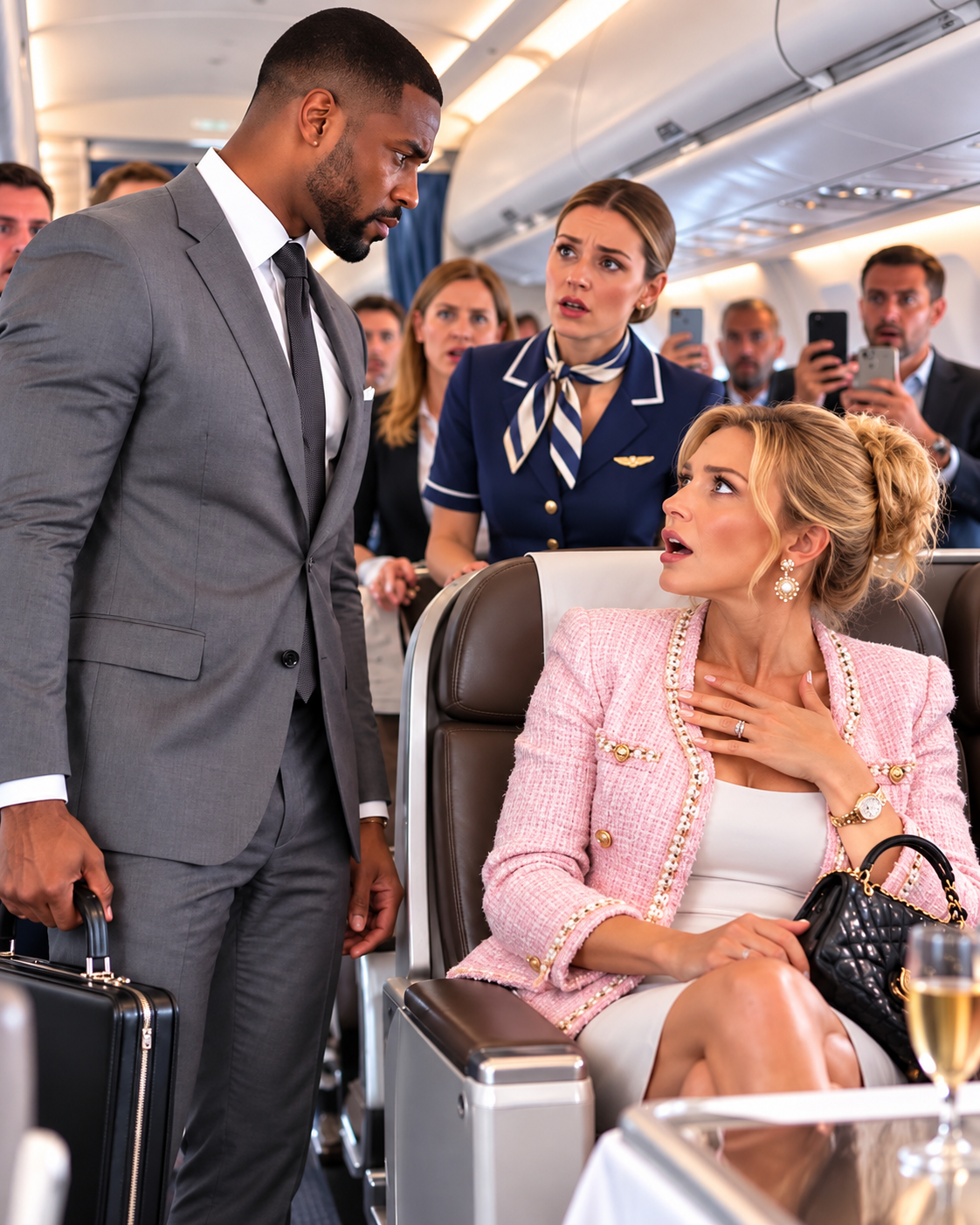
The entire first-class cabin seemed to hold its breath when Darla Whitmore stretched one designer heel into the aisle and blocked Evan Cole from reaching seat 2A.
She did not simply refuse to move.
She looked him up and down, tightened her grip on her expensive handbag, and said loudly enough for half the cabin to hear:
“Seats like this are not for people like you.”
Several passengers turned immediately.
A few phones rose.
Evan did not argue.
He did not raise his voice.
He simply stood beside his leather suitcase and looked at the woman occupying the exact seat printed on his boarding pass.
“Excuse me,” he said calmly. “You’re sitting in my seat.”
Darla gave a short laugh.
“Go find your real seat.”
“My assigned seat is 2A.”
She leaned back comfortably.
“I fly first class all the time. I know who belongs here.”
The words landed heavily.
Even passengers who had been pretending not to listen now looked up.
A young flight attendant named Jessica hurried over.
“Is there a problem?”
“Yes,” Darla answered before Evan could speak. “This man is trying to take my seat. I want security.”
Evan silently handed Jessica his boarding pass.
Before she could properly examine it, Darla interrupted.
“It’s probably fake.”
Jessica’s expression tightened.
“Ma’am, please let me verify the boarding information.”
Darla crossed her arms.
“My husband’s company spends millions with this airline. I suggest you think carefully before embarrassing me.”
Evan’s face remained calm.
That seemed to irritate Darla even more.
“You should learn your place,” she muttered.
A few passengers visibly flinched.
Jessica disappeared toward the galley and returned moments later with Marissa, the lead flight attendant.
Marissa accepted Evan’s boarding pass and scanned it.
A soft beep sounded.
Her expression changed.
Then she turned to Darla.
“Mrs. Whitmore, Mr. Cole is correct. Seat 2A is assigned to him.”
Darla stared at her.
“That’s impossible.”
“Your assigned seat is 4C.”
The cabin became completely silent.
Darla’s cheeks reddened.
“Do you know who my husband is?”
For the first time, Evan’s expression shifted.
“Yes,” he said.
Darla frowned.
“What?”
“I know exactly who your husband is.”
She gave him a suspicious look.
“And how would you know that?”
Evan slipped his boarding pass back into his jacket.
“Because I know Whitmore Logistics.”
Her confidence returned for half a second.
“My husband is a senior executive there.”
“I know.”
“And?”
Evan met her eyes.
“I own the company.”
Darla froze.
The color drained from her face.
Someone across the aisle whispered, “No way.”
But Evan was not finished.
His company, Cole Global Holdings, had quietly acquired a controlling interest in Whitmore Logistics six months earlier.
Darla’s husband, Richard Whitmore, had not told many people because he was still negotiating his future inside the reorganized company.
What Darla did not know was that Evan was flying that morning to meet with the board about those exact negotiations.
Marissa cleared her throat.
“Mrs. Whitmore, you need to move to 4C.”
Darla stood slowly.
For the first time since Evan had entered the cabin, she seemed unsure of herself.
“This is ridiculous,” she muttered.
But the situation was no longer under her control.
She grabbed her handbag and moved two rows back.
Evan placed his suitcase in the overhead compartment and sat in 2A.
He thought the incident was over.
It was not.
Ten minutes later, while passengers were still boarding, his phone vibrated.
A message from his chief legal officer appeared on the screen.
Richard Whitmore has been trying to reach you. Apparently someone sent him a video from the flight.
Evan looked across the cabin.
Darla was staring at her own phone.
Her face had gone pale again.
Then her phone rang.
She answered.
“Richard?”
Even from two rows away, several passengers could hear the furious male voice on the other end.
“Tell me that video isn’t real.”
Darla lowered her voice.
“I didn’t know who he was.”
There was a pause.
Then Richard said something that made her sit perfectly still.
“You didn’t need to know who he was.”
Darla said nothing.
“You humiliated a passenger because of what you assumed about him,” Richard continued. “And now the entire internet is watching.”
“I can explain.”
“No. You can’t.”
The call ended.
Darla stared at the dark screen.
The plane eventually pushed back from the gate.
During the flight, Evan worked quietly on his laptop.
He did not look at Darla again.
But by the time they landed, the video had already spread across social media.
One recording clearly captured Darla telling him that first-class seats were not “for people like you.”
Another showed her demanding security remove him.
The story exploded online.
Reporters began contacting Cole Global Holdings.
Whitmore Logistics released a statement saying that the company did not support discriminatory behavior and that the matter was under review.
Richard Whitmore called Evan personally before noon.
“I’m sorry,” he said. “What happened was unacceptable.”
Evan remained quiet for a moment.
Then he answered:
“You’re not responsible for your wife’s behavior. But you are responsible for the culture you help create when you stay silent around people who think like that.”
Richard had no response.
The board meeting that afternoon went ahead as planned.
Evan did not fire Richard because of Darla.
He did something more difficult.
He judged him only on his own record.
The review revealed that Richard had ignored multiple employee complaints about discriminatory comments made by senior managers because he believed confronting them would “create unnecessary conflict.”
That decision mattered.
Richard was removed from his leadership position.
Not because of his wife.
Because he had repeatedly chosen comfort over responsibility.
As for Darla, the public attention forced her to confront something she had spent years refusing to see.
For several weeks, she blamed everyone else.
The passengers.
The airline.
The cameras.
Evan.
But eventually she stopped.
Months later, Evan received a handwritten letter at his office.
It was from Darla.
She did not ask him to forgive her.
She did not ask him to defend her publicly.
The letter contained only an apology.
She admitted that what happened on Flight 2174 was not a misunderstanding.
It was prejudice.
And she admitted that the worst part was not that she had insulted a powerful CEO.
It was that she would have behaved the same way if he had been an ordinary man with no company, no wealth, and no influence.
Evan read the letter once.
Then he placed it in a drawer.
He never responded.
He did not need revenge.
He did not need to destroy her life.
The truth had already done something far more powerful.
It had forced everyone in that cabin to see exactly what had happened.
And for Evan, that was the lesson he carried with him long after Flight 2174.
Respect should never depend on discovering that the person you insulted is wealthy, important, or powerful.
Because dignity is not a first-class privilege.
It belongs to everyone.