My Son and His Wife Arrived With Suitcases, Expecting to Move Into My House—Then I Learned What They Had Really Done
“You are not moving into my house.”
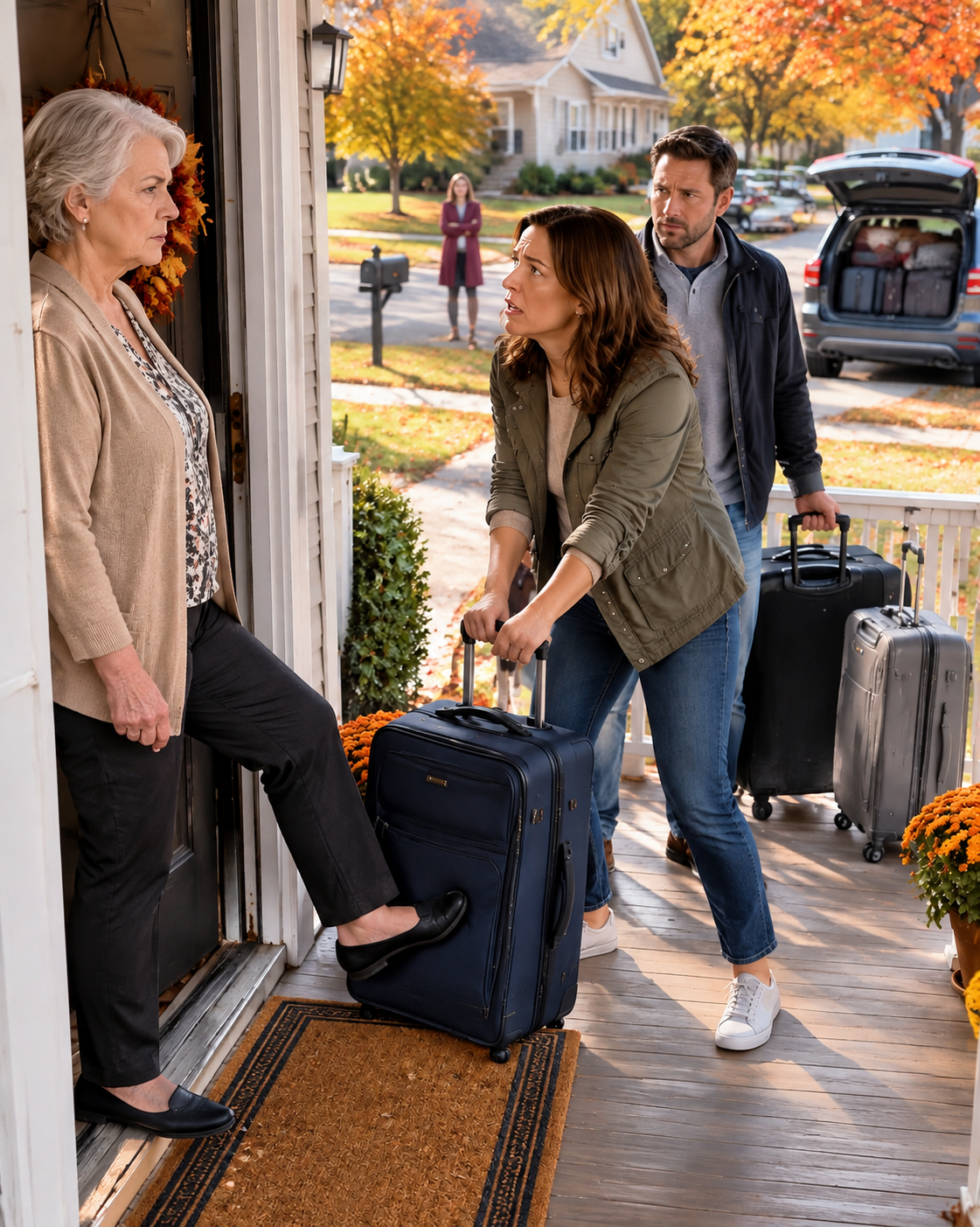
Dorothy Bennett said it calmly, one foot planted firmly against the navy suitcase already crossing her doorway.
Her daughter-in-law, Amanda, froze with both hands gripping the handle.
Behind her, Dorothy’s son Michael stood with two more suitcases, staring at the porch instead of at his mother.
“What did you just say?” Amanda demanded.
“You heard me.”
“We have nowhere else to go.”
Dorothy didn’t move.
“That doesn’t give you the right to move into my house without asking.”
Amanda’s face reddened.
“We lost our house!”
“I know.”
“And you’re still leaving us outside?”
“You came here without permission.”
Michael finally spoke.
“Mom, please.”
But something in his voice caught Dorothy’s attention.
It wasn’t anger.
It was fear.
And guilt.
She looked toward Michael’s SUV parked at the curb. The cargo area was packed to the roof with boxes, clothes, suitcases, and household belongings.
They hadn’t come to ask whether they could stay.
They had come believing they already could.
“You packed everything,” Dorothy said.
Amanda crossed her arms.
“We’re family.”
“Family calls first.”
“We needed help.”
“Help begins with asking.”
Amanda suddenly snapped, “We just lost six hundred and twenty thousand dollars!”
Michael flinched.
Dorothy stared at them.
She knew an investment had failed and that the sale of their house had collapsed, but $620,000 was far more than she had realized.
Michael quickly said, “Amanda, maybe we should leave.”
“Leave and go where?” she shot back.
Dorothy watched her son lower his eyes.
Something was wrong.
Amanda turned back toward Dorothy.
“You have three bedrooms, two bathrooms, and a finished basement. You live alone.”
Dorothy’s expression changed.
“How do you know exactly what part of my house you intended to use?”
Amanda stopped.
Michael went pale.
“We discussed options,” Amanda said.
“Without me?”
“We were trying to solve our problem.”
“In my house.”
Amanda rolled her eyes.
“Why are you obsessed with technicalities?”
“Permission is not a technicality.”
Then Michael said quietly, “She’s right.”
Amanda spun toward him.
“What?”
“Mom’s right.”
For a moment Dorothy thought her son was finally going to explain everything.
Instead Amanda looked at him sharply, and Michael fell silent again.
Dorothy had seen that pattern for years.
Until that moment, she had called it compromise.
Now it looked like fear.
“We are coming inside,” Amanda said.
“No.”
“Stop saying that!”
“Then stop making the same demand.”
Michael rubbed his face.
“Mom, there’s something I need to tell you.”
Amanda immediately turned toward him.
“Michael.”
“No.”
His voice was stronger now.
“I should have told her before we drove here.”
Amanda’s expression changed completely.
Dorothy removed her foot from the suitcase—but instead of opening the door wider, she stepped onto the porch and pulled the door closed behind herself.
“Tell me.”
Michael looked sick.
“The investment wasn’t exactly ours.”
Dorothy frowned.
“What does that mean?”
Amanda interrupted.
“Michael, don’t.”
He ignored her.
“Six months ago Amanda convinced me to invest in a property development company. They promised huge returns.”
“I remember.”
“What I didn’t tell you was that we borrowed against the house to increase the investment.”
Dorothy stared at him.
“How much?”
“Four hundred thousand.”
Her stomach tightened.
“That still doesn’t explain six hundred and twenty thousand.”
Michael looked toward Amanda.
She said nothing.
“There was another loan,” he whispered.
Dorothy felt the first real chill of the afternoon.
“What loan?”
Michael swallowed.
“One Amanda arranged.”
Amanda stepped toward him.
“That was supposed to be temporary.”
Dorothy’s eyes narrowed.
“Against what?”
Silence.
Then Michael whispered:
“Your house.”
Dorothy thought she had misheard him.
“My house?”
Amanda immediately jumped in.
“Nothing actually happened.”
Dorothy looked at her.
“What did you do?”
“It never went through.”
“What did you do?”
Amanda’s face hardened.
“We needed collateral. Michael had documents showing he would eventually inherit this house.”
Dorothy stared at her son.
Michael looked devastated.
“Amanda told the lender you had agreed to guarantee part of the loan.”
Dorothy went completely still.
“I never agreed to anything.”
“I know.”
Amanda folded her arms.
“The paperwork was never finalized.”
Dorothy’s voice became very quiet.
“Was my signature on it?”
Michael didn’t answer.
That was enough.
Dorothy turned toward Amanda.
“You forged my signature?”
“It wasn’t like that.”
“There are very few ways to misunderstand a forged signature.”
“We were going to repay everything before you ever knew.”
“But the investment collapsed.”
Amanda looked away.
“Yes.”
“And now?”
“The lender rejected the final collateral agreement when they requested additional verification.”
Dorothy slowly understood.
They hadn’t only lost their home.
Amanda had nearly dragged Dorothy’s home into the disaster too.
Michael stepped forward.
“Mom, I should have stopped it.”
“Yes,” Dorothy said.
“I was scared. We were already so deep in debt, and Amanda kept saying one more investment would fix everything.”
Amanda laughed bitterly.
“Oh, so now this is all my fault?”
Michael turned toward her.
“You signed my mother’s name.”
“You knew!”
“I knew afterward.”
“And you didn’t tell her.”
Michael fell silent.
Amanda looked triumphant.
Dorothy looked between them.
“You both knew.”
Michael’s eyes filled with shame.
“Yes.”
“And instead of telling me what happened, you packed your belongings and came here expecting to move into my basement.”
Neither answered.
Dorothy finally understood Amanda’s certainty.
They hadn’t believed Dorothy would agree.
They had believed Michael’s guilt would prevent him from telling her the truth, and once the suitcases were inside, Dorothy would be too compassionate to throw them out.
Amanda reached for the suitcase.
“So now you know. We made a mistake. Can we please stop turning this into a courtroom and go inside?”
Dorothy almost admired the audacity.
“No.”
Amanda stared at her.
“What?”
“You’re still not moving in.”
“After everything Michael just told you?”
“Especially after everything Michael just told me.”
“You would make your own son homeless?”
Dorothy turned toward Michael.
“Are you homeless?”
He hesitated.
“We can afford a hotel for maybe two weeks.”
“And after that?”
Michael looked down.
“I don’t know.”
Dorothy nodded.
“I do.”
Amanda narrowed her eyes.
Dorothy continued.
“There’s a furnished one-bedroom apartment above Carol Jensen’s garage. Her tenant moved out last week. I spoke to her yesterday.”
Michael looked up.
“You knew?”
“I knew you were in trouble. I just didn’t know how much trouble.”
Amanda gave a short laugh.
“And you expect us to live over somebody’s garage?”
“I expect you to live somewhere you have permission to live.”
Amanda’s face twisted.
“We can’t afford rent.”
“I will cover the first month.”
Michael’s eyes widened.
“Mom—”
“And I’ll pay the deposit directly to Carol. After that, you pay your own rent.”
Amanda shook her head.
“That place is tiny.”
Dorothy looked at the SUV.
“Then you’ll have to decide which possessions actually matter.”
Amanda’s voice rose.
“We had a four-bedroom house!”
“And now you don’t.”
“That’s cruel.”
“No. Cruel would be watching you fall and refusing to help. I’m helping. I’m simply not surrendering my house while doing it.”
Michael sat down heavily on one of the suitcases.
For the first time that afternoon, he looked relieved.
Amanda noticed.
“You actually want this?”
Michael looked up at her.
“I want to stop pretending we can live like nothing happened.”
Her face went blank.
He continued.
“We lost the house because we kept trying to preserve a lifestyle we couldn’t afford.”
“That isn’t fair.”
“It’s true.”
“You agreed to everything.”
“Yes,” Michael said.
“And that’s my responsibility.”
Dorothy watched him carefully.
Then Michael looked directly at his wife.
“But I’m done agreeing because I’m afraid of what happens when I say no.”
Amanda stared at him.
The porch went silent.
Even Dorothy hadn’t expected that.
Michael stood.
“You told me my mother wouldn’t care if we used her house as collateral because it would be mine someday anyway.”
Dorothy’s breath caught.
Amanda’s expression hardened.
“You agreed.”
“I was wrong.”
“You’re pathetic.”
Michael flinched.
Dorothy stepped between them.
“No.”
Amanda looked at her.
“You stay out of our marriage.”
“You are standing on my porch after forging my name. You don’t get to tell me where to stand.”
Amanda reached for her handbag.
“Fine. I’m leaving.”
Michael didn’t move.
She stared at him.
“Michael?”
He slowly shook his head.
“I’m going to Mom’s friend’s apartment.”
Amanda laughed.
“Without me?”
“That depends on you.”
Her smile disappeared.
“You’re choosing her?”
“No. I’m choosing to stop digging.”
Amanda stood motionless for several seconds.
Then she walked toward the SUV, climbed into the passenger seat, and slammed the door.
Michael looked at Dorothy.
“I’m sorry.”
Dorothy nodded.
“I know.”
“I should have told you immediately.”
“Yes.”
“And I should have stopped the paperwork.”
“Yes.”
He gave a weak smile.
“You’re not going to make this easy, are you?”
“No.”
She picked up her phone.
“My lawyer will review every document connected to that loan tomorrow morning.”
Michael nodded.
“And if my signature was forged, I will report it.”
His face tightened, but he nodded again.
“I understand.”
Dorothy placed a hand on his shoulder.
“I love you, Michael.”
His eyes filled with tears.
“But loving you does not mean protecting you from every consequence of your decisions.”
“I know.”
“Do you?”
He looked toward the SUV.
“I’m starting to.”
That evening, Michael and Amanda checked into a budget hotel.
Three days later, Michael moved into the small apartment above Carol’s garage.
Amanda didn’t join him.
Instead, she went to stay with her sister.
Within two weeks, Michael hired his own attorney.
The investigation into the attempted loan uncovered something even worse: Amanda had altered several financial documents and had secretly opened credit accounts using Michael’s information.
Michael filed for separation.
Dorothy’s house was never legally at risk because the lender had stopped the transaction before the fraudulent documents were accepted.
But Dorothy still installed a new security system and met with an estate attorney.
For years, she had assumed Michael would inherit the house automatically.
She changed that.
Not to punish him.
To protect both of them.
Six months later, Michael was still living above Carol’s garage.
He had sold his luxury SUV, paid down a portion of his debt, and found a second job on weekends.
One Saturday morning, he arrived at Dorothy’s house carrying a grocery bag.
He knocked.
Dorothy opened the door.
Michael smiled.
“I called first.”
She smiled back.
“I noticed.”
He lifted the grocery bag.
“Breakfast?”
Dorothy stepped aside.
“Come in.”
Michael crossed the threshold.
No suitcases.
No assumptions.
No demands.
Just an invitation.
And Dorothy realized something she wished she had understood years earlier:
A boundary does not destroy a family.
Sometimes, it is the first thing that gives a family a chance to become healthy again.
The day she refused to let her son move into her house had felt cruel to everyone standing on that porch.
Months later, Michael told her it was the day that had saved him.
And Dorothy never regretted saying no.