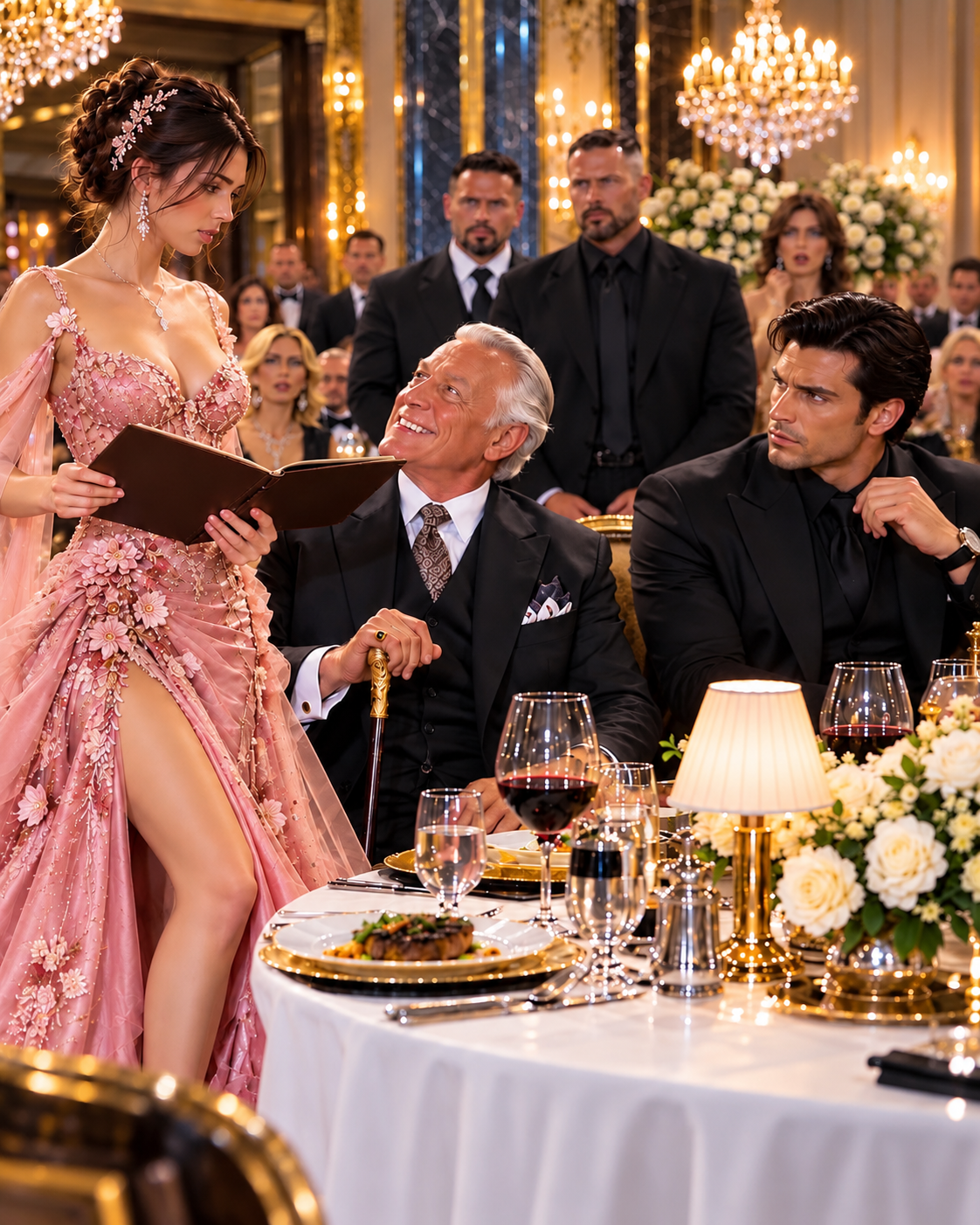
The entire restaurant fell silent when the old mafia boss pointed at me and insulted me in a Sicilian dialect no one was supposed to understand.
His son tried to intervene.
But I calmly set down the water pitcher, looked the most feared man in the room straight in the eyes, and answered him fluently in the language of his childhood.
My name is Tessa Morgan, and at Ilvento, one of Manhattan’s most expensive restaurants, my job was simple: serve wealthy people, remain invisible, and collect enough tips to keep my medical bills from swallowing me alive.
A dinner at Ilvento could easily cost $800 per person.
That meant our customers expected perfection.
And one customer in particular made everyone nervous.
Gabriel Rossi arrived every Thursday at exactly eight o’clock.
He always chose the same table.
Back against the wall.
Clear view of the entrance.
Black coffee.
Rare steak.
Very little conversation.
Everyone in Manhattan seemed to know the Rossi name.
Newspapers called them “businessmen” when lawyers were paying attention and “organized crime figures” when reporters felt brave.
Gabriel was only thirty-two, but a single glance from him was enough to make my manager, Richard, forget how to breathe.
I had served Gabriel for almost three months.
He was never rude to me.
He barely spoke, always said thank you, and left exactly $200 beneath his coffee cup.
Once, I noticed dried blood on the cuff of his white shirt.
I pretended not to see it.
Then came the Friday night that changed everything.
The restaurant was packed when our hostess answered the phone.
Her face went white.
“Gabriel Rossi is coming,” she whispered.
Richard frowned.
“He comes on Thursdays.”
She swallowed.
“His father is with him.”
Richard nearly dropped the reservation book.
Don Salvatore Rossi had not appeared publicly for more than a year.
Depending on which rumor you believed, he was sick, dying, hiding from enemies, or slowly losing his mind.
Older employees knew stories about him.
None of them were pleasant.
Ten minutes later, the front doors opened.
Gabriel entered first.
Behind him came a thin old man leaning heavily on a polished wooden cane.
Two massive bodyguards followed.
Tap.
Tap.
Tap.
Every strike of Salvatore’s cane against the marble floor seemed to silence another conversation.
Within seconds, the entire restaurant had noticed him.
Nobody wanted their table.
Richard eventually pulled me aside.
“Tessa.”
“No.”
“I haven’t even asked.”
“You’re about to.”
He glanced toward the Rossis.
“Serve them tonight and I’ll give you the entire weekend off. Paid.”
My feet had been aching since noon.
I sighed.
“Fine.”
I carried sparkling water to the table.
Gabriel gave me a polite nod.
“Good evening, Tessa.”
His father ignored me.
Salvatore studied the menu for nearly a minute before throwing it onto the table.
Then he started muttering.
It wasn’t standard Italian.
It wasn’t even the kind of Sicilian I had heard in movies.
It was an old, rough Palermo dialect.
And I understood every word.
Years earlier, when I was a broke college student living in Queens, my upstairs neighbor had been an elderly Sicilian widower named Mr. Cosenza.
He had arthritis and hated elevators because he didn’t trust anything that “moved without horses.”
For four years, I carried his groceries upstairs.
In return, he fed me.
And talked.
Constantly.
He told me stories about Palermo, olive groves, fishing boats, poverty, weddings, funerals, family arguments and feuds that had begun before he was born.
Whenever I mispronounced a word, he made me repeat it until I got it right.
By the time he died, I could understand his dialect almost as easily as English.
Salvatore Rossi had no idea.
He complained about the restaurant.
He called the food “decorated garbage.”
Then he pointed at me.
“Are you deaf as well as stupid?” he growled in Sicilian. “Bring me meat, garlic and oil. If nobody in this place knows how to cook, perhaps I should burn it down.”
Gabriel’s jaw tightened.
“Papa—”
I gently placed the pitcher on the table.
“No need.”
Gabriel looked at me.
I turned toward his father.
Then I answered in the same dialect.
“If Your Grace wants to eat like a human being instead of a newly rich snob, I’ll bring you a bone-in steak cooked over flame with garlic and good olive oil.”
Gabriel froze.
I continued.
“But if Your Grace only wants to complain, I’ll help you stand up and you can go find chickpea fritters somewhere else.”
Silence.
Absolute silence.
At the next table, someone actually stopped chewing.
Gabriel stared at me as though I had just performed surgery with a butter knife.
Salvatore slowly raised his eyes.
For a moment, I wondered whether I had just ended my career.
Or possibly my life.
Then the old man asked quietly in Sicilian:
“Who taught you to speak like that?”
“Mr. Cosenza.”
His fingers tightened around his cane.
“What was his first name?”
“Giuseppe.”
The color disappeared from Salvatore’s face.
Gabriel leaned forward.
“Papa?”
Salvatore ignored him.
“Giuseppe Cosenza from Via Albergheria?”
I nodded.
“He used to talk about that street all the time.”
Salvatore stared at me for several seconds.
Then, unbelievably, he laughed.
Not a polite chuckle.
A genuine laugh.
The entire restaurant seemed to exhale.
“That miserable old goat,” Salvatore whispered.
“You knew him?”
Salvatore leaned back.
“When I was twelve years old, Giuseppe broke my nose.”
I blinked.
“Why?”
“Because I stole his bicycle.”
That sounded exactly like Mr. Cosenza.
Salvatore smiled faintly.
“We grew up three doors apart. His mother fed me when my father had nothing. Giuseppe and I were closer than brothers.”
“What happened?”
The smile disappeared.
“I chose one road.”
He looked at his hands.
“He chose another.”
According to Salvatore, they had fallen out as young men.
Giuseppe left Sicily and eventually came to America.
Salvatore built the life everyone whispered about.
They had not spoken in almost forty years.
“I tried to find him later,” Salvatore said. “Pride wastes more years than hatred.”
I didn’t know what to say.
Finally, I told him the truth.
“He talked about someone named Toto sometimes.”
Salvatore’s eyes lifted immediately.
“Toto?”
I nodded.
“He said Toto was the most stubborn idiot in Palermo.”
Gabriel covered his mouth.
I couldn’t tell whether he was coughing or hiding a laugh.
Salvatore glared at him.
Then he started laughing again.
“Yes,” he said. “That was me.”
Something changed after that.
The terrifying Don Salvatore Rossi disappeared for a while.
In his place sat an old Sicilian man remembering a childhood friend.
I went into the kitchen myself.
Chef Beaumont nearly had a nervous breakdown when I asked him to forget the tasting menu and prepare a simple bone-in steak with charred garlic, olive oil, lemon, roasted potatoes and parsley.
“You want me to serve that to Salvatore Rossi?”
“Yes.”
He stared at me.
“Do you have life insurance?”
“Just cook it.”
Twenty-five minutes later, I placed the plate in front of Salvatore.
He stared at it.
Then he took the first bite.
His expression changed.
For a few seconds, he didn’t speak.
Finally, he whispered:
“My mother used to make potatoes like this.”
That evening, Salvatore ate almost everything.
Before leaving, he called me over.
“How did Giuseppe die?”
“Heart failure. Six years ago.”
“Was he alone?”
“No.”
That seemed important to him.
“I was with him in the hospital,” I continued. “So were several neighbors. He complained about the soup until the end.”
Salvatore smiled.
“Good.”
Then he reached inside his jacket.
Gabriel immediately put a hand on his father’s arm.
“Papa.”
Salvatore frowned.
“What?”
“Maybe don’t reach into your jacket suddenly in a crowded restaurant.”
For the first time that night, I laughed.
Salvatore looked offended.
Then he pulled out a small black notebook.
He wrote something inside it.
“What do you owe?” he asked.
“Excuse me?”
“Your medical bills.”
My stomach tightened.
I had never told him about them.
Gabriel glanced at me.
“You mentioned them once to Richard. He wasn’t exactly discreet.”
I looked toward the manager.
Richard suddenly became deeply interested in the ceiling.
“I’m not taking your money,” I said.
Salvatore stared at me.
Most people probably did not say no to him.
“Why?”
“Because I served you dinner. I didn’t save your life.”
His eyes narrowed.
“You kept Giuseppe from being alone at the end.”
“He was my friend.”
“And he was mine before I was foolish enough to lose him.”
I shook my head.
“I still don’t want money.”
Salvatore considered that.
Then he nodded.
“Good.”
I wasn’t expecting that.
“Good?”
“People who take money too easily usually cost more later.”
Gabriel sighed.
“Papa.”
Salvatore pointed his cane toward Richard.
“Bring me the manager.”
Richard approached as if walking toward his execution.
Salvatore asked him one question.
“Is she a good employee?”
Richard nodded quickly.
“One of our best.”
“Then why is she still carrying water?”
Richard blinked.
“I—I don’t understand.”
“She speaks three languages, remembers every customer’s order, knows more about hospitality than your entire dining room, and she has enough courage to insult me in Palermo Sicilian.”
Salvatore looked at me.
“That alone deserves a promotion.”
I nearly laughed.
But Gabriel wasn’t laughing.
Neither was Richard.
Three weeks later, I became assistant floor manager.
It wasn’t because Salvatore threatened anyone.
At least, I don’t think it was.
Richard later admitted he had been considering me for the position for months but assumed I was satisfied waiting tables.
Apparently terror had simply accelerated the conversation.
My salary nearly doubled.
I finally began paying down my medical debt without choosing between rent and groceries.
But the strangest part came two months later.
Gabriel asked me to meet him at a small café in Queens.
He placed an old photograph on the table.
Two skinny teenage boys stood beside a battered bicycle in Palermo.
One of them was unmistakably a young Salvatore.
On the back, written in faded ink, were the words:
Toto and Giuseppe, 1959.
“Where did you get this?” I asked.
“My father kept it.”
Gabriel slid an envelope toward me.
Inside was a copy of another photograph.
This one showed Mr. Cosenza as I remembered him—older, smiling, holding a grocery bag.
I had taken that picture myself.
“How did your father get this?”
“You gave it to him.”
“I did not.”
Gabriel smiled.
“Remember when he asked you where Giuseppe was buried?”
I nodded.
“My father went there.”
I stared at him.
“He visits once a month.”
For some reason, that affected me more than I expected.
Salvatore Rossi continued coming to Ilvento.
Not every week.
But often enough.
And every time he came, the kitchen prepared the same simple meal.
Bone-in steak.
Garlic.
Olive oil.
Potatoes.
Sometimes he complained.
Sometimes we argued in Sicilian.
Once, he told me the potatoes were terrible.
I told him his taste buds were older than electricity.
Gabriel nearly choked on his coffee.
A year later, I became general manager of the restaurant.
The medical bills were finally gone.
And on the wall inside my office, I kept a copy of that old photograph of two boys standing beside a stolen bicycle in Palermo.
People sometimes asked why.
I never told them the whole story.
I simply said it reminded me that the person sitting at your table is rarely only what the world says they are.
And that sometimes a language you learned while carrying an old man’s groceries can change your entire life.
As for Don Salvatore Rossi?
He never insulted me again.
At least not in English.