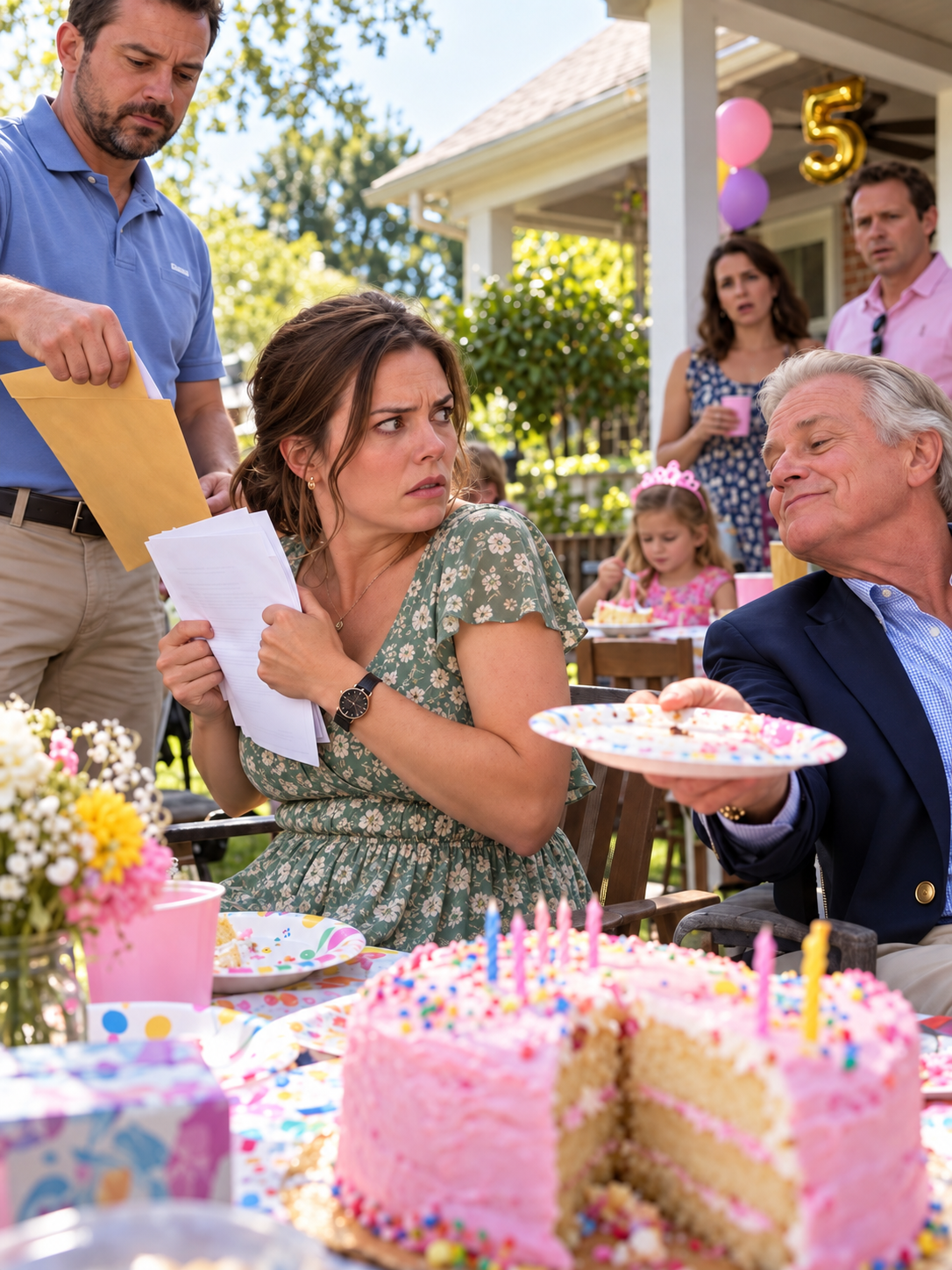
My CEO father-in-law had me served with a lawsuit beside my daughter’s fifth-birthday cake, called me “just a housewife,” and then calmly asked for another slice.
His company wanted the twelve acres my mother had left me for $150,000, even though the most recent appraisal valued the property at $480,000.
What Warren Baker didn’t know was that I had drafted the power of attorney he was relying on.
And I had specifically forbidden my husband from signing away any real estate.
The process server came through our side gate at three on a Saturday afternoon.
My daughter Mabel was leaning toward the candles on her fifth-birthday cake while a dozen children shouted encouragement.
“Rosalie Baker?”
Before I could answer, my father-in-law lifted one hand from his lawn chair.
“She’s right there.”
Warren Baker had spent thirty years building Baker Landworks into one of the largest development companies in the county. He was the kind of man who entered other people’s homes as if he owned the mortgage.
The process server handed me a thick manila envelope.
I opened it.
Baker Landworks was suing me.
The company wanted a court order forcing me to convey the Hollis property—my mother’s farmhouse and twelve acres on Ridge Road.
Around me, the birthday party went strangely quiet.
Warren smiled.
“Don’t take it personally, sweetheart. It’s business.”
Then he added, loud enough for the other parents to hear:
“You’re just a housewife. Let the grown-ups handle the land.”
I folded the papers, carried them into the kitchen, and placed them in a drawer beside the extra candles.
Then I returned outside and cut my daughter’s cake.
When Warren held out his plate for another slice, I gave him one.
Mabel would remember balloons, cake, and presents.
She would not remember the day her grandfather tried to steal her grandmother’s land.
The Hollis property had belonged to my mother.
She worked twenty-six years in a school cafeteria and evenings in a nursing-home kitchen before she managed to buy it.
When I was eight, Ridge Road was still gravel.
The farmhouse was small and drafty, but my mother loved it.
Every spring she planted tomatoes along the south fence and tied them to cedar stakes she cut herself.
When I came home from law school, she still made me help her weed the rows.
She died three years before Mabel’s birthday.
At the reception after her funeral, Warren stood in her kitchen staring through the window toward the road frontage.
“I could take this place off your hands,” he told me.
He talked about taxes, repairs, and weeds.
Then he offered what he called a “fair family price.”
My mother had been buried less than four hours earlier.
I said no.
My husband Daniel only told him, “Not today, Dad.”
At the time, I ignored the difference between “not today” and “never.”
That was my mistake.
Daniel had once been proud of me.
When we met, I was an Army lawyer. Later, I became a captain and continued serving in the reserve.
At our first dinner with his family, Daniel told Warren what I did.
Warren barely looked up from carving the roast.
“So you type forms for soldiers?”
Daniel laughed awkwardly.
I didn’t.
Later he told me not to make an issue out of it.
Eventually, I stopped correcting Warren.
It made family dinners easier.
I had also watched what happened to his daughter Celeste.
Celeste was a CPA with her own clients, but Warren expected her to handle Baker Landworks accounting for free because she was family.
One Thanksgiving, I found her crying in the pantry over three companies’ worth of tax documents.
Warren appeared behind her and said:
“The work isn’t going to do itself.”
That was when I realized Warren didn’t respect competence.
He exploited it.
So I let him think I was harmless.
I drove to reserve duty in ordinary clothes and changed into uniform when I arrived.
I never discussed legal work at family dinners.
By Mabel’s fifth birthday, Warren sincerely believed I had spent years doing little more than packing lunches and folding laundry.
That misunderstanding was about to become expensive.
After the last guest left the party, Daniel washed plastic cups at the kitchen sink.
I sat at the table and read the lawsuit twice.
Attached to it was an option agreement supposedly signed two years earlier.
The purchase price was $150,000.
The date was March 14.
I remembered that date.
I had been deployed in Kuwait.
The signature belonged to Daniel.
He had signed as my attorney-in-fact.
“What did you sign?” I asked.
Daniel shut off the water.
“Dad said it was paperwork for the bank.”
“Did you read it?”
He said nothing.
“When did you sign it?”
“I don’t remember.”
“Where?”
“I’ll talk to Dad tomorrow.”
That answer told me almost everything.
Daniel’s paycheck came from Baker Landworks.
The company also owned the house where we lived.
His title sounded impressive, but Warren controlled his salary, bonuses, and future.
Daniel had spent years convincing himself that obeying his father was the same thing as keeping the peace.
“I’ll handle it,” I said.
Relief flashed across his face.
He went upstairs.
I opened the gray file box I had prepared before deploying.
Inside was the special power of attorney I had drafted myself.
Daniel could manage our bank accounts, cars, school documents, medical forms, and matters involving our rental home.
But page two contained a bold restriction:
This power does not include the sale, transfer, option, or encumbrance of real property.
Daniel had never possessed the authority to sign away the Hollis property.
But then I noticed something else.
The option agreement had supposedly been notarized on March 14 at a branch of Franklin County Bank.
I checked the notary name.
Then I searched my deployment records.
Daniel had visited me overseas by video call that day from our kitchen at 8:17 p.m.
The time stamp was saved automatically.
Because Kuwait was eight hours ahead, it had been 12:17 p.m. at home.
According to the notarization, Daniel had supposedly signed the option at the bank at 12:05 p.m.
Possible.
Barely.
But another attachment made that timeline impossible.
Baker Landworks had submitted an internal board authorization claiming Warren presented the signed option at an emergency company meeting at 11:30 that morning.
Thirty-five minutes before Daniel supposedly signed it.
I stared at the page.
Then I started making notes.
The next morning, I called Celeste.
“Did Baker Landworks hold a board meeting on March 14 two years ago?”
There was a long silence.
“Why?”
“Because your father says there was one.”
Another pause.
“No.”
“How sure are you?”
“I did the corporate minutes back then.”
I waited.
Celeste lowered her voice.
“Rosalie, what did he do?”
I told her.
She came to my house an hour later carrying an old laptop.
Warren had forced her to maintain digital copies of corporate records because, in his words, “family won’t lose things.”
Celeste still had the backup.
There had been no emergency board meeting.
The document attached to my lawsuit had been created eleven months after its stated date.
The file metadata showed it.
That transformed the case.
This was no longer just about an invalid power of attorney.
Someone had manufactured evidence.
On Monday morning, I hired outside counsel—not because I needed someone to explain the law, but because I wanted a completely independent lawyer handling the litigation.
Her name was Miriam Cho.
After reviewing everything, she looked at me across her desk.
“Your father-in-law has a problem.”
“Several.”
She smiled.
“Yes. Several.”
We filed our answer denying the company’s claim.
Then we counterclaimed for fraud, abuse of process, and slander of title.
We also asked the court for sanctions based on the false documents.
Warren called me that evening.
“You’ve embarrassed Daniel.”
“No, Warren. Daniel embarrassed Daniel.”
“You’re turning family business into a war.”
“You served me during my daughter’s birthday.”
“That was the process server’s schedule.”
“You knew exactly what you were doing.”
He changed tactics.
“Take the $150,000. I’ll add another twenty-five. You’ll never get a better offer.”
“I already had one.”
Silence.
“What?”
“An appraisal. $480,000.”
His voice hardened.
“That property isn’t worth that.”
He was lying.
I had spent the previous day researching county planning records.
Six months earlier, Baker Landworks had quietly purchased three parcels along Ridge Road.
The county was considering a new commercial connector road.
If approved, my twelve acres would sit directly between two of Baker Landworks’ properties.
Without my land, Warren’s proposed development had no continuous access.
With it, the combined project could be worth millions.
That was why he needed the Hollis place.
And that was why he was willing to forge his way into it.
Discovery began.
Miriam subpoenaed company emails, board records, internal valuations, and messages between Warren and Daniel.
Daniel changed after that.
He became quiet.
Then defensive.
Finally angry.
One evening he walked into the kitchen holding his phone.
“You’re destroying my relationship with my father.”
I looked at him.
“Did you sign the option knowingly?”
“He said it wasn’t binding.”
“That isn’t what I asked.”
Daniel sat down.
For almost a minute he said nothing.
Then the truth came out.
Warren had brought the document to Daniel’s office.
Daniel saw that it concerned Ridge Road.
He asked whether I knew.
Warren told him I would “come around.”
Daniel signed anyway.
“Why?”
Daniel rubbed his face.
“He said he was making me regional director.”
There it was.
My mother’s land for a promotion.
“Did you receive it?”
Daniel stared at the table.
“No.”
Warren had promoted someone else four months later.
I should have felt sorry for him.
I didn’t.
“Pack a bag,” I said.
Daniel looked up sharply.
“Rosalie—”
“You didn’t make one mistake. You made a choice. Then you hid it for two years.”
He left that night.
Three weeks later, Celeste found something even worse.
Among the subpoenaed company messages was an email Warren had sent his chief development officer.
The subject line read:
HOLLIS PARCEL
The message said:
Daniel signed. Rosalie won’t understand the paperwork. If she fights it, we’ll bury her in legal fees until she sells.
Miriam read the email twice.
“Well,” she said, “that saves us some explaining.”
The hearing was held two months later.
Warren arrived in a dark suit with three lawyers.
He did not look at me.
His attorneys argued that Daniel’s signature created an enforceable option.
Miriam handed the judge my power of attorney.
The judge read the restriction.
Then she looked at Warren’s counsel.
“Your client had a copy of this document before filing?”
The lawyer hesitated.
“Yes, Your Honor.”
That was the beginning of the end.
Next came the board minutes.
Then the metadata.
Then the development emails.
Then Warren’s message about burying me in legal fees.
By the time the hearing ended, the judge had denied Baker Landworks’ request entirely and scheduled a separate sanctions hearing.
The lawsuit against me collapsed.
But Baker Landworks’ problems were only beginning.
The court referred the questionable notarization and fabricated corporate records to the appropriate authorities.
Two lenders froze financing for the Ridge Road project.
One major investor demanded an internal audit.
Celeste resigned and opened her own accounting practice.
Three former employees contacted her after hearing what had happened.
Within six months, Warren was removed as CEO by the company’s minority investors and board members.
He still owned a large piece of Baker Landworks.
But he no longer controlled every room he walked into.
Daniel and I divorced.
He never contested my ownership of the Hollis property.
In mediation, he apologized.
He said he had spent his whole life being afraid of disappointing his father.
“I know,” I told him.
“But eventually fear becomes a choice too.”
We arranged shared custody of Mabel and Theo.
I moved into my mother’s farmhouse with the children.
The place needed work.
The porch sagged.
The upstairs plumbing complained.
The old kitchen wallpaper looked like it had survived several governments.
But the south fence still stood.
That spring, Mabel helped me plant tomatoes there.
She pushed each seedling into the soil with both hands while Theo carried the watering can and spilled most of it on his shoes.
One afternoon, a certified envelope arrived from Baker Landworks.
Inside was a new offer for my property.
$925,000.
I read it once and put it in the kitchen drawer.
The same drawer where I now kept spare candles for the children’s birthdays.
Mabel saw the envelope.
“Is that important?”
“Yes.”
“Are you going to sell Grandma’s house?”
I looked through the kitchen window toward the tomato rows.
“No.”
She smiled.
“Good.”
The following year, the county approved a different route for the connector road.
Baker Landworks built around us.
My twelve acres remained exactly where they had always been.
Eventually, I renovated the farmhouse and converted the old detached garage into a small legal office.
I returned to civilian practice full time, specializing in property and contract disputes.
Every now and then, someone would recognize my name from the Baker Landworks case.
Most never guessed how it had started.
With a little girl’s birthday cake.
A lawsuit beside the candles.
And a man who looked at a woman he had underestimated for years and told her:
“You’re just a housewife.”
Warren had been wrong about many things.
But that was the mistake that cost him the most.