My seven-year-old daughter and I were told to give up our first-class seats for a wealthy businessman and “move to the back,” as though that was where people like us belonged.
I didn’t argue.
I took my daughter’s trembling hand, lifted my bag, and started down the aisle.
Then the cockpit door opened.
The captain stepped out, looked at me, and froze.
A second later, he straightened and raised his hand in a crisp salute.
The entire cabin went silent.
“Sir, we need you and your daughter to move to the back of the aircraft,” the gate agent had told me only moments earlier.
He spoke loudly enough for almost everyone around us to hear.
My daughter Maya looked up at me.
“Daddy, I thought these were our special seats.”
That hurt more than losing first class.
My name is Marcus Vance.
I’m forty-one, a widower, a single father, and a veteran who returned from my final deployment missing most of my left leg below the knee.
I rarely talk about my service.
To most people, I’m simply the tired father with a cane trying to keep up with a seven-year-old who still asks whether her mother can see her from heaven.
That morning, Maya and I were flying to the Carolina coast.
It wasn’t really a vacation.
We were returning to the beach where my wife, Elena, and I had fallen in love.
Before cancer took her two years earlier, she had asked me for one thing.
“Someday, take Maya back there.”
Inside my carry-on was a small sealed container I had packed before sunrise.
I was taking Elena back to the ocean.
The first-class tickets had taken nearly two years to afford.
A coffee can sat on top of our refrigerator with “Mama’s Beach Fund” written across it in Maya’s uneven handwriting.
Some weeks I put twenty dollars inside.
Other weeks, only five.
Maya added coins from her pink purse, convinced that every penny brought us closer to keeping the promise we had made to her mother.
When we finally boarded and Maya saw the larger seats, her entire face lit up.
“Daddy, are these really ours?”
“They are.”
For ten minutes, I felt as though I had finally done something right.
Then the gate agent appeared carrying a tablet.
Behind him stood a tall man in an expensive navy suit.
He looked irritated rather than embarrassed.
The businessman had apparently arrived late, but his company had a premium travel contract with the airline, and according to the agent, he “required” a first-class seat.
Required.
Not requested.
The agent glanced at my cane, my worn boots, and Maya’s older coat.
I could almost see the calculation taking place.
We looked like the people least likely to cause trouble.
I held up our boarding passes.
“These are our seats. I paid for them.”
“I understand, sir,” the agent said, giving me a tight professional smile. “But please don’t make this harder than it needs to be.”
Maya squeezed my fingers.
I could have argued.
I could have told him about the two years of saving.
The coffee can.
Elena’s hospital room.
Her final request.
The ashes in my bag.
But Maya was watching me.
And I didn’t want her final memory of this trip to begin with her father shouting in the middle of an airplane.
So I looked down at her.
“Maybe the seats in the back will be fun. We’ll get to see the whole plane.”
She nodded bravely.
But tears were already forming in her eyes.
That nearly broke me.
I didn’t care about first class.
I had slept in places much worse than the last row of a commercial aircraft.
What hurt was watching my daughter realize that strangers could look at her father and decide he mattered less because someone wealthier had arrived.
I slowly stood.
Pain shot through my left side as I balanced on my cane.
I lifted the carry-on carefully against my chest.
To everyone else, it was luggage.
To me, it held something sacred.
Then I took Maya’s hand.
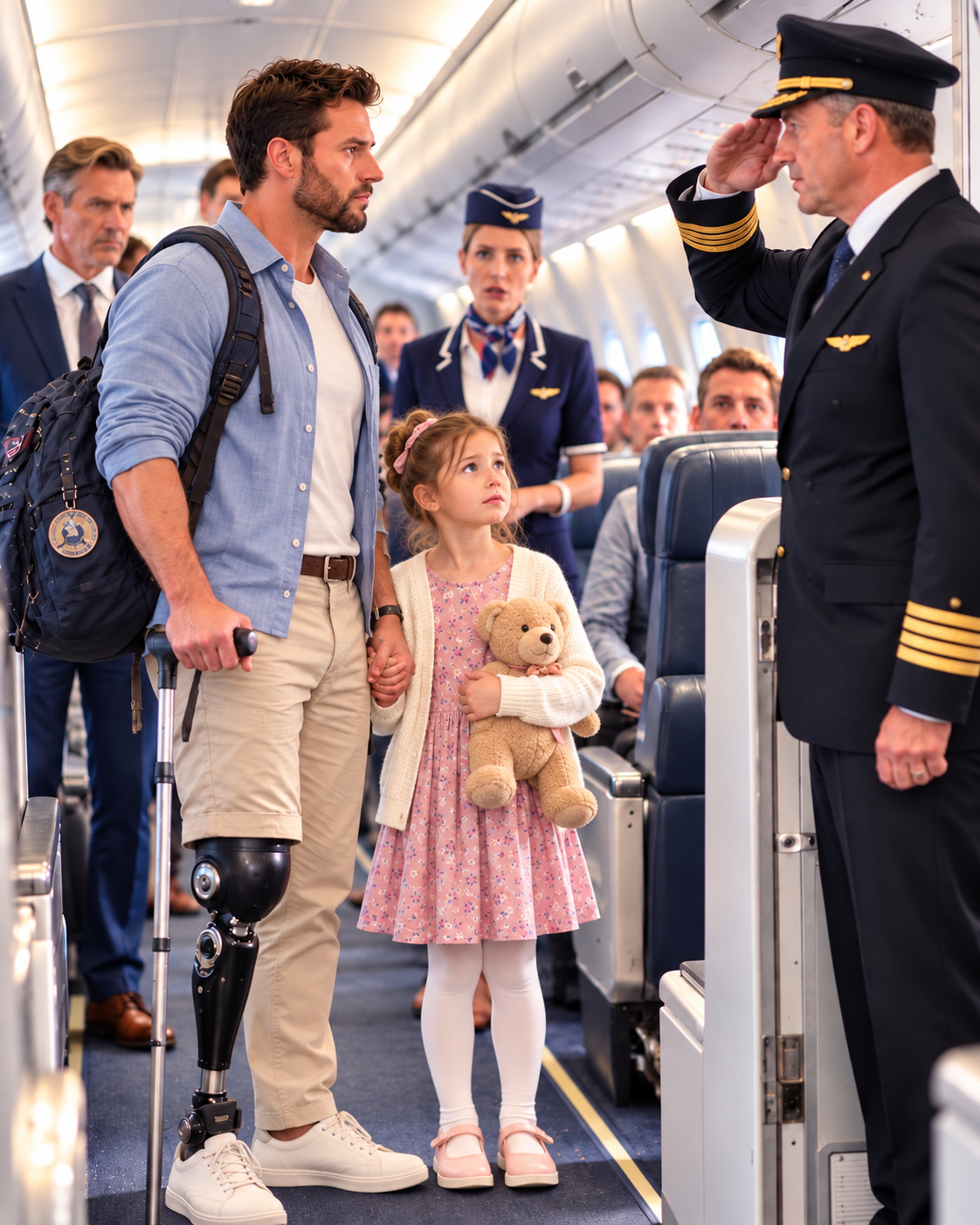
We had only taken a few steps when the cockpit door opened.
The captain stepped into the aisle.
Gray touched his temples, and his uniform was perfectly pressed.
At first, he didn’t look at the gate agent.
He looked directly at me.
Then his eyes moved to my cane.
To the challenge coin hanging from my carry-on.
To the veteran ID still visible behind my boarding pass.
His expression changed.
He stepped closer.
Then he straightened his shoulders and raised his hand in a sharp military salute.
The entire aircraft fell silent.
For a second, I nearly lost my grip on the bag.
For two years, I had simply been the widower limping through school pickup.
The tired father strangers passed in grocery stores.
The man people stepped around because he walked too slowly.
Now an airline captain was standing in front of an entire cabin saluting me.
I straightened as much as I could.
Then I returned the salute.
Maya stared at me as though she were seeing her father differently for the first time.
The captain lowered his hand.
“Sir,” he said, loudly enough for every first-class passenger to hear, “it’s an honor to have you aboard my aircraft.”
Then he turned toward the gate agent.
“This man and his daughter are not moving.”
The gate agent went pale.
The businessman suddenly became very interested in the floor.
“They are exactly where they belong,” the captain said.
Nobody spoke.
Then he glanced at the passenger manifest near the galley.
His eyes narrowed.
He looked back at me.
“Vance?”
Something in his voice made a chill move through me.
“Yes.”
“Marcus Vance?”
I nodded.
For a moment, he simply stared.
Then he whispered a name I had not heard in years.
“Captain Daniel Mercer?”
The world seemed to stop.
I stared at him.
He was older now.
His hair was gray.
His face had changed.
But suddenly I saw him differently.
Not in an airline uniform.
In camouflage.
Covered in dust and blood.
“Mercer?” I whispered.
His eyes filled.
“Oh, God.”
He stepped forward and grabbed my shoulder.
The cabin remained completely silent.
Maya looked between us.
“Daddy, who is he?”
I couldn’t answer immediately.
Daniel Mercer had been an Army helicopter pilot during my second deployment.
Eight years earlier, his aircraft had gone down after taking fire during an evacuation mission.
I had been part of the ground team sent to reach the crash.
By the time we got there, the wreckage was burning.
One crew member was dead.
Another was badly injured.
Mercer had been trapped inside.
I still remembered the flames.
The ammunition cooking off nearby.
Someone yelling that we had less than two minutes before the fuel ignited.
I remembered crawling into the wreckage anyway.
Mercer had been unconscious.
His leg was pinned.
We managed to cut him loose.
I dragged him nearly seventy yards before the helicopter exploded.
Minutes later, a second attack hit our position.
That was where I lost my leg.
I woke in a military hospital days later.
Someone told me Mercer had survived.
Then our units were scattered, reassigned, transferred.
Life moved forward.
I never saw him again.
Until now.
Mercer turned toward the passengers.
“This man saved my life.”
Nobody moved.
The gate agent stared at me.
The businessman looked as if he wanted to disappear into his suit.
Mercer continued.
“Eight years ago, I was trapped inside a burning aircraft overseas. Everyone was ordered to clear the area because the wreck was about to explode.”
His voice tightened.
“Marcus Vance went back for me anyway.”
Maya’s mouth fell open.
I looked down at her.
She had heard fragments about my service, but I had never told her much.
Elena and I had decided long ago that Maya didn’t need to grow up surrounded by stories of war.
Mercer looked at my prosthetic leg.
“He lost part of his leg minutes after carrying me away from that wreck.”
The cabin stayed silent.
Then someone in the second row began to clap.
Another passenger joined.
Then another.
Within seconds, almost the entire first-class cabin was applauding.
I hated attention.
Always had.
But when I looked at Maya, I saw tears on her cheeks.
Not sad tears.
Proud ones.
She wrapped both arms around my waist.
“You saved him?”
I rested my hand on her hair.
“We saved each other, sweetheart. A lot of people did brave things that day.”
Mercer shook his head.
“That sounds exactly like you.”
Then he turned sharply to the gate agent.
“Who authorized moving them?”
The agent swallowed.
“There was a seat accommodation request from Mr. Whitaker’s company, Captain.”
Mercer looked at the businessman.
“So you arrived late and expected a seven-year-old girl and her father to give up seats they purchased?”
The businessman finally spoke.
“I wasn’t told there was a child involved.”
The gate agent looked at him.
“That isn’t true.”
The businessman’s face reddened.
Mercer’s expression hardened.
“You can take the open seat in economy or take the next flight.”
“But my company—”
“This is my aircraft.”
That ended the discussion.
The man grabbed his briefcase and walked toward the back without another word.
The gate agent quietly apologized to us.
I could tell he wanted to disappear too.
I didn’t humiliate him.
I simply said, “Next time, ask instead of assuming.”
He nodded.
“You’re right, sir.”
Maya and I returned to our seats.
But Mercer stayed beside us.
Then he noticed how carefully I was holding the carry-on.
“Important cargo?”
I looked at Maya.
She nodded permission.
“My wife.”
Mercer’s face changed.
I explained about Elena.
About the cancer.
About the beach.
About the promise.
Mercer took off his captain’s hat.
“I’m sorry.”
“Thank you.”
He looked toward the cockpit, then back at me.
“What beach?”
I told him.
His eyes softened.
“We’ll be flying almost directly along that stretch of coastline during descent.”
Then he crouched beside Maya.
“How would you like to help me with something special for your mother?”
Maya blinked.
“What?”
“Come see me after we land.”
For the rest of the flight, everything felt different.
Passengers stopped by quietly to shake my hand.
An elderly woman gave Maya a small silver bracelet she had been wearing.
A man across the aisle bought her a chocolate dessert.
I appreciated the gestures, but I also felt uncomfortable.
I hadn’t boarded the plane to become anyone’s hero.
I was just trying to keep a promise.
About twenty minutes before landing, Mercer’s voice came over the intercom.
“Ladies and gentlemen, we’ll shortly begin our descent toward the Carolina coast. Today we have a special family aboard, returning to a place that means a great deal to them. With their permission, we’ll be taking a slightly wider coastal approach.”
I stared toward the window.
Maya pressed her face against the glass.
Minutes later, the ocean appeared beneath us.
Blue water.
White sand.
A long curving shoreline.
Then I saw it.
The lighthouse.
The wooden pier.
The beach where Elena and I had spent our first weekend together.
Maya gasped.
“That’s Mama’s beach.”
I couldn’t speak.
I pressed my fist against my mouth.
For the first time since Elena died, I allowed myself to cry in front of strangers.
Maya slipped her tiny hand into mine.
“She can see us, Daddy.”
Maybe she could.
Maybe she couldn’t.
But in that moment, I wanted to believe her.
After landing, Mercer met us at the door.
But instead of sending us directly into the terminal, he had arranged something else.
Two airport operations employees escorted us to a quiet observation area overlooking the ocean side of the runway.
Mercer joined us once his post-flight duties were complete.
Then he handed Maya a small pair of pilot wings.
“For your mom,” he said.
Maya held them to her chest.
We drove to the beach later that afternoon.
Mercer came too.
He told me he had been trying for years to find the soldier who had pulled him from the wreckage.
Military records, relocations, privacy restrictions, and a misspelled surname in an old report had kept him from finding me.
He had eventually left the military and become a commercial pilot.
“Every time I flew over this coast,” he told me, “I wondered whether I’d ever get the chance to thank you.”
I smiled.
“And I spent years wondering whether you made it home.”
“I did.”
He looked toward Maya.
“Because of you.”
At sunset, Maya and I walked into the shallow water.
I carried Elena’s ashes.
The wind was warm.
The sea moved gently around my prosthetic leg.
Maya held one side of the container.
“You ready?” I asked.
She nodded.
“Bye, Mama.”
Together, we released the ashes into the ocean.
For several seconds, neither of us moved.
Then Maya began crying.
I picked her up.
She wrapped her arms around my neck.
“I miss her.”
“I know.”
“Do you?”
“Every day.”
Behind us, Mercer stood far enough away to give us privacy.
When Maya finally calmed, she looked at me.
“Daddy?”
“Yeah?”
“That man on the plane thought we didn’t belong in first class.”
I sighed.
“He did.”
“But the captain said we did.”
“Yes.”
She thought about that.
Then she shook her head.
“No. I think Mama would say we belong wherever we worked hard to get.”
I smiled.
“That sounds like your mother.”
Three months later, an envelope arrived at our house.
Inside was a photograph of Mercer, Maya, and me standing on that beach.
There was also a letter.
Marcus,
For eight years, I thought the most important moment of my life was the day you carried me out of that wreck.
I was wrong.
The most important moment came afterward—the years I got to live because you refused to leave me behind.
I watched my daughter graduate.
I walked her down the aisle.
I held my first grandson.
Every one of those moments exists partly because of you.
You once carried me home.
I’m grateful I could help carry you and Maya back to Elena.
Your brother always,
Daniel.
I read the letter twice.
Then I placed it beside Elena’s photograph.
The coffee can still sits on top of our refrigerator.
But the label has changed.
Maya crossed out “Mama’s Beach Fund.”
Underneath, she wrote:
“OUR NEXT ADVENTURE.”
And every now and then, when life makes me feel invisible again, I remember that airplane cabin.
Not the applause.
Not the salute.
Not even the first-class seats.
I remember Maya looking up at me after discovering a piece of my past I had never shown her.
And I remember what I finally understood that day.
A person’s worth is not decided by the clothes they wear, the seat they occupy, the balance in their bank account, or whether strangers recognize their sacrifices.
Sometimes the quietest person in the room has carried battles nobody else can see.
And sometimes all it takes is one person who remembers to make everyone else look again.