My Mother Gave Me 60 Days to Leave—Then Grandma’s Lawyer Revealed Who Really Owned the Farmhouse
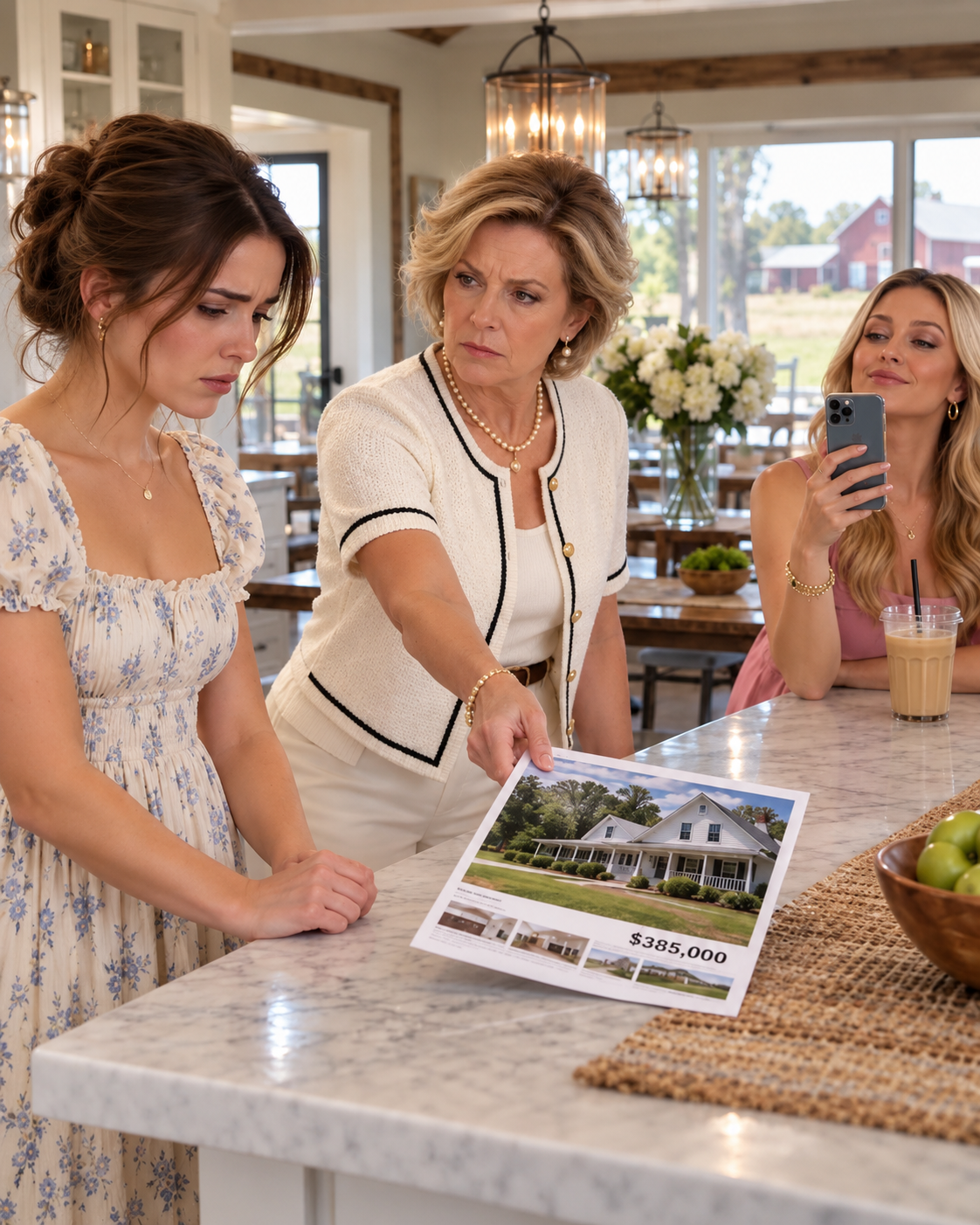
My mother slid a glossy real estate listing across the kitchen counter.
“We’re selling. You have sixty days to leave.”
For a moment, I thought I had misunderstood her.
Then I looked down.
There it was.
A professional photograph of the farmhouse where I had lived most of my life, beneath bold black letters:
FOR SALE — $385,000
Across from me, my half-sister Presley raised her phone and hit record.
“Finally,” she said, laughing. “Good luck, loser.”
I stared at her.
Presley was twenty-seven, six years younger than me, and had somehow transformed never holding a real job into a lifestyle brand.
According to her social media, she was a “digital creator.”
According to reality, my mother paid her car insurance, credit cards, rent whenever she decided she needed an apartment for “content,” and most of the luxury vacations she pretended brands had sponsored.
Meanwhile, I had worked graveyard shifts at a diner while attending community college.
I had paid my own tuition.
My own insurance.
My own groceries.
Even my own contact lenses.
But Presley had always been the golden child.
And I had always been the inconvenience.
My mother, Diane, folded her arms.
“I’m buying a new house outside Asheville. Modern kitchen, mountain view, community pool. I’ve already put down a deposit.”
“You listed this house without telling me?”
“It’s my house.”
Something about the certainty in her voice bothered me.
The farmhouse had been in our family for forty-one years.
But when I thought of it, I didn’t think of my mother.
I thought of Nana Evelyn.
I remembered her kneeling in the garden until her knees hurt.
Painting the porch every few summers.
Replacing broken fence boards herself because she said paying someone else seventy dollars an hour was “highway robbery.”
This house was Nana’s sweat, savings, and stubborn determination.
She had loved it.
And she had loved me.
More importantly, she had been the only person in my family who never made me feel like I needed to earn the right to be there.
My mother tapped the listing.
“The agent wants to start showings next week.”
“Sixty days,” I repeated.
“That’s generous.”
Presley turned her phone toward herself.
“Mom, say the part about the couch again.”
My mother smiled.
“I told Bridget she can stay on a friend’s couch until she figures her life out.”
They both laughed.
Something inside me became very still.
I didn’t scream.
I didn’t argue.
Instead, I walked upstairs.
“Where are you going?” Mom called.
I didn’t answer.
At the back of my closet was an old storage box containing the few things I had kept from Nana Evelyn.
Her recipe cards.
A blue scarf.
Two photographs.
And a faded quilted pouch she had pressed into my hands three days before she died.
I could still remember that afternoon.
Nana had looked impossibly small beneath the hospital blanket.
But her eyes were sharp.
“Bridget.”
I leaned closer.
She placed the pouch in my hands.
“Keep this somewhere safe.”
“What is it?”
“You’ll know when you need it.”
“Nana—”
“Promise me.”
I promised.
For almost two years, I had never opened it.
That day, I finally did.
Inside was a heavy brass key.
A business card.
Arthur Finley, Attorney at Law.
And a sealed letter.
My fingers trembled as I opened it.
My dearest Bridget,
If you are reading this, your mother has done what I always feared she would do. Do not argue with her. Do not warn her. Take this letter and the key directly to Arthur Finley. He has been holding the armor I built for you.
I stopped breathing.
I read it again.
Then I grabbed my purse and left.
My mother shouted from downstairs.
“Where are you going?”
“Out.”
Presley laughed.
“Probably apartment hunting.”
I kept walking.
Finley & Associates occupied the second floor of an old brick building downtown.
I almost turned around twice.
Then I remembered Nana’s letter.
I opened the heavy mahogany door.
A silver-haired receptionist looked up.
She stared at me for perhaps three seconds.
Then she picked up her phone.
“Arthur,” she said quietly.
A pause.
“She’s here.”
I froze.
A door at the far end of the hall opened.
An attorney in his late sixties stepped out.
He wore a charcoal suit and gold-rimmed glasses.
“Bridget Summers?”
“Yes.”
His shoulders seemed to relax.
“Thank God.”
He took both of my hands.
“I cannot tell you how glad I am that you finally walked through that door.”
He led me into his office.
Then he shut the door.
And locked it.
I must have looked terrified, because he smiled.
“Privacy. Nothing more.”
I handed him Nana’s letter.
He read one line, then gestured toward the chair opposite him.
“Ms. Summers, you need to sit down.”
My knees suddenly felt weak.
Arthur opened a locked cabinet and removed a thick folder.
On the front was my grandmother’s name.
EVELYN SOMERS FAMILY TRUST
He placed it between us.
“Your mother cannot sell the farmhouse.”
I blinked.
“What?”
“She doesn’t own it.”
I almost laughed.
“She says she does.”
“I’m sure she does.”
Arthur opened the folder.
“Your grandmother purchased the property forty-one years ago. Your mother lived there, but ownership remained exclusively with Evelyn.”
“I thought Nana left it to Mom.”
“That is what your mother believes.”
He slid a document toward me.
“But your grandmother revised her estate plan six years before her death.”
My name was on the page.
Not my mother’s.
Mine.
Arthur looked directly at me.
“The farmhouse belongs to a trust. You are the sole beneficiary.”
I stared at him.
“So… I own it?”
“Effectively, yes.”
My mind raced back to my mother calmly announcing the sale.
“The realtor already listed it.”
“Then either your mother misrepresented ownership or the agent failed to verify the title before marketing it.”
Arthur’s expression hardened.
“Neither gives your mother authority to transfer this property.”
I whispered, “Why didn’t Nana tell me?”
“Because she knew your mother.”
He opened another document.
“Evelyn feared Diane would pressure you, guilt you, or manipulate you into signing something.”
That sounded exactly like my mother.
Arthur continued.
“So your grandmother created protections.”
“What protections?”
He leaned back.
“This is where things become interesting.”
The brass key opened a safe-deposit box.
And what Nana had placed inside it was far more than another deed.
There were bank statements.
Investment documents.
Letters.
Receipts dating back almost twenty years.
And a handwritten ledger.
Arthur explained that Nana had suspected my mother was taking money from accounts intended for my education.
When I was twelve, my grandfather had left $48,000 in a custodial account for me.
I had never known it existed.
By the time I turned eighteen, almost all of it was gone.
Withdrawals had been made for “educational expenses.”
Except the attached receipts showed what the money had really purchased.
A used BMW.
A Caribbean vacation.
Furniture.
And payments on a credit card held in my mother’s name.
I felt sick.
“I worked nights because she told me there was no money for college.”
Arthur nodded slowly.
“Your grandmother discovered that too late. It is one of the reasons she changed her estate plan.”
Then he showed me something else.
Nana had left investments worth just over $260,000 inside the trust.
For me.
I covered my mouth.
“All of this is mine?”
“Yes.”
“Why?”
Arthur seemed surprised by the question.
“Because your grandmother believed you deserved a chance to build a life without begging your mother for permission.”
For several seconds, I couldn’t speak.
Then Arthur pulled the real estate listing toward himself.
“And now we deal with this.”
He picked up his phone.
“What are you doing?”
“Protecting your property.”
Just as Nana had instructed him to do.