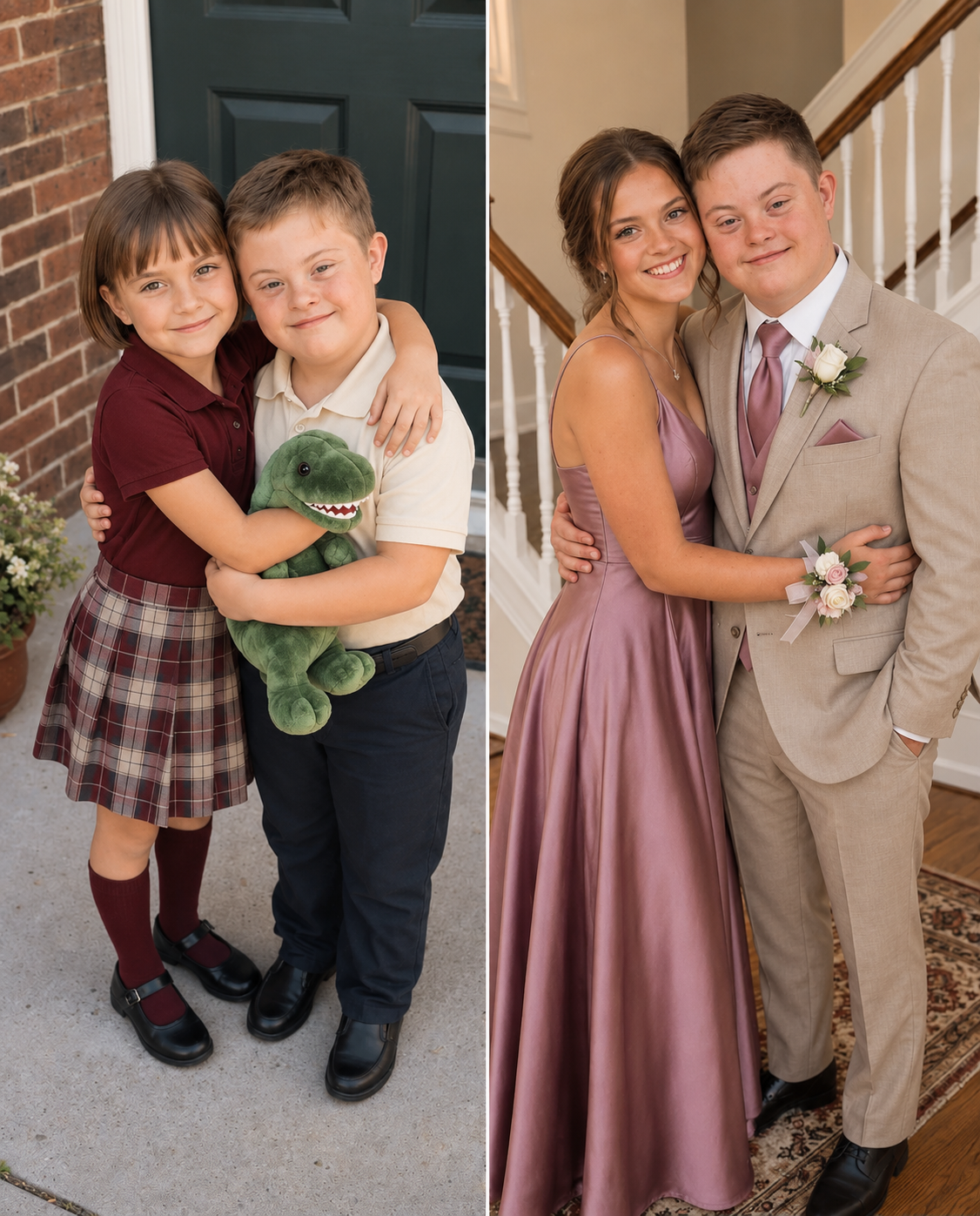
When I was six years old, I promised my best friend Noah that one day we would go to prom together.
At the time, “prom” was just a mysterious grown-up word we had heard from our teacher.
Twelve years later, Noah stood at our front door in a midnight-blue suit, holding a corsage in both hands.
And my mother locked me in my bedroom.
“You can go with him,” she said, her hands trembling. “But before you do, there’s something you need to know.”
I stared at her.
Downstairs, I could hear Noah laughing with my younger brother.
He sounded nervous and happy.
Exactly as I had imagined he would.
“What are you talking about?”
Mom sat on the edge of my bed.
“Do you remember when you disappeared for several hours when you were seven?”
I frowned.
I remembered fragments.
My parents fighting.
Police cars.
My mother crying.
A strange motel room that sometimes appeared in my dreams.
But whenever I had asked about that day, my parents had told me I had wandered away during a difficult period in our family.
Mom opened the drawer of my old desk and removed a tiny plastic bracelet.
Pink beads.
A silver plastic star.
The string was torn and one side was stained brown.
I recognized it immediately.
“I wore that all the time.”
“I know.”
“Where did you get it?”
Mom took a long breath.
“Noah found it.”
My stomach tightened.
Then she told me the story she had kept from me for eleven years.
My parents were in the middle of a terrible divorce when I was seven.
My father had lost temporary custody after several frightening arguments at home. He was allowed supervised visits, but he was furious about it.
One afternoon, he appeared outside our elementary school.
He told me Mom had sent him.
I trusted him.
Of course I did.
He was my father.
I got into his car.
But Noah saw us leave.
“He knew something was wrong,” Mom said.
“How?”
“Because you had told him that morning that I was picking you up.”
Apparently Noah had watched my father rush me toward the parking lot.
He later told his mother that I looked scared.
Most seven-year-olds would have gone home.
Noah didn’t.
His grandmother was late collecting him that afternoon, and instead of waiting near the school entrance, Noah followed my father’s car as far as he could on his bicycle.
He lost sight of us several blocks away.
But he remembered something my father had once told us.
There was an old baseball field near the highway where Dad used to play as a teenager.
Noah pedaled there.
And he found my father’s car parked behind the empty bleachers.
I was sitting inside crying.
Dad had packed two suitcases into the trunk.
He was planning to take me out of state before Mom or the police could stop him.
Noah did not confront him.
He was seven.
He was terrified.
Instead, he rode to a nearby gas station, walked inside and told the cashier:
“My friend is in a car with her dad, but she isn’t supposed to be.”
The cashier called the police.
Twenty minutes later, officers surrounded the parking lot.
My father was arrested for violating the custody order and attempting to take me across state lines.
I was returned to my mother that evening.
I remembered none of it clearly.
Trauma had turned the day into disconnected pictures in my head.
The police.
The motel.
Dad shouting.
Mom holding me.
And Noah sitting on our front steps later that night.
“What happened to my bracelet?” I whispered.
“You tore it when you tried to get out of the car,” Mom said. “Noah picked it up near the bleachers.”
I stared at the little bracelet in her palm.
“But why didn’t anyone tell me?”
Mom’s eyes filled with tears.
“Because Noah asked us not to.”
I almost laughed.
“He was seven.”
“I know.”
“What could he possibly have said?”
Mom smiled through her tears.
“He said, ‘If she knows I saved her, she might think she has to be my friend.’”
My throat closed.
“He said that?”
Mom nodded.
“He made me promise that when you played with him, came to his birthday parties, defended him at school or chose him as your partner, it would be because you wanted to. Not because you felt like you owed him something.”
I sat there unable to speak.
Suddenly, dozens of memories returned to me.
Noah sharing half his sandwich with me even though I had forgotten mine.
Noah sitting beside me while my parents separated.
Noah throwing pebbles at my window after my first breakup and arriving with two tubs of ice cream.
Noah standing beside me at school when other kids decided being friends with him was somehow embarrassing.
I had always believed I was the protective one.
I had believed I was the person who defended Noah.
All those years, no one had told me that when we were seven, Noah had been brave enough to save me.
“Why are you telling me tonight?” I asked.
Mom looked toward the bedroom door.
“Because when he arrived downstairs, I saw that bracelet in his pocket.”
“What?”
“He brought it with him.”
My heart started racing.
Mom unlocked the door.
“Go.”
I didn’t walk downstairs.
I ran.
Noah was standing in the living room with my brother, straightening his bow tie for the tenth time.
When he saw me, he grinned.
“Wow.”
I stopped in front of him.
“Wow good or wow bad?”
“Wow very good.”
Then his smile faded slightly.
“You’ve been crying.”
I looked at him.
“You found me.”
His face changed.
For the first time that evening, Noah stopped smiling.
He glanced toward my mother.
“Oh.”
“That’s all you’re going to say?”
He shoved his hands into his pockets.
“I told her not to tell you.”
“You were seven!”
“So were you.”
“Noah…”
He looked uncomfortable.
“I didn’t do anything special.”
“You followed a car on your bicycle.”
“It was a fast bicycle.”
“You went to the police.”
“I went to a gas station.”
“You saved me.”
He shook his head.
“They saved you.”
I started crying again.
Noah looked alarmed.
“Please stop. Your makeup is doing something weird.”
I laughed through my tears.
There he was.
Exactly the same Noah.
I hugged him.
He froze for half a second, then wrapped his arms around me.
“You never wanted me to know because you thought I’d feel obligated to stay your friend?”
He nodded against my shoulder.
“That would be cheating.”
I stepped back.
“Then let me make something very clear.”
“Okay.”
“I’m going to prom with you because I want to.”
He smiled.
“Good. Because I already paid for the tickets.”
At prom, Noah danced to every fast song.
He refused every slow one.
A promise, apparently, was a promise.
Halfway through the evening, the DJ announced a special request.
A slow song began.
I turned toward Noah.
“I thought you hated slow songs.”
“I do.”
“Then who requested this?”
He reached into his pocket.
And pulled out the broken pink bracelet.
“I did.”
I stared at him.
He placed it carefully in my hand.
“You should have it back.”
My eyes filled again.
“You kept this for eleven years?”
“You keep important things.”
I held the bracelet tightly.
Then I offered him my hand.
“One slow dance.”
Noah sighed dramatically.
“Fine.”
We walked onto the dance floor.
Around us, couples swayed beneath strings of tiny lights.
Noah stepped on my shoe twice.
I accidentally hit him in the chin once.
Neither of us cared.
“You know,” I whispered, “when we were six, you asked if I would marry you.”
“I remember.”
“And I said maybe.”
“I remember that too.”
I smiled.
“Well, I still don’t know about marriage.”
He laughed.
“But I do know something.”
“What?”
“You’re stuck with me for a very long time.”
Noah grinned.
“I already knew that.”
Years later, that broken bracelet still sits inside a small glass box on my desk.
People sometimes ask why I keep something so cheap and damaged.
They don’t understand.
To everyone else, it is a child’s plastic bracelet.
To me, it is proof of something I learned far too late:
Sometimes the people who save us never ask to be called heroes.
Sometimes they simply stay beside us.
And sometimes a promise made by two six-year-olds turns out to be one of the most important promises we ever keep.