For three years, my son told me the same thing every November.
“Just us this year, Mom. We’re keeping Thanksgiving small. You understand.”
And for three years, I said I did.
I never complained.
I never asked to be included.
I simply bought a small turkey breast, made mashed potatoes for one, and ate Thanksgiving dinner alone while pretending it didn’t hurt.
What I didn’t know was that my daughter-in-law, Melissa, had been ordering Thanksgiving pies every year from the bakery where I worked.
And she had no idea I was the woman baking them.
I worked the ovens at Hartley’s Bakery, starting at five every morning.
Melissa always picked up her orders later in the day, so she had never seen me there.
Her order always came under her name.
But the phone number attached to it belonged to my son, Daniel.
I knew that number by heart.
The first year, I told myself it was probably a coincidence.
Maybe they were taking the pies somewhere else.
The second year, I stopped believing that.
The truth finally became impossible to ignore when a neighbor showed me photographs my granddaughter Emma had posted online.
There was Daniel’s dining room.
A huge turkey.
A long table.
Fourteen chairs.
Melissa’s parents.
Her brother and his wife.
Several cousins.
Friends.
And sitting in the middle of the table was something that made my stomach twist.
My mother’s white porcelain gravy boat with the thin gold rim.
I hadn’t seen it since my husband, Richard, died.
After the funeral, Daniel and Melissa had helped me pack away some of his belongings and several family pieces.
I had assumed the gravy boat had accidentally been misplaced.
Apparently, it had not.
I didn’t confront them.
Instead, I quietly began saving the bakery order tickets.
Three years.
Three Thanksgiving dinners.
Three orders large enough to feed a crowded house.
Then one afternoon, a young woman who worked at the bakery counter said something without realizing how important it was.
“Your daughter-in-law is sweet,” she told me. “She always says it’s sad that her husband’s mother refuses to come for Thanksgiving.”
I nearly dropped the tray I was holding.
“What?”
The girl looked embarrassed.
“She said they invite you every year, but you like being alone.”
That was when everything became clear.
Melissa had been telling me they weren’t hosting Thanksgiving.
And apparently she had been telling everyone else that I refused to attend.
She had created two separate stories and kept them going for three years.
Even Daniel seemed to believe I had simply declined their invitations.
That realization hurt almost more than being excluded.
My son had never once called me himself and said, “Mom, are you sure you don’t want to come?”
He had simply accepted whatever Melissa told him.
This year’s order finally pushed me over the edge.
Four pies.
Apple.
Pumpkin.
Pecan.
Sweet potato.
And beside the sweet potato pie was a handwritten instruction.
“Extra nutmeg, please. Family recipe. It’s a tradition!”
I stared at those words for a long time.
The recipe was mine.
Before that, it had belonged to my mother.
Apparently, Melissa wanted my family recipe on her Thanksgiving table.
She just didn’t want the woman who had taught her how to make it.
Then I looked again at the old Thanksgiving photographs.
That was when I noticed another detail.
A gray-haired man I didn’t recognize was sitting near the head of the table wearing Richard’s green cardigan.
My husband had worn that sweater every winter for almost twenty years.
I thought I had donated it after he died.
Seeing another man wearing it while sitting at my son’s Thanksgiving table felt strangely intimate.
Something inside me hardened.
Hartley’s offered delivery on large holiday orders.
So this year, I volunteered for Melissa’s route.
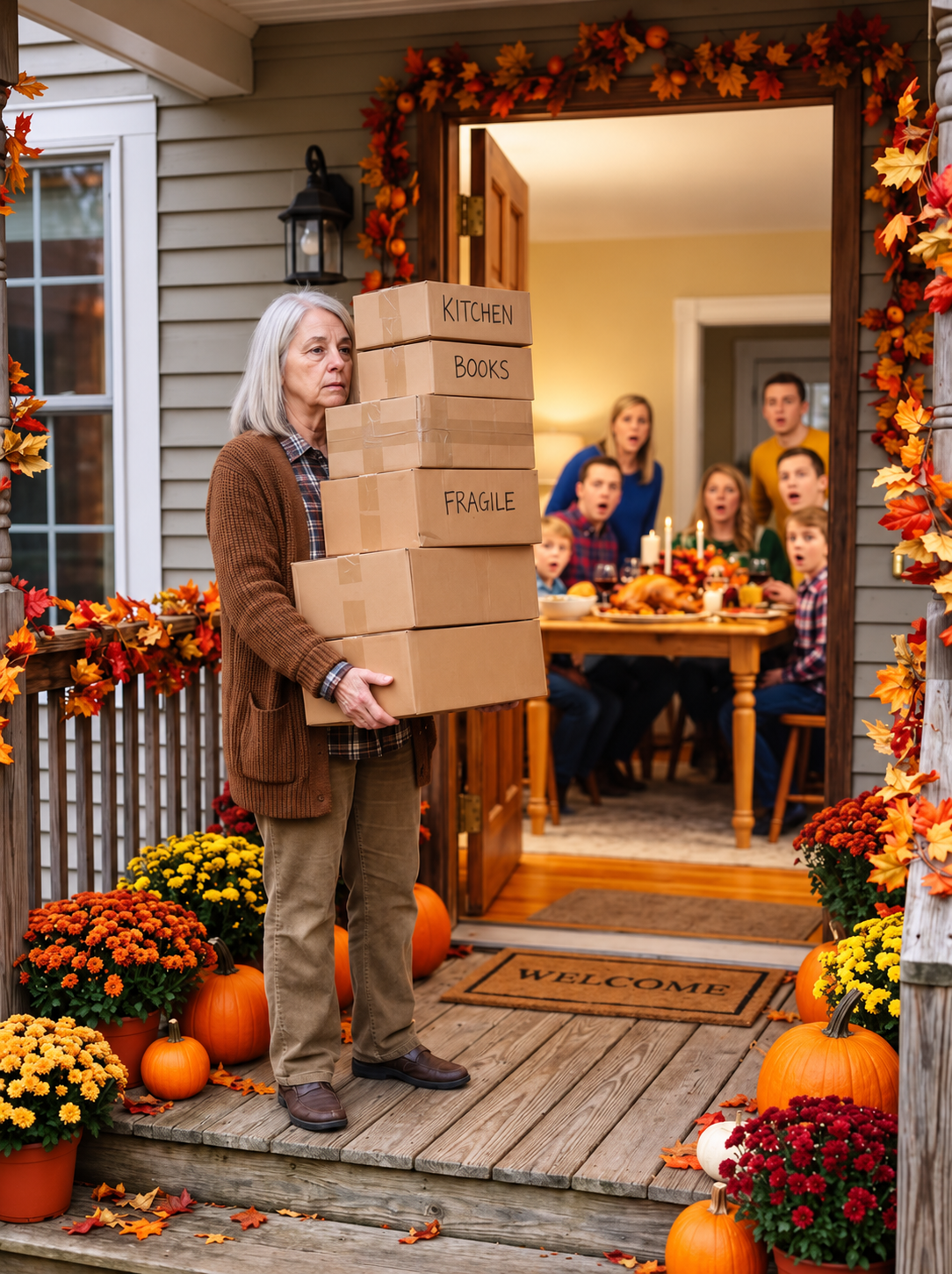
At 8:50 on Thanksgiving morning, I walked up my son’s front steps wearing my best navy coat.
In my hands were four pies.
Under my arm was an envelope containing the three previous order tickets.
I rang the bell.
There was laughter inside.
Dishes clattered.
Someone was playing music.
For a moment, I almost turned around.
Then the door opened.
Daniel stood there.
And in his hands was my mother’s gravy boat.
His face went completely blank.
“Mom?”
Behind him, the house slowly became quiet.
Melissa appeared from the dining room.
The color disappeared from her face.
“What are you doing here?”
I smiled.
“Delivering your pies.”
Daniel stared at the bakery boxes.
“You work at Hartley’s?”
“For six years.”
Melissa whispered, “Daniel…”
But before she could continue, her mother, Carol, stepped into the hallway.
She looked at me, then at the boxes.
“Melissa, isn’t that the pie lady you told us about?”
Melissa closed her eyes.
The silence that followed was so complete I could hear the clock ticking in the living room.
I handed Daniel the receipt.
Then I gave him the three older order tickets.
He looked at them one by one.
- 2023.
- 2024.
- 2025.
All Thanksgiving orders.
All under Melissa’s name.
All using his phone number.
Daniel looked up.
“What is this?”
I answered calmly.
“The Thanksgiving dinners you told me didn’t exist.”
His expression changed.
“I never told you that.”
“Yes, you did.”
“No. Melissa told me you didn’t want to come.”
I looked at her.
Daniel turned toward his wife.
“Melissa?”
She folded her arms.
“This isn’t the time.”
“It’s exactly the time,” Carol said quietly.
Melissa glared at her mother.
Then Daniel looked down and realized what he was holding.
The gravy boat.
I pointed to it.
“I’d like that back.”
His eyes widened.
“You gave this to us.”
“No, I didn’t.”
Melissa immediately interrupted.
“You said we could take some things after Richard died.”
“I said you could take the serving dishes I had placed in the donation boxes. That gravy boat belonged to my mother.”
Daniel looked sick.
I continued.
“And while we’re clearing things up, I’d also like Richard’s green cardigan returned.”
From the dining room, the gray-haired man slowly stood.
It was Melissa’s father, George.
He looked down at himself.
“This?”
I nodded.
George immediately began removing the cardigan.
“I’m sorry. Melissa gave it to me last Christmas. She said Daniel didn’t want it.”
Daniel’s face went pale.
“I never even knew you had it.”
Now everyone was looking at Melissa.
She finally snapped.
“Oh, come on! They’re just things!”
“No,” I said. “They’re memories.”
Then I looked at Daniel.
“And Thanksgiving isn’t just a meal.”
My son’s eyes filled with something I hadn’t seen in years.
Shame.
He asked the question I think he had been afraid to ask.
“How many Thanksgivings have you spent alone?”
“Three.”
He shut his eyes.
“Mom…”
I didn’t raise my voice.
I didn’t need to.
“I sat alone because I believed my son wanted a private holiday with his wife and daughter. Meanwhile, your wife told everyone I refused your invitations.”
Daniel turned to Melissa.
“Why?”
For the first time, she had no answer ready.
Then finally she said, “Because every holiday became about your mother.”
I almost laughed.
“I wasn’t even here.”
“That’s not what I mean,” she snapped. “The recipes were yours. The traditions were yours. Daniel compared everything to how you used to do it. Emma asked about Grandma’s stuffing, Grandma’s pies, Grandma’s decorations. I wanted one holiday that felt like mine.”
Carol stared at her daughter.
“So you solved that by stealing her traditions and excluding her?”
Melissa looked away.
That sentence ended the argument.
I had expected anger.
Instead, I suddenly felt exhausted.
I took my mother’s gravy boat from Daniel.
George handed me Richard’s cardigan, neatly folded.
Then I turned toward the door.
Daniel caught my arm gently.
“Mom, please stay.”
I looked at the crowded dining room.
Fourteen chairs.
Exactly as the bakery order had indicated.
“No,” I said.
His face crumpled.
“Please.”
“I’m not staying today because you feel guilty.”
That hurt him, but he nodded.
“I understand.”
“No,” I said softly. “You don’t. But maybe eventually you will.”
I walked home.
For the first time in three years, eating Thanksgiving alone didn’t feel humiliating.
It felt like a choice.
I heated soup, cut myself a slice of sweet potato pie I had saved at the bakery, and placed my mother’s gravy boat on the shelf beside Richard’s photograph.
At 7:20 that evening, someone knocked.
Daniel stood outside.
Alone.
He wasn’t carrying leftovers.
He wasn’t carrying flowers.
He was carrying an old cardboard box.
Inside were family photographs, serving spoons, Christmas ornaments, two pieces of my wedding china, and several other things I hadn’t realized were missing.
“I checked the storage room,” he said.
I stared at him.
He looked terrible.
“Melissa is staying with her parents for a few days.”
I didn’t respond.
He swallowed.
“I should have called you myself. Every year. I should have asked. I should have noticed.”
“Yes.”
“I’m sorry.”
There were a hundred things I could have said.
Instead, I stepped aside.
“Come in.”
Daniel sat at my kitchen table.
For the first time in years, we talked without Melissa interpreting one of us to the other.
He admitted that their marriage had been strained for some time.
Melissa had increasingly controlled their family plans, messages, and invitations.
But I refused to let him put everything on her.
“You’re my son,” I told him. “You had my phone number too.”
He lowered his head.
“I know.”
That mattered.
Because an apology means little if it comes with an excuse attached.
Over the next few months, Daniel began rebuilding our relationship.
Slowly.
He started calling me himself.
Emma began spending Saturday afternoons at my house again.
And in March, Melissa came to see me.
She apologized.
Not dramatically.
Not perfectly.
But sincerely enough that I listened.
I forgave her eventually.
Forgiveness, however, did not mean pretending nothing had happened.
The following Thanksgiving, Daniel called me in October.
“Mom, we’re having Thanksgiving at our house. I’m inviting you myself.”
I smiled.
“What time?”
“Two.”
“And how many people?”
He laughed nervously.
“Fourteen.”
This time, there was a seat for me.
Not at the end.
Not squeezed into a corner.
Right beside Emma.
My mother’s gravy boat sat in front of me.
And when Melissa brought out the sweet potato pie, she set it down carefully.
“I used your recipe,” she said.
I raised an eyebrow.
“Extra nutmeg?”
She smiled.
“Extra nutmeg.”
Then she handed me the knife.
“You should cut the first piece.”
And this time, when everyone gathered around that table, my traditions weren’t being used to replace me.
They were being shared with me.
That made all the difference.