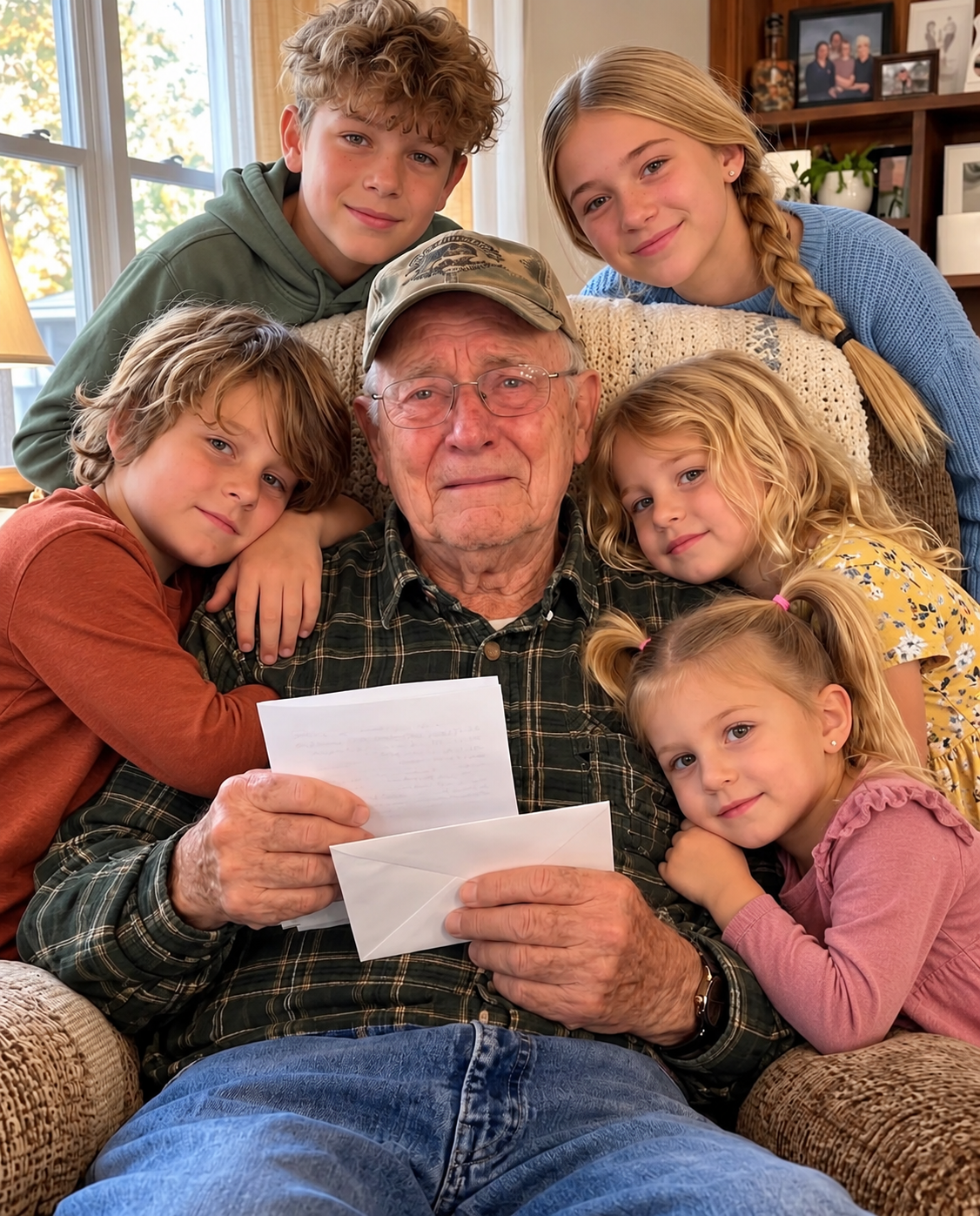
We decided to adopt our elderly neighbor after he became part of our family.
But when we handed him the papers, his face went white.
“There’s something I have to tell you,” Walter said.
We had five children, a loud house, a permanently overflowing laundry basket, and very little money left at the end of each month.
Walter had moved into the small house next door two years earlier, shortly after his wife, Margaret, died.
He was eighty-six then.
They had been married for forty-one years.
Walter spoke about Margaret constantly. He told us how she made coffee too strong, how she complained about his driving, and how she always left the porch light on when he came home late.
At first, Walter was just the lonely man next door.
Then he started throwing a ball with our children.
Then he began joining us for coffee.
Then dinner.
And somewhere along the way, he stopped being “Mr. Harris” and became “Grandpa Walter.”
No one planned it.
It simply happened.
When Walter got sick one spring, nothing serious but enough to frighten us, my husband, Daniel, and I realized how fragile the situation actually was.
If Walter ever ended up in the hospital, we weren’t his legal family.
We might not be allowed to make decisions, receive information, or even stay beside him.
That was when Daniel discovered adult adoption.
It sounded unusual at first, but the more we thought about it, the more sense it made.
Walter already was family.
We only wanted the law to recognize what our children already knew.
So we prepared the paperwork as a surprise for his eighty-eighth birthday.
The kids decorated the kitchen.
There was chocolate cake, crooked paper decorations, and six handmade cards because our youngest insisted Walter needed “an extra one from the dog.”
My daughter Emily handed him the folder.
“Open it, Grandpa.”
Walter smiled.
Then he read the first page.
The smile disappeared.
His hands began to tremble.
“There’s something I have to tell you,” he said.
He asked the children to take their cake into the living room.
Once they were gone, Walter closed his eyes.
“I should have told you months ago.”
Daniel sat down across from him.
“Told us what?”
Walter looked directly at me.
“I knew your father.”
I stared at him.
“My father?”
My father, Thomas, had died when I was eleven.
I remembered very little about the last months of his life. He had worked long hours, traveled often, and then one rainy evening there had been a car accident.
My mother rarely spoke about him afterward.
“What do you mean, you knew him?”
Walter stood slowly.
“I was his business partner.”
That made no sense.
My father had owned a small construction company.
At least, that was what I had always believed.
Walter continued.
“Your father and I started a company together in 1978. It became much larger than either of us expected.”
I felt my stomach tighten.
“What company?”
Walter gave me the name.
Harris & Cole Development.
I knew it.
Everyone in our city knew it.
It owned apartment buildings, commercial property, and several large developments throughout the state.
I laughed nervously.
“That can’t be right.”
“It is.”
Walter reached into his jacket and pulled out an old photograph.
Two young men stood beside a half-finished building.
One was Walter.
The other was my father.
I recognized him immediately.
On the back, written in faded ink, were the words:
Walter & Thomas — first project, 1979.
I sat down.
Walter explained everything.
My father had owned forty percent of the company.
When he died, his shares should have passed to my mother and eventually to me.
But my mother wanted nothing to do with the company.
She was grieving, overwhelmed, and afraid of debt.
So she signed an agreement allowing Walter to hold the shares in trust until I turned thirty.
There was only one problem.
My mother died before I turned thirty.
And by then, I had moved three times, gotten married, changed my last name, and had children.
Walter had tried to find me.
But not very hard.
That was the part he struggled to admit.
“I was a coward,” he said quietly. “The company was growing. Your shares became worth more every year. Margaret kept telling me to find you. She said the money wasn’t mine.”
I couldn’t speak.
Walter’s eyes filled with tears.
“But I kept delaying it.”
Daniel leaned forward.
“How much are we talking about?”
Walter swallowed.
“Today? Your portion of the company is worth approximately 3.8 million dollars.”
The kitchen went completely silent.
I honestly thought I had misheard him.
We were behind on two bills.
Our minivan needed repairs.
Three days earlier, I had stood in a supermarket putting cereal back because I had gone over our budget.
And now Walter was telling me that I had inherited millions?
I stood up so quickly that my chair scraped the floor.
“You knew this the whole time?”
“Not when I first moved here.”
That surprised me.
Walter explained that he had chosen the neighborhood randomly.
Then, several months after moving in, he heard one of the children say my maiden name while we were filling out a school form at the kitchen table.
Cole.
He asked questions.
Little by little, he realized who I was.
“Why didn’t you say anything then?”
Walter looked ashamed.
“At first, I was scared. Then I became attached to all of you. And the longer I waited, the worse it became.”
I felt betrayed.
For two years, this man had eaten at our table.
He had helped the children with homework.
He had attended school plays.
He had become family.
And he had been hiding something that could completely change our lives.
I walked outside.
Daniel followed me.
For almost twenty minutes, we sat silently on the porch.
Finally, he said, “He has to make this right.”
“I know.”
“But that doesn’t mean you have to forgive him tonight.”
I didn’t.
For several weeks, things between Walter and us were different.
He didn’t come for dinner.
The children kept asking why Grandpa Walter was always busy.
We told them adults sometimes had difficult things to work through.
Meanwhile, Walter gave us every document he had.
We hired an independent attorney and accountant.
They confirmed his story.
The trust existed.
The shares were legally mine.
And Walter had never sold them or transferred them.
More importantly, he had never taken dividends belonging to me.
He had placed every payment into a separate account.
The total was even larger than he had estimated.
Walter could have stolen everything.
He hadn’t.
He had simply been too ashamed to tell me the truth.
One afternoon, I walked next door.
Walter was sitting alone at his kitchen table.
The room looked painfully quiet.
He stood when he saw me.
“I’m sorry,” he said immediately.
“I know.”
I sat across from him.
“You should have told me.”
“I should have.”
“You had years.”
“Yes.”
“And I’m still angry.”
“You should be.”
For a moment, neither of us spoke.
Then I placed the adoption folder on his table.
Walter stared at it.
“I don’t understand.”
“The papers were never about money.”
His eyes filled with tears.
“You still want this?”
I smiled.
“You made a terrible mistake, Walter. But you also spent years protecting something that legally belonged to me when you could easily have taken it.”
He lowered his head.
“I don’t deserve you people.”
“That isn’t your decision.”
Three months later, we stood in a small courtroom.
All five children were there.
Our youngest wore a tie that he kept twisting backward.
When the judge asked Walter whether he understood that the adoption would legally make him part of our family, Walter started crying before she finished the question.
“Yes,” he said. “That’s all I’ve wanted for a very long time.”
The adoption was approved.
We didn’t suddenly become extravagant because of the inheritance.
We paid off our mortgage.
We created education accounts for the kids.
We repaired the minivan.
And Daniel finally convinced me to buy a new washing machine instead of repairing the old one for the seventh time.
But Walter did something else.
He transferred his own remaining shares into a charitable foundation named after Margaret and my father.
The foundation now helps elderly people who have no close family with housing, medical advocacy, and legal support.
Walter is ninety now.
He still lives next door, although the children insist that calling it “next door” is silly because he spends most evenings at our house anyway.
His chair at our table is always the same one.
And every birthday, my daughter Emily hands him the first gift.
Last year, Walter looked around the noisy kitchen and said something I’ll never forget.
“For years, I thought losing Margaret meant my family story was over.”
Then he looked at our children.
“I didn’t realize I was just waiting for the next chapter.”
And that was when I finally understood something too.
Family is not always the people you begin life with.
Sometimes it is the people who arrive later, carrying mistakes, secrets, grief, and second chances.
And sometimes, if you are lucky, they stay.