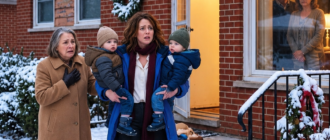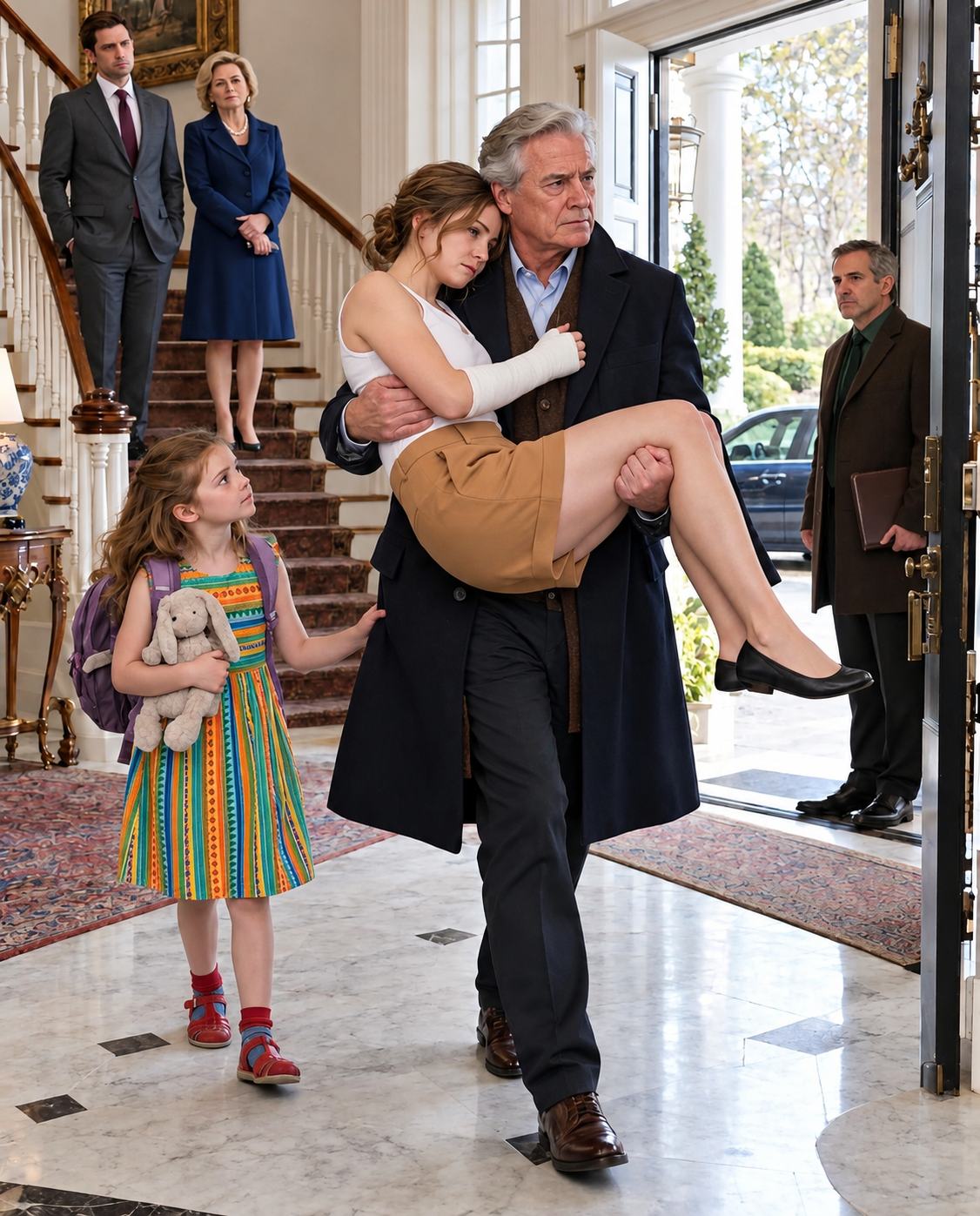
The first thing I remember after falling down the staircase was my mother-in-law’s voice.
Not concern.
Not panic.
Not even my name.
Just annoyance.
“Come get your daughter, Arthur,” Eleanor Whitcomb said into the phone. “We’ve done everything we can for her, and frankly, she’s become more trouble than she’s worth.”
I was lying on the cold marble floor of the Whitcomb mansion, trying to breathe around the sharp pain in my ribs.
My husband, Preston, stood only a few feet away.
He didn’t kneel beside me.
He didn’t tell his mother to stop.
He simply adjusted his cuffs and stared toward the front windows as though my fall had inconvenienced him.
Then I heard my father’s voice through the phone.
“If my daughter has been harmed, Eleanor, every person involved will answer for what happened.”
Eleanor laughed.
“You really don’t understand who you’re dealing with.”
She ended the call.
She had no idea how wrong she was.
My name is Claire Dawson Whitcomb, and until that morning, I had spent almost nine years telling myself I was lucky.
Lucky to marry into the Whitcomb family.
Lucky to live in an enormous house outside Richmond.
Lucky that Preston’s parents had “accepted” me despite the fact that I came from what Eleanor called an ordinary family.
I was a speech therapist at an elementary school.
Preston worked for his father’s development company.
His family had money, connections, and the kind of confidence that made everyone around them move a little faster.
At first, Eleanor’s criticism seemed harmless.
She disliked the way I dressed.
Then she disliked my job.
Then she questioned my parenting.
Then she began opening my mail, making decisions about our daughter Lily without asking me, and reminding me that everything around me technically belonged to the Whitcombs.
Preston always had the same response.
“She means well.”
By the eighth year of our marriage, I had heard those words so many times that they no longer meant anything.
The argument that morning began when I told Preston I wanted Lily and me to stay with my father for a few weeks.
“I need space,” I said.
Preston stared at me.
“From me?”
“From all of this.”
Eleanor appeared from the sitting room.
“If you leave, Lily stays.”
I turned toward her.
“She’s my daughter.”
“And she’s a Whitcomb.”
“That does not give you ownership of her.”
Eleanor stepped closer.
“You should be careful, Claire.”
“Are you threatening me?”
I remember her hand on my arm.
I remember trying to pull away.
Then my heel slipped near the top step.
The rest happened too fast.
By the time the ambulance arrived, I could barely sit up.
At the hospital, doctors found two fractured ribs and a badly strained shoulder.
But my first question was about Lily.
A man in a dark suit entered my room that afternoon.
“My name is Jonathan Hale,” he said. “Your father retained me.”
Before I could respond, he added, “Lily is with your father. She’s safe.”
I started crying.
Then Jonathan placed a folder on my blanket.
Preston had filed an emergency petition seeking temporary custody.
According to the documents, I was emotionally unstable.
Financially irresponsible.
Dangerous to myself.
Temporarily incapable of caring for my child.
I stared at the pages.
“They know that isn’t true.”
Jonathan nodded.
“They also know that if they repeat something confidently enough, people sometimes hesitate long enough for them to gain control.”
I looked at him.
“Why does my father have an attorney like you?”
Jonathan gave me a measured look.
“Because your father spent thirty-one years investigating people who thought money and reputation could protect them from consequences.”
I almost laughed.
“My father?”
Arthur Dawson lived in a small brick house outside Charlottesville.
He drove a twelve-year-old sedan.
He fixed his own plumbing.
He bought generic cereal.
Whenever anyone asked about his career, he said he had done “government legal work.”
Jonathan explained that Dad had actually supervised major federal investigations involving financial fraud, public corruption, and corporate misconduct.
When Dad walked into my room twenty minutes later wearing his familiar brown cardigan, he still looked like the same man who brought Lily homemade pancakes every Saturday morning.
He kissed my forehead.
“You scared me, sweetheart.”
“I didn’t know.”
“About what?”
“About you.”
He smiled faintly.
“There was never much worth talking about.”
Jonathan opened another folder.
Dad’s expression changed.
Inside were bank statements, trust records, transfer authorizations, and corporate filings.
At first, I didn’t understand.
Then I saw my name.
My grandmother had left me an investment account years earlier.
Preston had repeatedly told me the account had performed badly and was nearly depleted.
It hadn’t.
Nearly $860,000 had been moved from it during our marriage.
Much of that money had eventually gone into companies connected to Preston and his father.
Several authorization forms carried my signature.
Except I had never signed them.
I felt cold.
“That’s impossible.”
Dad asked quietly, “Did Preston ever give you financial paperwork to sign without explaining it?”
I remembered a stack of papers after Lily was born.
Insurance.
Taxes.
Estate planning.
At least, that was what Preston had told me.
“I signed some things.”
Jonathan shook his head.
“Several of these signatures aren’t yours. They’re reproductions.”
There was more.
One of the companies receiving my money, Marlowe Development Holdings, was already connected to another financial investigation.
Dad knew the company’s name.
That was why Eleanor’s phone call had immediately gotten his attention.
The next morning, Preston and Eleanor came to the hospital.
Preston carried flowers.
Eleanor wore pearls and the same expression she wore when sending food back at restaurants.
“We need to resolve this privately,” Preston said.
“No.”
His jaw tightened.
“Claire, think carefully.”
Jonathan stood by the window.
Dad sat beside my bed.
Eleanor looked at him.
“Arthur, surely you understand that Lily needs stability.”
Dad nodded.
“I do.”
Eleanor smiled.
“Then we agree.”
“No,” he said. “We don’t.”
Her smile vanished.
Dad leaned forward.
“A child does not belong in a house where her injured mother is left on the floor while someone prepares a custody strategy.”
Preston stepped closer.
“That’s a ridiculous accusation.”
Dad looked at him.
“Then perhaps Marlowe Development Holdings is also ridiculous.”
Preston went still.
Eleanor’s face changed for only a second.
But Dad saw it.
Jonathan saw it.
So did I.
Three days later, we appeared before a family court judge.
Preston’s attorney tried to portray him as a worried father protecting his daughter from an unstable wife.
Jonathan produced Lily’s school records.
Medical appointments.
Teacher emails.
Messages proving I handled almost every aspect of Lily’s daily life.
Then came something no one expected.
A security camera at the foot of the Whitcomb staircase had recorded audio from the morning of my fall.
The top landing wasn’t visible.
But the sound was clear.
Eleanor’s voice.
Mine.
“Let go of me.”
A thud.
My scream.
Then Preston:
“Mom, what did you do?”
And Eleanor’s reply:
“Call Arthur. If she leaves, we need Lily secured before Claire starts causing trouble.”
The courtroom went silent.
The judge denied Preston’s custody request.
I received temporary primary custody.
Lily remained with my father while I recovered.
Preston’s visits were supervised.
But the custody case was only the beginning.
Financial investigators began examining the Whitcomb companies.
Subpoenas followed.
Bank accounts were reviewed.
Former employees were questioned.
One accountant turned over emails proving Preston knew money from my inherited account was being diverted.
His father had approved transfers.
Eleanor had participated in preparing paperwork.
Other clients had also complained about questionable transactions.
What started as a family dispute widened into something far larger.
Within five months, federal authorities announced charges related to financial fraud, falsified documents, and unlawful transfers connected to multiple Whitcomb-controlled companies.
I never asked Dad for details.
He wasn’t part of the investigation.
He had simply known where to send the evidence and how to preserve it properly.
That was enough.
Six months after my fall, I sat across from Preston in a mediation room.
He looked exhausted.
“You’re really going to end our marriage over this?” he asked.
I stared at him.
“Over this?”
He looked away.
For years, I had believed marriage meant enduring difficult seasons.
Compromise.
Forgiveness.
Patience.
But somewhere along the way, I had started calling fear loyalty.
I had called silence peace.
I had called control love.
“I’m not ending the marriage today, Preston,” I said quietly. “It ended a long time ago. I’m just finally admitting it.”
Our divorce became final the following spring.
I regained the money that investigators could trace directly to my inheritance.
I received primary custody of Lily.
Preston was given structured visitation after completing court-required conditions.
Eleanor accepted a plea agreement on charges related to fraudulent financial documents.
Preston and his father faced separate financial consequences.
The Whitcomb name, once displayed proudly on buildings, charity events, and business magazines, became associated with investigations they had once assumed would never reach them.
Yet none of that became the most important part of my new life.
What mattered most was quiet.
Real quiet.
The kind that didn’t mean someone was angry.
The kind that didn’t force me to measure every word before speaking.
Lily and I eventually moved into a small two-bedroom house with pale blue shutters.
It wasn’t impressive.
There was no marble staircase.
No chandelier.
No staff.
The kitchen cabinets were slightly crooked, and one bedroom window stuck whenever it rained.
I loved every inch of it.
One evening, while unpacking the last few boxes, Lily found an old framed photograph from my wedding.
The Whitcomb mansion stood behind us.
“Mom?”
“Yes?”
“Do you miss that house?”
I looked at the picture for a long moment.
Once, I had believed that house proved I had succeeded.
I thought wealth meant safety.
I thought being chosen by Preston meant I had entered a better life.
I finally understood that a beautiful house can still be a terrible home.
“No,” I said.
Lily smiled.
“This house is smaller.”
“Much smaller.”
“And Grandpa’s house is old.”
“It is.”
She looked around our little living room.
“But people are nicer here.”
I laughed softly and pulled her into my arms.
“Yes.”
She rested her head against my shoulder.
“Then this one is better.”
She was right.
My father had warned Eleanor that everyone involved would answer for what happened to me.
She had laughed because she thought he was just an ordinary retired man.
But Dad never destroyed the Whitcombs.
He didn’t need to.
Their own documents did.
Their own greed did.
Their certainty that no one would ever challenge them did.
And the staircase I once thought had nearly ended my life became the place where my old life finally ended instead.
Because I learned something I wish I had understood years earlier.
A home isn’t the place with the biggest rooms, the most expensive furniture, or the most impressive name on the mailbox.
Home is the place where you are safe enough to speak.
Safe enough to stay.
And, if you need to, safe enough to leave.