My Father Locked Me Out During a Blizzard at −12°F. The Next Morning, a News Crew Arrived — and My Brother Revealed the Truth
My father’s hand slammed against the kitchen table.
“That’s irrelevant!” he shouted.
But for the first time in twenty-four years, I didn’t obey him.
I kept my eyes on my younger brother.
“Tyler,” I repeated quietly, “what time did Dad open the garage for you last night?”
My brother looked at our father, then at me.
And what he said next destroyed the perfect reputation our father had spent twenty-six years building.
But to understand why, I have to go back to the night before.
My name is Kayla Mercer. I’m twenty-four years old, and I work as a registered nurse at a regional hospital in Minnesota.
Until that winter, I lived with my parents.
Not because I couldn’t support myself. I was paying off student loans and saving for an apartment.
Every month, I gave my father $600 in rent and another $150 toward the Toyota Corolla he had helped me purchase.
The car remained registered in his name.
So, apparently, did my independence.
My father, Richard Mercer, had taught at the local high school for twenty-six years. He was respected, admired, and frequently invited to speak about responsibility, discipline, and family values.
At home, those values came with rules.
No guests without permission.
My phone location had to remain visible.
And regardless of my hospital schedule, I had to be home before ten.
My twenty-one-year-old brother, Tyler, had no curfew.
Dad called that “different circumstances.”
I called it unfair, but usually only in my head.
Then came the blizzard.
That evening, two nurses couldn’t reach the hospital because of the snow. My supervisor asked whether I could stay longer.
We had patients requiring medication, monitoring, and emergency care.
I couldn’t abandon them.
At 8:15 p.m., I texted my parents.
Hospital is short-staffed. I’ll be late. Roads are terrible. I’ll drive carefully.
Mom sent a heart.
Dad replied with one word.
Read.
I finished my work, changed into fresh scrubs, and started driving shortly after eleven.
Snow swept across County Road 75 so fiercely that I could barely see beyond my headlights.
That’s when I noticed the hazard lights.
An old pickup had slipped into a ditch. Beside it stood an elderly man struggling to climb a snow-covered embankment.
I pulled over.
His forehead was bleeding, his wrist hung at an unnatural angle, and his lips were beginning to turn pale.
His name was Walter Peterson.
Everyone called him Walt.
I called 911, helped him into my heated car, and wrapped my coat around his shoulders.
While we waited for the ambulance, he told me he’d spent thirty-one years driving snowplows on those very roads.
“Funny, isn’t it?” he murmured. “Spent half my life getting other people home. Now I can’t get myself there.”
I squeezed his uninjured hand.
“You’re going to get home, Walt.”
When the ambulance finally arrived, my coat went with him.
I didn’t mind.
He needed it more.
At 12:12 a.m., I pulled into my parents’ driveway.
The house was dark.
I hurried to the front door and turned my key.
It opened three inches.
Then stopped.
The security chain was fastened from inside.
A folded piece of paper had been pushed through the gap.
“Curfew is 10. Rules are rules.”
I stared at those words.
Then I knocked.
Nothing.
I called my mother.
She didn’t answer, but a text arrived moments later.
Honey, Dad says you knew the rules. He’ll open the door at six. I’m sorry.
I stood there in damp scrubs, staring at the house where I’d grown up.
It was twelve degrees below zero.
I could have called a coworker, but I was exhausted, embarrassed, and still foolishly hoping my father would change his mind.
Instead, I returned to my Corolla.
I checked the exhaust pipe repeatedly, ran the engine in intervals, and tried to stay warm.
At 1:20 a.m., headlights swept across the driveway.
Tyler’s red pickup pulled in.
Before he reached the garage, its door began opening.
Through the kitchen window, I saw Dad standing by the wall control, holding his favorite blue coffee mug.
He wasn’t asleep.
He hadn’t forgotten about me.
He had deliberately left me outside.
I watched Tyler disappear into the garage.
The door closed.
I sat alone in my freezing car and cried.
Not because I was cold.
Because, for the first time, I understood that my father’s rules had never really been about safety.
They were about obedience.
At 2:03 a.m., my phone rang.
It was Dana Peterson, Walt’s daughter.
She had gotten my number through the emergency responders after her father asked to thank me.
“He’s stable,” she said. “The doctors think he’ll recover well.”
I was so relieved that my voice broke.
Then she asked, “Did you make it home safely?”
I hesitated.
And finally told her the truth.
Twenty-five minutes later, Dana arrived carrying hot coffee, my coat, and an old army blanket that had belonged to Walt.
When she saw where I was sleeping, her expression changed.
“Your father knows you’re out here?”
I nodded.
“And he won’t let you inside?”
I nodded again.
Dana stared at the house for a long moment.
Then she said, “My father spent his life clearing roads so strangers could get home safely. You saved him tonight. And your own family won’t open a door?”
She offered me her guest room. I was too exhausted to drive again, so she called a nearby motel and helped me arrange a room. By then, the roads were beginning to clear.
The following morning, she posted the story on the Facebook page of her bakery.
She hadn’t mentioned my father’s name.
She simply described a young nurse who had helped an elderly stranger during a blizzard, then been forced to sleep in her car because her family refused to let her inside.
Within hours, the post had been shared more than three thousand times.
By nine that morning, a Channel 7 news van was parked outside our house.
I had returned to collect my work bag and some clothes when my mother opened the door to find a reporter standing on the porch.
“Excuse me, ma’am. Is this where the nurse who spent last night in her car lives?”
Mom went pale.
Dad appeared immediately.
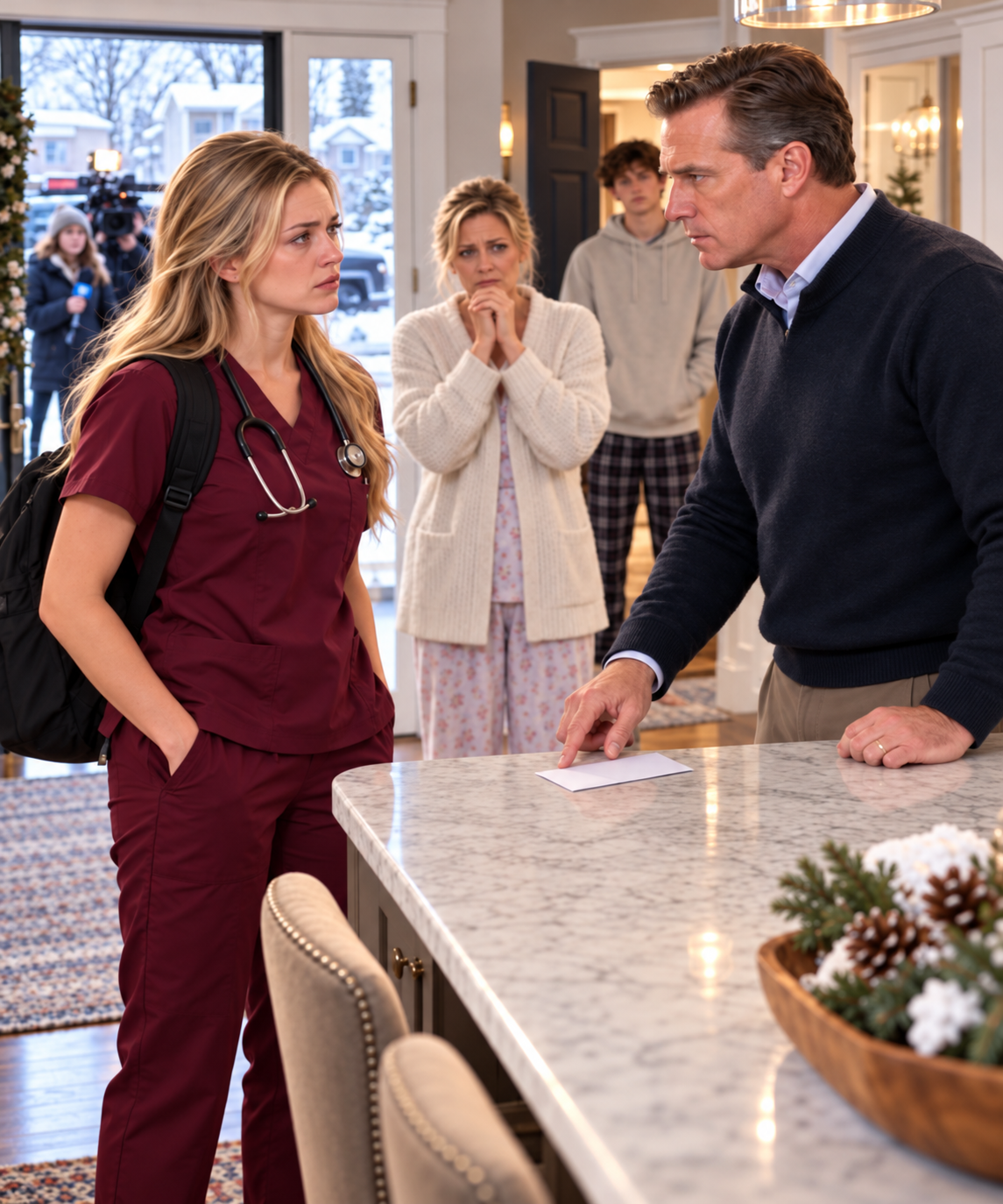
And within minutes, he was standing beside the kitchen island, holding an index card.
He had written three numbered sentences.
- The lock froze during the storm.
- Kayla voluntarily chose to remain in her car rather than wake the family.
- Nobody inside knew she was outside.
“That’s what you’ll say,” Dad instructed.
I stared at his familiar blue handwriting.
“The chain was on,” I said.
His jaw tightened.
“The house is mine. The car is mine. Think carefully before you embarrass this family.”
I looked toward my mother.
She stared at the floor.
Something inside me finally changed.
I walked outside and spoke to the reporter.
I told her about the hospital, about Walt, and about finding the security chain fastened when I got home.
I didn’t shout.
I didn’t exaggerate.
I simply told the truth.
That evening, Channel 7 aired the interview.
Dad switched off the television before it ended.
Three parents had already contacted his school. The principal was reconsidering his role in Monday’s character assembly.
My father was furious.
“You’re going to retract that interview tomorrow,” he announced. “Otherwise, you’re out of this house by Friday. And don’t expect to take the Corolla.”
Then I asked Tyler about the garage.
Dad slammed the table.
“That’s irrelevant!”
But Tyler finally raised his head.
“One twenty,” he whispered.
Dad glared at him.
“Enough.”
“No, Dad,” Tyler replied, his voice shaking. “It isn’t enough.”
He took out his phone.
“I need to show her something.”
On his screen was a text message from our father, sent at 1:11 a.m.
Use the garage when you get home. Your sister is outside. Do not let her in. She needs to learn that rules have consequences.
My mother covered her mouth.
I read the message three times.
Dad had known.
Not just that I was late.
Not just that I was outside.
He had specifically ordered my brother not to help me.
“Why didn’t you tell me?” I asked Tyler.
Tears filled his eyes.
“Because I was scared of him too.”
Then he turned toward Dad.
“But I’m more ashamed of myself now.”
My father tried to snatch the phone.
Tyler stepped back.
“Don’t,” he said.
It was the first time I’d ever heard my brother speak to our father that way.
Dad looked from Tyler to me.
“After everything I’ve done for you two, this is how you repay me?”
I felt the familiar urge to apologize.
But it passed.
“You didn’t teach us responsibility,” I said. “You taught us to be afraid of you.”
Then I went upstairs and packed a suitcase.
That night, I called my charge nurse, Emily, who had recently mentioned an empty bedroom in her duplex.
She told me I could stay there while I searched for my own apartment.
The next morning, Tyler helped carry my belongings to his truck.
Dad stood in the hallway with the Corolla keys in his hand.
“Those stay here,” he said.
I looked at them.
For eighteen months, I’d paid toward a car that was never legally mine.
But I was done bargaining for things he could take away.
“Keep it.”
Tyler drove me to Emily’s.
Before leaving, he hugged me so tightly that I nearly cried.
“I should’ve opened that door,” he whispered.
“Yes,” I said.
Then I hugged him back.
“But you opened another one.”
On Monday, my father didn’t lead the school’s character assembly.
The principal assigned another teacher while the school reviewed the complaints and Dad’s conduct.
I never contacted the school or demanded that Dad lose his job. But when he continued telling relatives the lock had frozen, Tyler chose to show the text message to our mother and the principal.
The truth no longer depended on my word alone.
A week later, I visited Walt at his daughter’s house.
He was sitting beside the fireplace, his injured wrist in a cast.
My coat lay neatly folded across his knees.
“I hear you caused quite a storm,” he joked.
I laughed.
“I think the storm was already there.”
His smile faded.
“Dana told me what happened.”
He reached for my hand.
“Thirty-one years I drove a snowplow. Know what I learned?”
I shook my head.
“You can clear a road for someone, but you can’t make them take it.”
I thought about my mother, who had called twice but still hadn’t apologized.
About Tyler, who had begun looking for his own apartment.
And about my father, whose messages I had stopped answering.
“Maybe,” I said, “some people have to find their own way out.”
Walt nodded.
“Exactly.”
Three weeks later, I signed a lease for a small one-bedroom apartment.
It wasn’t beautiful.
The kitchen was tiny, the bathroom tiles were old, and the living room window overlooked a parking lot.
But when I turned the key, the door opened.
Every single time.
On my first evening there, Mom arrived carrying a cardboard box.
Inside were my childhood photographs, my nursing school diploma, and the little ceramic angel my grandmother had given me.
“I should have opened the door,” she said.
I said nothing.
“I heard you knocking. I wanted to get up. But your father told me not to.”
Her eyes filled with tears.
“I was afraid of making him angry.”
I looked at her.
“So was I.”
For a long moment, neither of us spoke.
Then she whispered, “I’m sorry.”
It wasn’t enough to repair everything.
But it was the first honest thing she’d said about that night.
I invited her inside.
We drank tea at my little kitchen table.
And when she left, I walked her to the door without checking a clock.
My father eventually sent me a letter.
He wrote that he’d been humiliated, that his intentions had been misunderstood, and that discipline was an expression of love.
He never actually apologized.
I didn’t reply.
Perhaps someday we would have a different conversation.
But I wasn’t going to spend my life waiting for him to become the father I needed.
On a quiet Sunday morning, Walt called to thank me once more.
“How’s the new place, kid?”
I looked around my apartment.
The heater hummed.
Snowflakes floated past the window.
My nursing badge hung beside the door.
And my keys rested on a little wooden hook I’d installed myself.
“It’s good,” I said. “Really good.”
“Warm enough?”
I smiled.
“Very.”
For years, my father had told me that a good daughter followed the rules.
That winter, I learned something different.
A good home isn’t a place where someone controls when you may enter. It’s a place where you never have to earn the right to be safe.
And for the first time in my life, I was finally home.