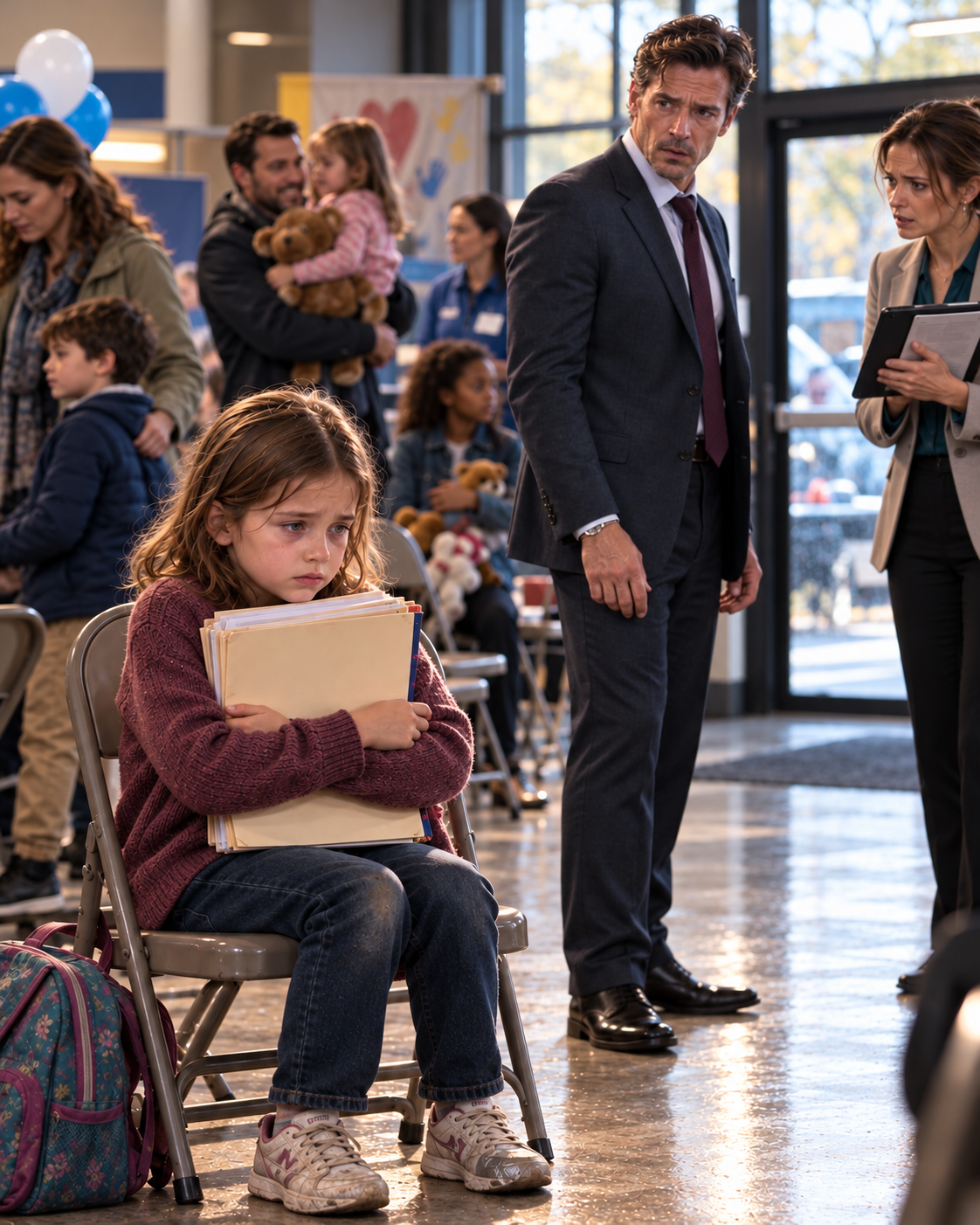
A Millionaire Saw Her Sitting Alone—Until He Heard Her Whisper, “Nobody Picks Me… They Never Do”
“Nobody picks me,” the little girl whispered, staring at the silver tape peeling away from the toe of her worn sneaker.
The wealthy man standing near the exit had come only to deliver a generous donation and leave before anyone asked him for anything else.
But then his assistant leaned closer and whispered something that changed everything.
“Sir, there’s a serious problem with that child’s file. Legally, she isn’t even supposed to be here.”
Carter Hale slowly turned toward the little girl.
And for the first time in years, he forgot about the meeting waiting for him.
The folding chairs in the community center never stood perfectly straight.
A volunteer had tried to arrange them twice before finally giving up.
The old building stood on Pittsburgh’s North Side, a place that had hosted weddings, charity dinners, blood drives, and children’s basketball games for decades.
The faded linoleum still carried marks left by furniture long since removed. Fluorescent lights buzzed overhead, and a pot of coffee sat beside a tray of inexpensive cookies.
Outside, cold March rain streaked the windows.
Inside, eleven children waited to meet prospective foster and adoptive families.
The organizers carefully avoided the word “chosen.”
Officially, this was a family-matching event, where approved adults could meet children who might eventually become part of their families.
There would be no immediate adoptions, no promises, and no guarantees.
But children understood something that paperwork could never explain.
They noticed which adults stopped to speak to them.
And which ones walked away.
Eight-year-old Emily Reed sat alone near the wall.
She was small for her age, with uneven brown hair falling over a faded gray sweater. Her jeans were slightly too short, and her sneakers had become so worn that someone had repaired one toe with silver duct tape.
A thick folder rested on her knees.
Her entire childhood seemed to be trapped inside it.
School records.
Medical reports.
Placement histories.
Psychological assessments.
Court documents.
Pages of professional observations describing a little girl who had already experienced more rejection than many adults could bear.
Across the room, a smiling couple stopped beside a boy named Marcus.
The woman knelt and asked him about dinosaurs.
Marcus immediately began talking, his face glowing with excitement.
Emily looked away.
Another family approached two sisters near the refreshments table.
The sisters held hands while the adults smiled warmly at them.
Emily watched their shoes.
She had learned that shoes were easier to understand than faces.
Faces sometimes showed pity.
But shoes always revealed when someone was leaving.
A woman in a cream-colored cardigan approached the row where Emily sat.
For one hopeful second, Emily straightened her back.
But the woman stopped beside the girl in the next chair.
She admired the child’s drawing, asked whether she liked animals, and laughed when the girl mentioned her favorite dog.
Then she stood and walked away.
Her shoes passed directly in front of Emily.
They never stopped.
Emily lowered her head.
She pressed the damaged toe of one sneaker against the other, trying to hide the peeling tape.
Behind her, two adults were speaking quietly.
“Her records mention attachment difficulties related to trauma.”
“We were hoping for someone younger.”
“But she’s only eight.”
“I know. Still, eight is different.”
Emily’s shoulders tightened.
They hadn’t mentioned her name.
They didn’t have to.
She knew what adults meant when they used that word.
Different meant complicated.
Different meant too much history.
Different meant someone else’s problem.
She blinked rapidly.
Crying only made adults uncomfortable.
And uncomfortable adults usually left.
“Nobody picks me,” she whispered.
Her voice was so quiet it almost disappeared beneath the humming lights.
“They never do.”
Near the exit, Carter Hale heard her.
At forty-five, Carter was one of Pittsburgh’s wealthiest businessmen.
His technology company, Hale Systems, employed thousands of people, and his name appeared regularly in business magazines.
He wore an expensive navy suit and carried himself with the confidence of a man accustomed to controlling every situation.
He had mastered the art of leaving uncomfortable rooms.
Board meetings.
Hospital corridors.
Funerals.
Family gatherings.
And now, apparently, charity events.
He had not come to meet children.
His company donated $250,000 annually to programs supporting young people in foster care, and the organization’s board had persuaded him to make a brief appearance.
Carter disliked publicity.
He disliked ceremonial photographs even more.
He had planned to hand over the donation, exchange a few polite words, and return to his office.
Then he heard Emily.
Something about those five words reached a part of him he had spent years trying to bury.
“Nobody picks me.”
His assistant, Daniel, approached carrying a tablet.
“Sir, the car is waiting. But there’s something unusual about that little girl’s paperwork.”
Carter glanced at him.
“What do you mean?”
“Her file appears to have been included in today’s event by mistake. The court records indicate her legal status hasn’t been properly updated. She’s not currently eligible for this particular matching program.”
Carter looked toward Emily again.
“Does she know?”
Daniel hesitated.
“I don’t think so.”
Carter’s expression changed.
“So she’s sitting there waiting for a family, and nobody has told her that even if someone wants to meet her, the process can’t move forward?”
“That’s what it looks like.”
For several seconds, Carter said nothing.
Then he removed his expensive coat and handed it to Daniel.
“Cancel my afternoon meetings.”
“Sir?”
“Every one of them.”
He walked across the room.
Emily noticed his polished black shoes first.
They stopped directly in front of her.
She slowly raised her eyes.
“Hello,” Carter said gently. “Is this seat taken?”
Emily shook her head.
He sat beside her, leaving enough space that she wouldn’t feel crowded.
“My name is Carter.”
“Emily,” she whispered.
“That’s a beautiful name.”
She shrugged.
“My mom picked it.”
“Did she?”
Emily nodded.
“She said it sounded like sunshine.”
Carter felt something tighten in his chest.
“Where is your mom now?”
Emily looked at the folder on her lap.
“She died when I was five.”
“I’m sorry.”
The girl gave another small shrug, the kind children learn when sadness has become too familiar.
“It’s okay. People say that a lot.”
Carter didn’t know what to say.
For once, his money, influence, and carefully practiced confidence offered him no useful words.
Then he noticed her shoes.
“What happened to your sneaker?”
“It broke.”
“Does it hurt when you walk?”
“Sometimes.”
“Why didn’t you tell someone?”
Emily looked surprised.
“Because they already have lots of things to worry about.”
Carter stared at her.
An eight-year-old child had learned to make herself smaller so that adults wouldn’t consider her a burden.
“Emily,” he asked softly, “what would you want most if you could have anything?”
She considered the question seriously.
“Not a toy?”
“Anything.”
“Someone who comes back.”
Carter swallowed.
“Comes back?”
“When they say they’ll come back, I want them to really do it.”
He looked away for a moment.
Years earlier, Carter had lost his wife and young daughter in a car accident.
Since then, he had filled his days with work, believing that staying busy would keep the silence away.
He had built a fortune.
But he had never rebuilt a home.
Now a little girl with broken shoes was sitting beside him, asking for the one thing money could not guarantee.
Someone who stayed.
Daniel approached carefully.
“Mr. Hale, the director would like to speak with you.”
Carter stood, then turned back to Emily.
“I need to talk to someone for a few minutes.”
Her expression immediately closed.
“Okay.”
“But I’m coming back.”
Emily stared at him.
“People say that.”
“I know.”
He paused.
“So don’t believe me because I said it. Wait and see what I do.”
For the first time, she looked directly into his eyes.
Carter followed Daniel into a small office.
There, the program director explained that Emily’s case had become trapped between agencies after a court hearing was postponed.
Her eligibility paperwork had not been updated, and she should not have been invited to the matching event.
The mistake had gone unnoticed until that afternoon.
“Then correct it,” Carter said.
“We’re trying, Mr. Hale. But there are procedures.”
“Of course there are. And they need to be followed.”
He took a breath.
“But while the adults sort out their paperwork, somebody needs to remember there’s a child sitting out there believing she’s unwanted.”
He offered to fund additional administrative and legal support for the program, without requesting special treatment for Emily.
Then he asked a question that surprised everyone.
“What would I need to do to become an approved foster parent?”
The director looked at him carefully.
“It’s a serious process, Mr. Hale. Background checks, training, home assessments, interviews. Your wealth won’t make it automatic.”
“I understand.”
“And it could take months.”
“Then I’d better start.”
When Carter returned to the hall, Emily was still sitting in the same chair.
She looked up in disbelief.
“You came back.”
“I told you I would.”
He sat beside her again.
“Emily, I can’t promise you anything today. But I’d like to get to know you, if the people responsible for your care agree.”
She studied his face.
“Why?”
“Because I think you’re worth knowing.”
Emily looked down at her shoes.
Then she asked the question that nearly broke him.
“Even if I’m difficult?”
Carter’s voice softened.
“Especially when things are difficult, people deserve someone who doesn’t disappear.”
That afternoon did not end with a miraculous adoption.
Emily returned to her foster home.
Carter returned to his empty mansion.
But something had changed.
Over the following months, Carter completed the required training, passed background checks, and opened his home to social workers who examined everything from safety arrangements to his ability to provide emotional stability.
With permission from Emily’s case team, he began attending supervised meetings with her.
At first, she barely spoke.
Then she started bringing drawings.
Later, she asked whether he liked pancakes.
One Saturday, during an approved visit, she spilled orange juice across his expensive kitchen table.
She froze.
“I’m sorry,” she whispered. “Please don’t send me away.”
Carter picked up a towel.
“Emily, it’s juice.”
“But I ruined your table.”
“Tables can be cleaned.”
She stared at him.
“And people don’t get sent away for accidents?”
“Not from my house.”
Months passed before the legal and placement processes allowed Emily to move in with him.
Even then, she slept with her shoes beside her bed.
She kept a small backpack packed beneath the pillow.
Carter never forced her to unpack it.
He simply kept showing up.
At school events.
At doctor’s appointments.
At bedtime when nightmares came.
At breakfast when she refused to speak.
Slowly, the backpack moved from beneath the pillow to the closet.
Then one evening, Emily unpacked it herself.
Nearly two years after that rainy afternoon, a judge finalized her adoption.
Emily wore a yellow dress and new white sneakers.
When the judge asked whether she wanted Carter Hale to become her father, she nodded so enthusiastically that everyone in the courtroom smiled.
Then she reached for his hand.
“Does this mean you really have to keep me?”
Carter knelt beside her.
“No, sweetheart.”
Her smile faded.
He gently held both her hands.
“It means I get to keep being your dad. And I choose that, every single day.”
Emily threw her arms around his neck.
For the first time, she cried without trying to hide it.
That evening, Carter placed the old sneaker with its silver duct tape inside a small glass display case in his study.
Not as a reminder of poverty.
Not as a symbol of charity.
But as a reminder of the day an eight-year-old girl taught a millionaire what wealth truly meant.
Years later, when someone asked Emily how she had found her family, she smiled.
“I was sitting alone in a room where everyone kept walking past me,” she said. “Then one man stopped.”
She paused.
“And the most important thing wasn’t that he chose me.”
“What was it?”
“He kept coming back.”
THE END.