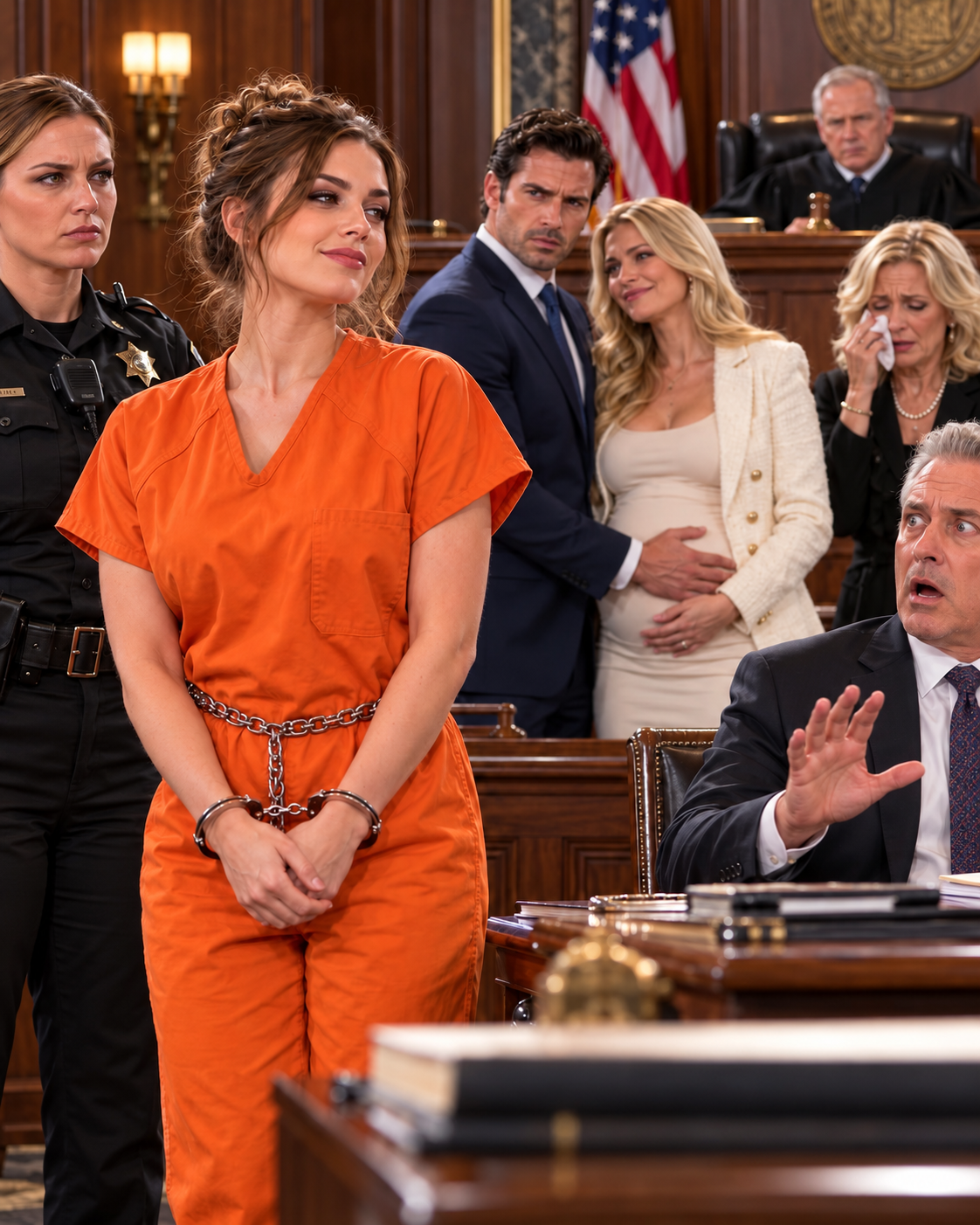
The judge sentenced me to twenty-five years in prison. As the guards approached to take me away, my mother-in-law pretended to cry while my husband lovingly stroked his pregnant mistress’s belly.
They thought they had won.
But when I calmly revealed one secret, the prosecutor suddenly shouted, “Stop the transfer!”
My name is Rosalind Whitmore, and three months earlier, I had been one of the wealthiest women in the country.
My adoptive father, Walter Whitmore, had built a business empire worth nearly five billion dollars. He raised me with love, taught me everything about business, and trusted me more than anyone.
When I married Grant, I believed I had found a man who loved me for who I was, not for my fortune.
I was terribly wrong.
I helped Grant become executive vice president of Whitmore Holdings. I welcomed his mother, Margaret, into our family and ignored her constant criticism.
Then my father died unexpectedly.
Within days, investigators accused me of deliberately tampering with his medication.
My fingerprints were found on his medicine containers. Suspicious transactions had been made from my computer. Two witnesses claimed they had seen me give Walter his medication shortly before his death.
Those witnesses were my husband and his mother.
I insisted I was innocent, but the evidence appeared overwhelming.
The judge sentenced me to twenty-five years.
Grant barely concealed his satisfaction.
While I remained behind bars, he moved his pregnant mistress, Savannah, into my twenty-five-million-dollar estate in the Hamptons.
Margaret began wearing my jewelry, and Grant took control of my father’s company.
But he made one enormous mistake.
He believed prison had made me powerless.
My attorney, Preston Doyle, continued investigating the company’s finances. He discovered that Grant was preparing to transfer 1.5 billion dollars into an offshore account.
The money was being moved through an old financial channel that I had personally ordered closed years earlier.
Every transaction left a trace.
Then, during his final visit, Grant revealed something even more disturbing.
He mentioned Tessa Marlow, his first wife, who had disappeared five years earlier.
Grant had always claimed she had abandoned him and moved overseas.
But that day, he smiled and said, “Tessa discovered some financial records she wasn’t supposed to see. We argued at my family’s farm in Kentucky. Nobody saw her again.”
Margaret interrupted nervously.
“Nobody will ever find her belongings. That property has been abandoned for years.”
Grant immediately ordered his mother to be quiet.
But it was too late.
I memorized every word and asked Preston to contact Detective Brennan.
Investigators quietly began examining the abandoned farm.
The following morning, as the guards prepared to transfer me to prison, I requested permission to speak.
“I know where you should search for evidence connected to Tessa Marlow’s disappearance,” I announced.
Grant’s face turned white.
The prosecutor stepped forward.
“What exactly are you saying?”
“Search the old Whitmore family farm in Kentucky. Examine the cellar beneath the northern barn. And look into the financial records Tessa was investigating.”
Grant suddenly shouted, “She’s lying!”
But Detective Brennan had already received preliminary information from my attorney.
The prosecutor raised his hand.
“STOP THE TRANSFER!”
My husband froze.
Within hours, investigators obtained a search warrant.
At the abandoned farm, they discovered a concealed storage compartment containing Tessa’s personal belongings, financial documents, and a damaged mobile phone.
The recovered records revealed that Tessa had uncovered a fraud scheme involving Grant and several business associates.
Further forensic examination led investigators to evidence of her death.
Grant’s story about his first wife leaving the country began to collapse.
Meanwhile, investigators traced the suspicious financial transactions at Whitmore Holdings.
They discovered that Grant had secretly transferred company funds through shell corporations and had used my computer credentials to conceal his activities.
Then came the discovery that changed my life.
A forensic examination of my father’s medication records revealed that the evidence against me had been manipulated.
Security footage recovered from an archived backup showed Margaret entering my father’s private study and handling his medication while I was away.
Investigators also found messages between Grant and his mother discussing how to make me appear responsible for Walter’s death.
My father had discovered Grant’s financial crimes shortly before he died.
Grant knew Walter was preparing to remove him from the company.
So he had decided to eliminate the man who could expose him and frame the woman who stood to inherit everything.
The prosecution reopened my case.
After reviewing the new evidence, the court vacated my conviction and ordered my release.
When I walked out of detention, Preston was waiting for me.
“You’re free, Rosalind,” he said.
For the first time in months, I cried.
Grant and Margaret were arrested and later convicted for their roles in the crimes against my father and the financial fraud. Grant also faced prosecution in connection with Tessa’s death.
Savannah, who had believed Grant’s lies about his wealth and marriage, cooperated with investigators.
The stolen corporate assets were traced, and substantial funds were recovered.
Months later, I returned to Whitmore Holdings.
I restored the employees Grant had dismissed, strengthened the company’s financial controls, and established a foundation in my father’s name to support people wrongfully convicted of crimes.
One afternoon, I visited Walter’s grave.
“I finally understand what you meant, Dad,” I whispered. “Money can buy almost anything, but it cannot buy integrity.”
I placed white roses beside his headstone.
Grant had stolen my freedom, my reputation, and precious months of my life.
But he had failed to destroy the one thing that mattered most.
My determination to uncover the truth.
And when I walked away from my father’s grave, I knew something with absolute certainty.
The greatest revenge wasn’t watching my enemies fall. It was reclaiming the life they believed they had taken from me forever.