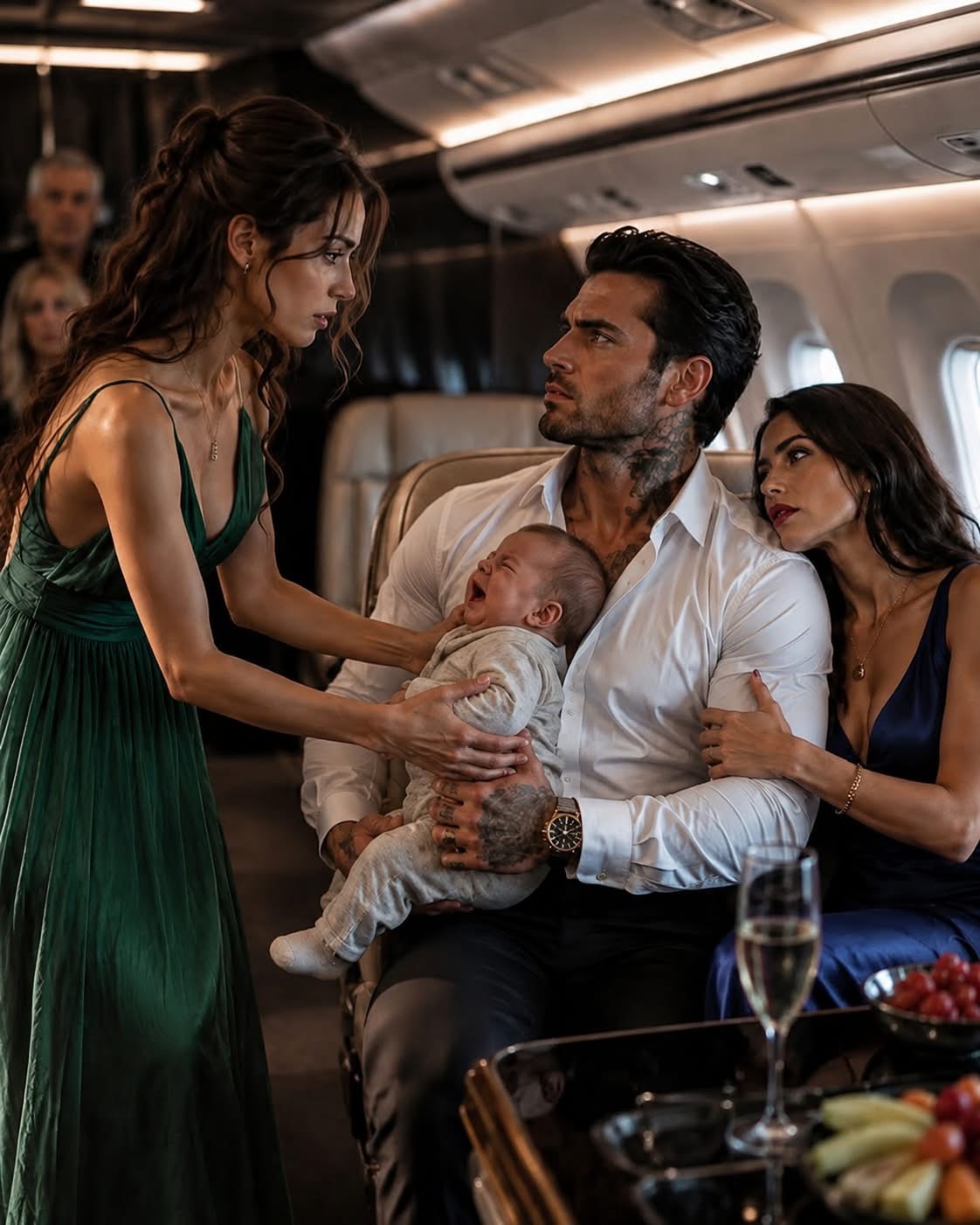
By the time the baby had cried for eighty-seven minutes, first class had gone from irritated to completely defeated.
I was sitting in premium economy with my three-year-old daughter, Maya, asleep beside me, when I finally stood and walked through the curtain.
The baby’s father looked powerful enough to frighten everyone around him. Dark suit, steel-gray eyes, bodyguard across the aisle. But with his six-month-old son screaming against his chest, he looked helpless.
“I think I know what’s wrong,” I said.
He stared at me. “And you are?”
“Claire. I was a labor and delivery nurse for six years.”
The baby rejected another bottle.
“He isn’t only hungry,” I explained. “He’s searching for the comfort he associates with feeding—warmth, heartbeat, scent. Has something changed recently?”
The man’s expression suddenly broke.
“My wife died three weeks ago.”
The cabin went silent.
The baby had been breastfed since birth. Since losing his mother, he barely accepted formula and cried whenever strangers tried to hold him.
I showed his father how to hold him skin-to-skin beneath a blanket, keeping the baby upright against his chest while speaking softly instead of constantly offering another bottle.
At first, nothing happened.
Then the crying weakened.
A minute later, the baby’s tiny hand closed around his father’s shirt.
And finally, silence.
The terrifying man in seat 2A lowered his head and cried.
His name was Adrian Moretti, founder of an international shipping company. But in that moment, he wasn’t wealthy or intimidating.
He was simply a grieving father.
He asked why I was traveling to Rome.
I hesitated, then told him the truth: I had left an unsafe marriage four days earlier with one suitcase, €274, and nowhere permanent to live.
Adrian said nothing for a long moment.
When the plane landed, I expected never to see him again.
Instead, his assistant handed me a business card.
On the back Adrian had written:
“St. Gabriel Children’s Foundation needs an experienced neonatal nurse. Interview tomorrow. No favors—only an opportunity.”
I almost refused.
But I went.
Three weeks later, I had a job, an apartment arranged through the foundation’s employee program, and something I hadn’t felt in years: stability.
Adrian never tried to become my rescuer.
He simply opened one door after I helped him through the worst night of his life.
Months later, Maya and I met him in a Rome park. His son was laughing in his arms.
Adrian smiled at me.
“Eighty-seven minutes,” he said. “And you were the only person who listened to what he was actually saying.”
I looked at my daughter running through the grass and realized something.
Sometimes a new life doesn’t begin with a grand miracle.
Sometimes it begins with one crying baby, one brave decision, and a stranger who finally decides to stand up.