The morning after Mama’s funeral, my brother Russell and I returned to her house to sort through everything she had left behind.
Mama had died at seventy-eight after suffering a stroke in her sleep. The hospice nurse assured us it had been quick.
We buried her on Thursday.
By Friday morning, Russell was already talking about clearing the house.
“We can finish this over the weekend,” he said. “There’s no reason to drag it out.”
He took the living room and garage.
I chose the kitchen.
Almost nothing had changed since my childhood.
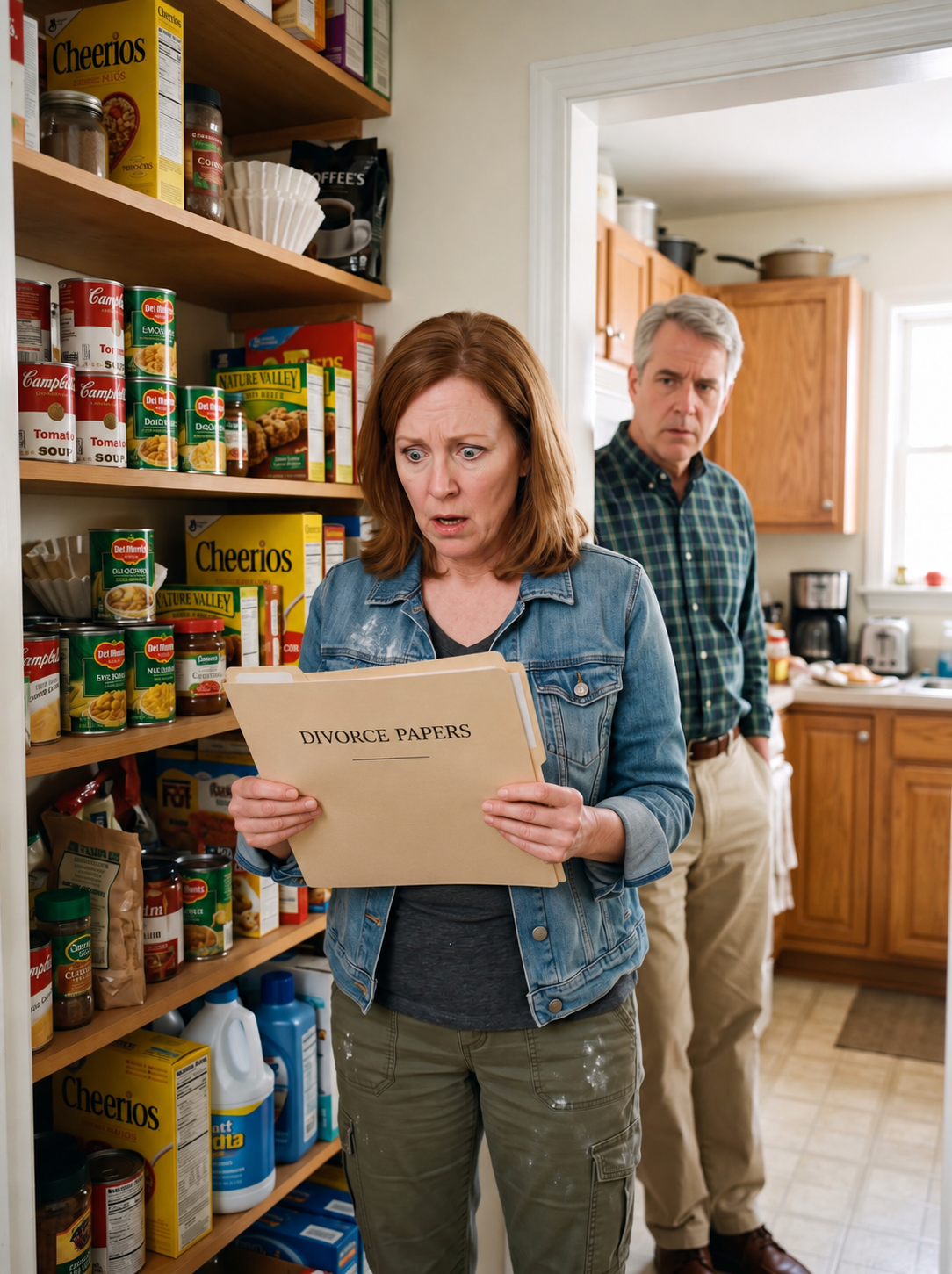
The spices were still arranged alphabetically. Coffee mugs hung from the same little metal hooks. Towels were folded neatly inside the pantry.
Then I saw it.
The white enamel flour tin decorated with faded blue flowers.
Growing up, there had been one absolute rule in Mama’s kitchen.
Never touch that tin.
When I was twelve, I once reached for it because I wanted to bake cookies. Mama slapped my hand away so suddenly that I burst into tears.
Later, she brought me cocoa and apologized.
But she still refused to explain.
“Leave that tin alone, Linda.”
More than three decades later, I finally took it down.
It was much too heavy.
I placed it on the counter and lifted the lid.
There was flour on top, but only a few inches.
Underneath was a plastic bag.
Inside were bundles of cash.
Twenties.
Fifties.
Hundreds.
And beneath the money was a yellowed envelope with my name written across the front in Mama’s handwriting.
Russell walked into the kitchen.
“What did you find?”
“Money.”
We counted it twice.
$18,940.
“Probably grocery savings,” Russell said.
I stared at him.
Mama compared milk prices at three different stores. She hadn’t accidentally forgotten nearly nineteen thousand dollars.
I opened the envelope.
Inside were three handwritten pages.
The first sentence read:
“Forgive me, Linda.”
Then I read the next line.
“You deserved to know what Wayne did with your settlement.”
Wayne was my stepfather.
When I was seventeen, a delivery truck struck me outside a grocery store.
I suffered a fractured pelvis and a serious leg injury. I spent weeks in the hospital and months learning to walk normally again.
Because I was a minor, Wayne handled the insurance claim.
He later told me the settlement had been $42,000.
According to him, almost all of it had gone toward medical expenses.
Whatever remained, he promised, would become mine when I turned eighteen.
But on my eighteenth birthday, Wayne told me there was nothing left.
I believed him.
Mama’s letter told a different story.
The settlement hadn’t been $42,000.
It had been $63,000.
And most of my medical expenses had already been covered.
Wayne had taken the money.
All of it.
Mama discovered the truth five years later after finding the original documents.
She confronted him.
Eventually, he admitted everything.
But she didn’t call the police.
She didn’t demand that he repay me.
And she never told me.
“I was afraid,” Mama wrote. “The house belonged to Wayne. I had almost nothing of my own. I was terrified he would throw me out. I chose my security over justice for my daughter.”
Tears blurred the page.
Then I reached another sentence.
“Russell knows.”
I slowly turned toward my brother.
“You knew?”
His face changed.
“Linda…”
“How long?”
“What difference does it make now?”
“How long, Russell?”
He looked at the floor.
“About fifteen years.”
For fifteen years, my brother had celebrated birthdays and Christmases with me while carrying a secret about my own life.
“Mama asked me not to tell you,” he said. “Wayne was already getting old. She wanted to keep the family together.”
“You kept the family together at my expense.”
Russell sighed.
“They’re both gone. What good does digging this up do now?”
I folded the letter carefully.
“Because it was my life they were hiding.”
The final page explained the money in the flour tin.
After Wayne died, Mama had started putting aside part of her pension.
The $18,940 was her attempt to repay at least some of what had been stolen from me.
But at the bottom of the page was one final instruction.
“There is a key in this envelope. Go to the bank. I left you what I should have shown you years ago.”
There was indeed a tiny key beneath the letter.
At 5:05 that evening, I pulled into the bank parking lot with the flour tin sitting on the passenger seat and white flour still dusting my black clothes.
Inside Mama’s safe-deposit box was a blue folder.
The first document was the original settlement agreement.
$63,000.
Then came Wayne’s old bank statements.
I followed the transactions until I understood what he had done.
Weeks after receiving my settlement, Wayne had made a large down payment on a piece of land outside town.
With my money.
The property records were also inside the folder.
After Wayne died, Mama inherited the land.
Then I found the final document.
Her revised will.
She had left the property to me.
Beside the legal language, Mama had written one sentence by hand:
“I cannot give you the years back, but I can return what remains of what was yours.”
Several months later, the property sold.
Over the decades, the surrounding area had developed dramatically, and the land was now worth far more than the $63,000 Wayne had originally stolen.
When Russell learned about the sale, he called me.
“So you’re keeping all of it?”
“It was Mama’s decision.”
“We’re both her children.”
I was silent for a moment.
“That property was purchased with my settlement money, Russell.”
He had no answer.
“I’m not taking your inheritance,” I continued. “I’m recovering something that should never have been taken from me.”
Our relationship was never quite the same afterward.
We remained brother and sister, but something between us had changed permanently.
And strangely, receiving the money didn’t feel like winning.
I kept thinking about the seventeen-year-old girl I had once been.
The girl who chose a cheaper college because she was terrified of debt.
The young woman who worked weekends.
The years I spent renting because I couldn’t afford a down payment.
My life might have been different if the adults I trusted had simply done the right thing.
No amount of money could return those years.
But I could do something Mama had been too frightened to do.
I could stop hiding the truth.
I put part of the money aside for my children. With another portion, I finally paid off my mortgage.
And I kept the old white flour tin with the faded blue flowers.
There is no money inside it anymore.
Only Mama’s letter.
I still don’t know whether I have completely forgiven her.
Some betrayals cannot be erased by an apology, even when that apology is sincere.
But at least I finally know what happened.
Mama spent decades hiding the truth beneath a layer of flour, hoping that one day she would find the courage to tell me.
She never managed to do it while she was alive.
So she told me after she was gone.
And whenever I look at that old tin now, I remember something I never understood before:
Sometimes the most valuable thing a parent leaves behind isn’t money.
Sometimes it is the truth a family was afraid to speak aloud.