My Family Turned My Daughter Away on Christmas Eve—The Envelope I Delivered the Next Morning Changed Everything
“There wasn’t a chair for me, Dad.”
Those were the first words my sixteen-year-old daughter, Lennon, said when I returned home from a double shift at Boulder Memorial Hospital on Christmas Eve.
She was curled up on the couch, still wearing her winter coat. Her boots were wet, and the Christmas cookies she’d baked for her grandparents sat untouched by the door.
My daughter had driven forty minutes through a snowstorm because my parents had refused to let her join their Christmas dinner.
“There were twenty-eight people,” she whispered. “Grandma said there wasn’t room for me.”
“Did anyone offer to help you get home?”
She shook her head.
Then I noticed a piece of bread and half an orange on the kitchen counter.
That was her Christmas dinner.
My name is Orion Vale. I’m an emergency physician, a widower, and the father of a girl who has already experienced more heartbreak than any child should.
When my wife died, Lennon was eleven. Since then, I’d worked hard to give her a safe, loving home.
I thought my parents would help fill the emptiness her mother’s death had left.
Instead, they had made it bigger.
“Grandma doesn’t really like me, does she?” Lennon asked.
I pulled her into my arms.
“You did absolutely nothing wrong, sweetheart.”
After she fell asleep, I walked into my office and opened a locked drawer.
Inside was a folder containing seven years of financial records.
Mortgage statements. Insurance payments. Utility bills.
And the deed to my parents’ house in Aspen Creek.
The house belonged to me.
Seven years earlier, my parents had nearly lost everything. My father, Richard, had made several bad investments, and my mother, Marjorie, refused to give up the beautiful home where she’d entertained friends for decades.
So I purchased the property, took responsibility for the mortgage, and allowed them to stay rent-free.
I even paid their utilities.
My sister, Sienna, contributed nothing.
Instead, she regularly asked for money, used the property for her event-planning business, and treated me like the family’s personal bank.
Three weeks before Christmas, she’d demanded $1,200 for her daughter Nova’s science camp.
When I refused, she called me selfish.
Now I understood why my daughter had been excluded.
A week earlier, I’d seen my mother’s Christmas seating chart.
Twenty-eight names appeared on it.
Neighbors. Relatives. Sienna’s business clients.
But not Lennon.
I’d asked Mom about it.
“We’ll see,” she’d replied. “Things are getting crowded.”
I hadn’t imagined she’d actually turn her granddaughter away.
That night, I reviewed the seating chart again. On its reverse side was an invoice from Sienna’s company.
The dinner had been partly organized to impress potential clients.
My sixteen-year-old daughter had been rejected so my sister could entertain strangers in a house I was paying for.
I sat at my desk until three in the morning.
Then I called my attorney, whose emergency number I had for property matters, and arranged to have the documents reviewed after Christmas.
I wrote a letter explaining that my voluntary financial support was ending and that formal notice concerning their occupancy would follow through the proper legal process.
I wasn’t going to illegally throw my parents into the snow.
But I was finished financing people who treated my child like an inconvenience.
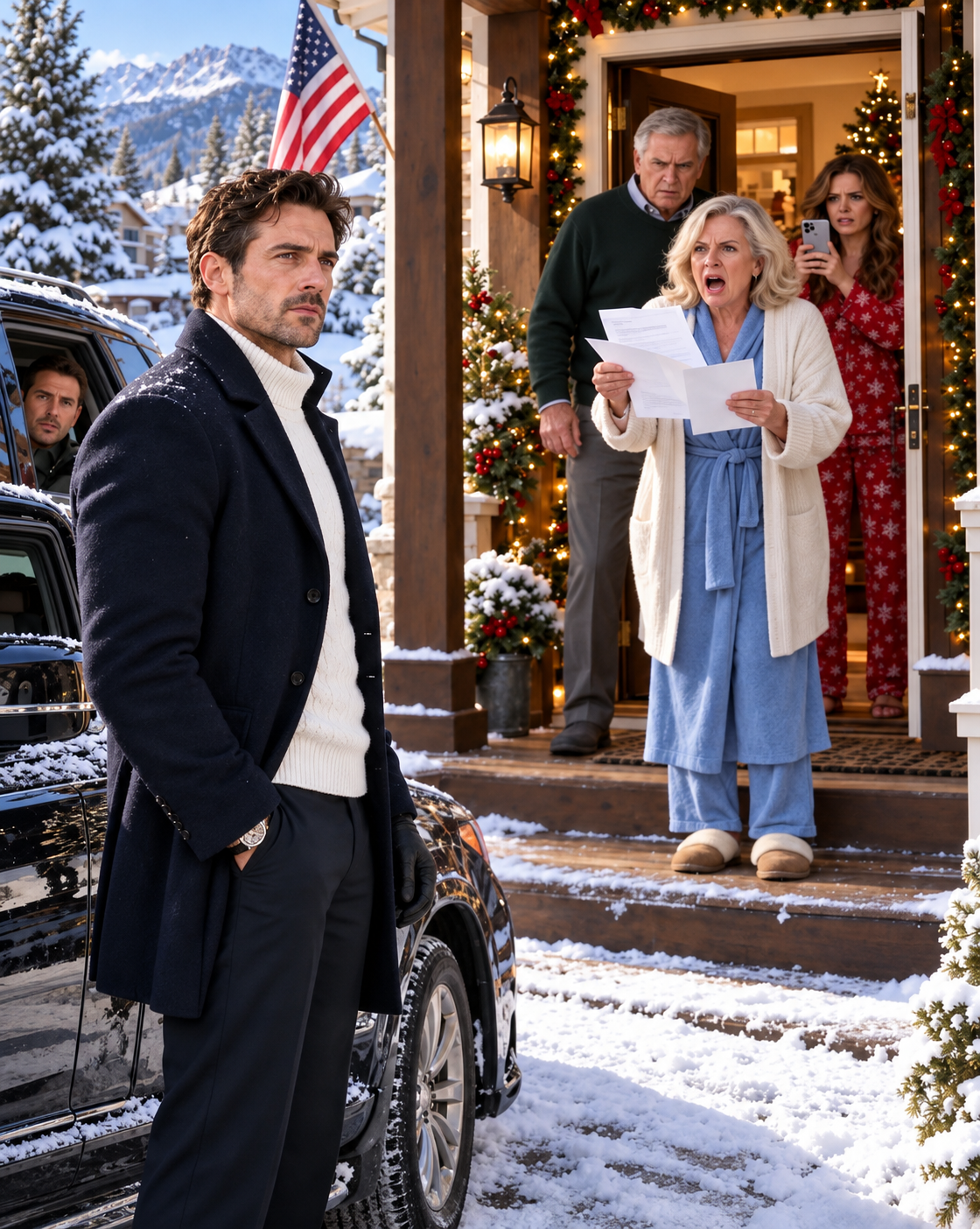
On Christmas morning, my friend Jonah drove me to Aspen Creek.
I placed an envelope containing the ownership documents, financial summary, and my signed letter at my parents’ front door.
As I turned toward the car, the door opened.
Mom appeared in her bathrobe.
“Orion? What’s this?”
“Something you should have read years ago.”
She unfolded the first page.
Her face drained of color.
Then she screamed.
“RICHARD! GET OUT HERE! LOOK WHAT YOUR SON HAS DONE!”
Dad hurried onto the porch, followed by Sienna.
Mom thrust the papers toward him.
“He says he’s stopping the payments!”
Dad read the letter, then looked at me.
“Son, surely we can discuss this.”
“We could have discussed it yesterday,” I replied. “When Lennon stood at your door holding homemade cookies.”
Sienna rolled her eyes.
“Oh, for heaven’s sake. It was one dinner.”
“One dinner?” I repeated. “She drove home alone through a snowstorm. She thought her own grandparents didn’t love her.”
Mom crossed her arms.
“We had important guests. Sienna needed to make a good impression.”
I looked at the brightly decorated windows behind her.
“And Lennon wasn’t important?”
Nobody answered.
Then Dad said quietly, “I told your mother we should make room.”
“But you didn’t,” I replied.
He lowered his eyes.
Sienna grabbed the papers.
“You can’t kick them out! This is their house!”
I pointed to the deed.
“No, Sienna. It’s mine. And I’ve paid for it for seven years.”
Her expression changed.
“You’d really do this to your own family?”
I thought of Lennon sitting alone on Christmas Eve with half an orange.
“No,” I said. “You already did something far worse to yours.”
My mother began crying.
Not when Lennon had been turned away.
Not when she’d learned her granddaughter had driven home in dangerous weather.
Only when she realized the financial consequences.
I left without raising my voice.
Over the following weeks, my attorney completed the necessary paperwork. My parents received proper notice and ample time to arrange another home.
I stopped making voluntary payments for Sienna’s business expenses immediately. Other financial arrangements ended according to their contractual and legal requirements.
Sienna was furious.
Without a free venue and subsidized utilities, her business suddenly became much less profitable.
For the first time, she had to rent commercial space and pay her own expenses.
My parents eventually moved into a modest two-bedroom apartment.
It wasn’t luxurious, but it was comfortable and affordable.
Before moving, Dad came to see Lennon.
He brought the red-ribboned cookie tin she’d left behind.
“I should have opened that door wider,” he told her. “I should have pulled up a chair. I failed you, and I’m sorry.”
Lennon studied his face.
“Why didn’t you say anything?”
Dad’s eyes filled with tears.
“Because I was afraid of upsetting your grandmother. That was cowardly.”
She accepted the apology, but didn’t hug him.
“I need some time, Grandpa.”
He nodded.
“You can have all the time you need.”
Mom sent several messages insisting I’d humiliated her.
Sienna demanded that I reconsider.
I didn’t.
Six months later, my parents were still living in their apartment. Dad occasionally called Lennon, and slowly, cautiously, she began answering.
My mother never offered a sincere apology.
That was her decision.
The following Christmas, I finished my hospital shift early.
Lennon and I cooked dinner together. Jonah joined us, bringing a ridiculous homemade pie that collapsed before we could serve it.
We laughed until our sides hurt.
There were only three people at our table.
Three plates. Three chairs.
And more warmth than that grand house in Aspen Creek had ever held.
Halfway through dinner, Lennon looked around and smiled.
“Dad?”
“Yes, sweetheart?”
“I’m glad we stayed home this year.”
I reached across the table and squeezed her hand.
“So am I.”
For years, I’d believed that providing a house meant taking care of my family.
That Christmas taught me something different.
A home isn’t measured by its size, its decorations, or the number of guests at the table.
It’s measured by whether the people you love are made to feel welcome.
And my daughter would never again have to wonder whether there was a place for her.