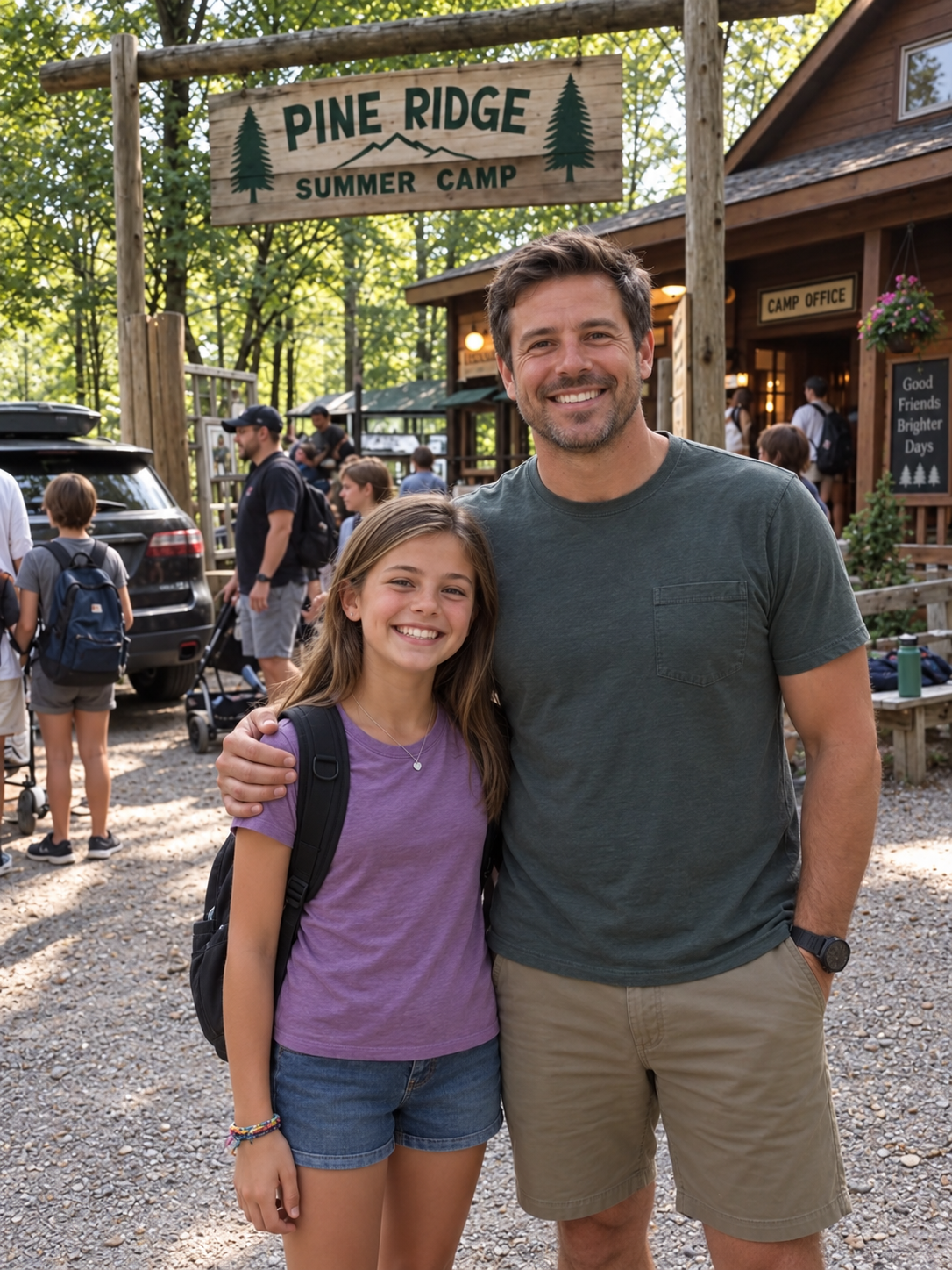
I Trusted My Closest Friend to Take My Daughter to Summer Camp—Hours Later, the Administrator Called Me
I trusted one of my closest friends to drive my ten-year-old daughter, Greta, to summer camp.
An hour later, he texted me:
“Greta’s checked in. She’s excited. Everything’s fine.”
I smiled, sent him a heart emoji, slipped my phone back into my pocket, and returned to work.
Three hours later, the camp administrator called.
“Your daughter is safe,” she said.
Then she paused.
“But I need you to come here as soon as possible.”
My stomach tightened.
“What happened?”
Another pause.
“It concerns the man who dropped her off.”
For a moment, I couldn’t speak.
“The man?”
“Yes.”
“You mean Owen?”
“Yes.”
I almost laughed from sheer confusion.
Owen had been one of my closest friends for nearly eight years.
Whatever this was, I told myself, there had to be a mistake.
I had been raising Greta alone since she was three.
Her father had left gradually—first missing weekends, then birthdays, then disappearing from our lives almost completely.
Since then, everything had depended on me.
I worked as a nurse at a busy regional hospital, which meant my schedule rarely cared about school events, stomach bugs, snow days, or summer plans.
But somehow, I always made it work.
That morning was different.
Greta had been looking forward to summer camp for weeks.
The night before, she packed her bag three times.
“Mom, do you think I need two swimsuits?”
“Probably not.”
“What if one doesn’t dry?”
“Then bring two.”
“What about three?”
“You’re going for five days, Greta, not moving there.”
She laughed.
By seven the next morning, she was already wearing her camp shirt and eating cereal with her backpack beside her feet.
Then my phone rang.
The hospital.
Two nurses had called out unexpectedly.
They needed me early.
Very early.
I stared at the clock.
The camp was forty minutes away in the opposite direction.
There was no way I could drive Greta there and reach the hospital when they needed me.
“I can take her,” Owen said.
He happened to be at our house because he had stopped by the previous evening to repair a loose cabinet hinge and stayed in the guest room after it got late.
I shook my head.
“You don’t have to do that.”
“I know.”
“It’s completely out of your way.”
“I’ll survive.”
He grinned at Greta.
“You ready, camper?”
Greta jumped from her chair.
“Yes!”
I hesitated.
Owen noticed.
“Hannah.”
His voice softened.
“You’ve trusted me with Greta a hundred times.”
He wasn’t wrong.
Owen had helped me through some of the hardest years of my life.
He had taught Greta to ride a bicycle.
He had driven us to the emergency room when she broke her wrist.
He remembered every birthday.
When my car wouldn’t start, Owen came.
When a pipe burst in my kitchen at midnight, Owen came.
When I worked Christmas Eve, he helped my mother assemble Greta’s dollhouse.
Greta called him Uncle Owen even though we weren’t related.
As far as I was concerned, he was family.
So I hugged my daughter tightly.
“Listen to your counselors.”
“I will.”
“No wandering off.”
“I know.”
“And call me tonight.”
“Mom!”
I kissed her forehead.
“Have fun.”
Owen grabbed her suitcase.
“I’ve got her.”
Those words stayed with me later.
I’ve got her.
About an hour after I arrived at the hospital, Owen texted.
“Greta’s checked in. She’s excited. Everything’s fine.”
And for the next several hours, I believed him.
Then Karen, the camp administrator, called.
I left the hospital as soon as another nurse could cover my patients.
During the forty-five-minute drive, my mind raced through every possible explanation.
Maybe Owen had argued with a counselor.
Maybe there was an issue with the authorization form.
Maybe he had accidentally entered a restricted area.
Maybe there had been confusion because he wasn’t Greta’s father.
Anything seemed possible except what Karen’s voice suggested.
I kept repeating the same thought.
I know Owen.
When I reached the camp, I parked crookedly across two spaces.
Karen was waiting outside the administration building.
She was in her fifties, with short gray-blond hair and a camp badge clipped to her shirt.
“You’re Greta’s mother?”
“Yes. Where is she?”
“She’s okay.”
“Then tell me what happened.”
Karen glanced behind her.
“Come inside.”
We walked through the main building.
I could hear children laughing outside.
Somewhere nearby, a whistle blew.
Everything sounded normal.
That somehow made the fear worse.
Karen stopped in front of a closed office door.
Before opening it, she turned toward me.
“Your daughter hasn’t been harmed.”
I stared at her.
“Why do you keep saying that?”
Instead of answering, she opened the door.
Greta sat in a chair near the window.
The second she saw me, she stood.
“Mom!”
I rushed toward her and wrapped my arms around her.
“You’re okay?”
“I’m fine.”
I pulled back and looked her over anyway.
Then I noticed the two other people in the room.
One was a uniformed police officer.
The other was a woman in plain clothes with a badge clipped to her belt.
My heart dropped.
“Where’s Owen?”
The officer stood.
“Ms. Carter, I’m Officer Ramirez.”
“Where is Owen?”
The plainclothes woman answered.
“He’s currently being questioned.”
“Questioned for what?”
Nobody spoke immediately.
I looked at Karen.
“What happened?”
Karen took a breath.
“When Mr. Grant brought Greta in this morning, one of our staff members recognized him.”
“Recognized him?”
“From a photograph.”
“What photograph?”
The woman with the badge stepped forward.
“I’m Detective Lena Morris.”
She placed a folder on the desk.
Then she opened it.
Inside was a photograph of Owen.
Except it wasn’t the Owen I knew.
His hair was shorter.
He looked younger.
And beneath the photograph was a name I had never seen before.
Michael Andrew Grantley.
I stared at it.
“That isn’t his name.”
Detective Morris watched me carefully.
“Yes, ma’am. It is.”
“No. His name is Owen Grant.”
“That’s the name he’s been using.”
My knees suddenly felt weak.
I sat down.
“What are you talking about?”
Detective Morris explained that Michael Grantley had been investigated years earlier in another state after several elderly clients lost large amounts of money from investment and retirement accounts.
He had worked as a financial services consultant.
When authorities began closing in on the company, Michael disappeared.
For years, the case went quiet.
Until recently.
A new investigation involving identity fraud had uncovered records linked to the same man.
His photograph had been redistributed to law enforcement agencies.
One of the camp employees happened to be a former police dispatcher.
She recognized him almost immediately.
I shook my head.
“No.”
I heard myself saying the word, but it barely sounded like my voice.
“You have the wrong person.”
Detective Morris didn’t argue.
Instead, she slid another photograph across the desk.
Owen standing beside a vehicle.
A clear surveillance image.
Then another.
Then an old driver’s license.
Same eyes.
Same scar near his eyebrow.
Same man.
My friend.
The person who had eaten Thanksgiving dinner at my table.
The man who had a spare key to my house.
I suddenly felt sick.
“What does this have to do with Greta?”
Karen sat beside me.
“That’s the part that concerned us most.”
I turned toward my daughter.
Greta stared at the floor.
“What happened?”
Greta looked up.
“When we got here, Uncle Owen helped me carry my stuff.”
“That’s normal.”
She nodded.
“Then after I checked in, he said we needed to go back to the car.”
“Why?”
“He said you forgot to sign another paper.”
My blood ran cold.
Karen continued.
“One of our counselors told him Greta had already been officially checked into camp and couldn’t leave without the authorized parent or guardian signing her out.”
“What did Owen do?”
“He became agitated.”
“Owen doesn’t get agitated.”
The words came out automatically.
Then I realized how ridiculous they sounded.
Karen continued.
“He insisted you had asked him to take Greta back into town.”
“I never did.”
“We know.”
Detective Morris leaned forward.
“Did Mr. Grant have permission to take Greta anywhere after dropping her off?”
“No.”
“Did you discuss her passport with him recently?”
I froze.
“My daughter’s passport?”
Greta looked at me.
“He asked about it in the car.”
I turned slowly toward her.
“What did he ask?”
“He asked if I knew where you kept our passports.”
I felt something inside me collapse.
“Exactly what did he say?”
Greta thought for a moment.
“He said, ‘Your mom keeps your passport somewhere safe, right?’ I said yes. Then he asked if I knew where.”
“Did you tell him?”
She nodded.
“I said your bedroom safe.”
I closed my eyes.
Owen knew about the safe already.
He had installed it.
Two years earlier, after someone broke into a neighbor’s house, Owen suggested I buy one.
He even helped bolt it inside my closet.
Inside were our passports, birth certificates, Greta’s Social Security card, emergency cash, insurance paperwork, and copies of several financial documents.
“Did he ask anything else?”
Greta hesitated.
Then she said something that made Detective Morris immediately start taking notes.
“He said maybe we were going on a surprise trip.”
My throat tightened.
“What trip?”
“He didn’t say.”
“When?”
“He said soon.”
Detective Morris exchanged a look with Officer Ramirez.
I stood.
“I need to go home.”
The police came with me.
I drove so fast Officer Ramirez had to tell me twice to slow down.
When we reached my house, nothing looked wrong.
The front door was locked.
There were no broken windows.
No sign of forced entry.
Then I remembered something else.
Owen still had a spare key.
I ran upstairs.
The safe door opened normally.
At first, everything appeared untouched.
Passports.
Birth certificates.
Cash.
Insurance documents.
Then I started checking carefully.
Greta’s Social Security card was gone.
So was an old bank statement.
And the envelope where I kept our spare house key was empty.
“I didn’t take these,” I whispered.
Detective Morris’s expression hardened.
“Are you certain?”
“Absolutely.”
She asked me to look for anything else.
That was when I discovered a credit card application tucked underneath a stack of old tax documents.
It had my full name.
My address.
My income.
My Social Security number.
But I had never filled it out.
The email address listed on the application wasn’t mine.
Neither was the phone number.
Detective Morris photographed everything.
Then she looked at me.
“We’re going to need you to contact your bank and freeze your credit immediately.”
I stared at her.
“You think Owen did this?”
“We’re going to find out.”
They searched his apartment that evening.
The detective called me the following morning.
“Hannah, I need you to prepare yourself.”
Police had found dozens of files.
Some belonged to people I knew.
Others were strangers.
Copies of driver’s licenses.
Tax forms.
Bank statements.
Social Security numbers.
Credit applications.
Birth certificates.
Owen—or Michael—had spent years collecting personal information.
Most of his victims had one thing in common.
They trusted him.
An elderly neighbor whose computer he “fixed.”
A widower whose taxes he helped organize.
A divorced mother whose car he regularly repaired.
A former coworker who let him housesit.
And me.
I couldn’t understand it.
For days, I barely slept.
Every memory became suspicious.
Had he helped me because he cared?
Or because helping gave him access?
When he installed the safe, had he been protecting me—or learning where I kept everything important?
When he offered to babysit Greta, had he really loved spending time with her?
Or was she simply another way into my life?
The worst discovery came three days later.
Detectives found two airline searches on Owen’s laptop.
Both were for one-way international flights.
One adult.
One child.
Departure date: the same weekend Greta was supposed to be at camp.
My hands began shaking when Detective Morris told me.
“You think he planned to take her?”
“We don’t know.”
“That’s exactly what it looks like.”
“We found no purchased tickets.”
“But he asked where her passport was.”
“Yes.”
“And he tried to get her out of camp.”
“Yes.”
I nearly stopped breathing.
“What would have happened if that counselor had let Greta leave?”
Detective Morris was silent.
That silence answered me.
Owen refused to speak with me after his arrest.
Then, two weeks later, I received a letter.
Hannah,
I know what everyone has told you.
I know what this looks like.
But I would never have hurt Greta.
I loved her.
I loved both of you.
I made mistakes before I met you, and then things got complicated.
Please let me explain—
I stopped reading.
I gave the letter to Detective Morris.
Months later, the truth came out in court.
His real name was Michael Grantley.
He had been using variations of false identities for more than a decade.
He admitted to multiple counts of identity theft, financial fraud, document theft, and using fraudulent identification.
He denied intending to kidnap Greta.
According to his attorney, he had only been considering “taking a trip” and had panicked when he realized camp staff recognized him.
But prosecutors produced messages from a prepaid phone.
One message, sent to an unidentified contact three days before camp, read:
“Once the girl is out of the city with me, Hannah will cooperate.”
I never learned exactly what he meant.
Maybe he intended to use Greta to force me to give him money.
Maybe he planned to disappear and believed taking her would stop me from reporting him immediately.
Maybe there was another plan investigators never uncovered.
Eventually, I stopped needing the answer.
Some answers don’t make nightmares easier.
Owen received a lengthy prison sentence.
Greta began seeing a counselor.
For months, she blamed herself for telling him where the passports were.
I told her the same thing every time.
“You were ten years old. An adult you trusted asked you a normal-sounding question. None of this is your responsibility.”
The harder conversation was explaining why I had trusted him too.
Because children believe adults know who the dangerous people are.
The truth is, sometimes we don’t.
Sometimes dangerous people don’t appear dangerous.
Sometimes they help you carry groceries.
Sometimes they remember your child’s birthday.
Sometimes they repair your broken sink at midnight.
Sometimes they sit at your dinner table for eight years before you discover you never really knew their name.
The following summer, Greta asked if she could return to camp.
I was surprised.
“Are you sure?”
She nodded.
“I don’t want him to ruin camp too.”
So on the first morning of camp, I drove her myself.
When we arrived, Karen was standing near the entrance.
The counselor who had stopped Owen from taking Greta out of the building was there too.
Her name was Ashley.
I had thanked her many times by phone, but I had never really known what to say face-to-face.
So I hugged her.
She looked surprised.
“You don’t have to thank me.”
“Yes,” I said. “I do.”
She had simply followed her instincts.
She had noticed that something felt wrong and refused to ignore it.
That small decision may have saved my daughter.
Greta groaned from beside me.
“Mom, please don’t start crying.”
“I’m not crying.”
“You’re definitely crying.”
I laughed and wiped my face.
Then I hugged her.
“Have fun.”
“I will.”
“Stay with your group.”
“I know.”
“Call me tonight.”
“Mom.”
I smiled.
“Okay. Go.”
She ran toward the other campers.
I watched until she disappeared into the crowd.
Then my phone vibrated.
For one terrifying second, I was back in the hospital hallway the year before.
I looked down.
It was Greta.
She had sent me a photo of herself and two new friends.
Underneath it, she had written:
“I’m checked in. I’m excited. Everything’s fine ❤️”
I stood there staring at those words.
They were almost exactly the same words Owen had sent me one year earlier.
But this time, they were true in every way that mattered.
I saved the message.
And I still have it today.
Because it reminds me of two things.
First, trust is valuable—but it should never make us afraid to listen when something feels wrong.
And second, one stranger paying attention at the right moment can change the course of someone’s entire life.
I once believed the most frightening thing that could happen to a mother was discovering she had trusted the wrong person.
I was wrong.
The most frightening thing is realizing how close you came to never discovering it at all.